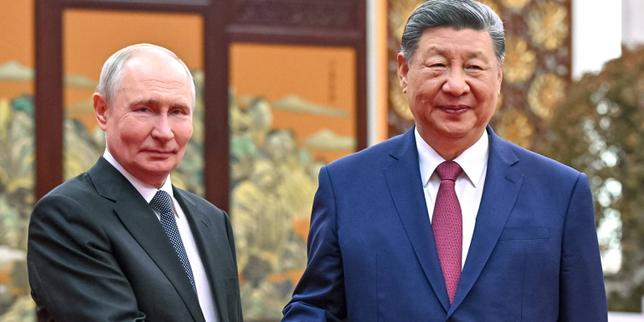
If you still think the relationship between Beijing and Moscow is just a marriage of convenience, you aren't paying attention. For years, politicians in Washington and Brussels comforted themselves with the idea that China and Russia would never truly align their militaries. They argued historical mistrust and competing ambitions in Central Asia would keep them apart.
They were wrong.
Leaked classified documents from a series of highly classified bilateral meetings reveal something far more dangerous than simple diplomatic posturing. Behind closed doors, the two nations are actively merging their defense brains to build weapons, share intelligence, and counter Western strategic advantages. This isn't just about selling oil or putting on joint naval drills for the cameras. It's a deep, institutionalized integration of military tech that has been hidden from the public eye until now.
A joint investigative effort uncovered presentations and protocols from these secret military cooperation forums held throughout 2023 and 2024. The findings outline a terrifying roadmap. They aren't just talking about border security anymore. They're planning for a grand conflict, focusing on space warfare, missile defense, and autonomous drone swarms.
The Reality Behind the Closed Doors in Moscow and Guangzhou
The public rarely hears about the military-technical cooperation forums. They don't show up on official state media calendars. Yet, the paperwork proves top officials are traveling between Moscow and Guangzhou to sign binding agreements.
In June 2023, a high-level Chinese military delegation quietly arrived in Moscow. Their destination wasn't a ceremonial wreath-laying. They went straight to the offices of Almaz-Antey, Russia's premier air defense manufacturer. The goal was simple: create an integrated, next-generation air and missile defense system.
Think about what this actually means. An integrated system requires sharing highly sensitive radar data, frequencies, and command-and-control software architectures. Militaries don't share this kind of data with casual acquaintances. They share it with allies they expect to fight alongside.
The documents reveal five specific areas where the two regimes are pooling resources:
- Space weapons aimed directly at neutralizing Western satellite networks.
- Next-generation air defense built to negate Western stealth technology.
- Autonomous loitering munitions designed to flood battlefields in swarm configurations.
- Advanced armored combat vehicles that utilize Chinese manufacturing power and Russian combat feedback.
- Joint military aviation programs to leapfrog current engineering bottlenecks.
This shakes the foundations of global security. Beijing gets to look at real-world data from the war in Ukraine, seeing exactly how Russian tech holds up against Western arms. Moscow gets access to China’s massive industrial supply chain and advanced microelectronics. It is a terrifyingly effective trade.
Taking Direct Aim at Starlink
One of the most revealing segments of the leaked data comes from a forum held in Guangzhou in November 2023. During these sessions, Chinese defense experts presented a multi-layered plan to destroy or neutralize Elon Musk’s Starlink satellite constellation.
The war in Ukraine taught both regimes a harsh lesson. Traditional electronic warfare can't easily shut down a decentralized, low-Earth orbit satellite network. Starlink gave Ukrainian forces a massive advantage in communications, drone targeting, and real-time situational awareness. Beijing looked at that and realized they would face the exact same problem in a conflict over Taiwan.
So, they formulated a strategy to take it down. The plan doesn't just rely on blowing up satellites with missiles, which creates dangerous space debris that could hurt Chinese assets. Instead, it relies on a sophisticated mix of tactics.
First, they want to use coordinated diplomatic and legal maneuvers through international bodies to choke Starlink's orbital expansions. Second, they plan to aggressively occupy neighboring frequency bands and orbital slots, deliberately creating massive electromagnetic interference to render the network useless over specific zones. Third, they discussed launching sophisticated cyberattacks targeted directly at civilian user terminals to disrupt the ground networks. Finally, they are building cheap, low-cost weapons specifically engineered to blind or disable individual low-Earth orbit satellites without creating massive clouds of debris.
This isn't theoretical speculation. The protocol documents show both sides assigned working groups to implement these ideas. They see Western commercial space dominance as a direct threat to their authoritarian survival. They're working together to end it.
High Tech Dreams and No Combat Experience
The cooperation goes deeper than just designing weapons on paper. It extends to actual troops on the ground. European intelligence reports revealed that Russian Defense Minister Andrei Belousov personally signed off on a secret training program for Russian soldiers inside Chinese military academies.
Hundreds of Russian personnel have quietly cycled through elite Chinese training facilities in Beijing and Nanjing. The courses are highly specific. We aren't talking about basic infantry tactics. They are training in radiological, chemical, and biological defense. Russian soldiers were photographed learning about nuclear reactor models, advanced chemical reconnaissance, and ways to protect critical ventilation infrastructure from toxic contamination.
This tells us two things. It tells us Russia takes the threat of unconventional warfare seriously. It also tells us China is willing to get its hands dirty preparing Russian troops for worst-case scenarios, despite claiming to be a neutral mediator in global conflicts.
But the internal Russian reports from these sessions highlight an interesting flaw in the alliance. Russian commanders praised the Chinese facilities, noting the superb quality of their simulators and the deep theoretical knowledge of the instructors. However, the reports also explicitly pointed out a glaring weakness: China’s complete lack of modern combat experience.
The People’s Liberation Army hasn't fought a major war since its brief conflict with Vietnam in 1979. Their generals know the math, the code, and the science, but they don't know the messy reality of the modern battlefield. Russia does. Russia has spent over four years adapting to high-intensity drone warfare, electronic jamming, and trench combat.
This mismatch creates a fascinating dynamic. China has the money, the chips, and the factories. Russia has the blood-soaked data. By combining the two through these secret forums, they are trying to fix each other's biggest flaws.
The Real Threat to Global Security
Western leaders need to stop treating this as a minor intelligence blip. The reality is that the axis between Beijing and Moscow is hardening into a functional military alliance, even if they refuse to sign a formal defense treaty. They don't need a treaty. The operational integration happening right now is far more practical than any piece of paper.
When German Chancellor Friedrich Merz confronted Chinese leadership about their covert support for Russia's war machine, he was met with standard diplomatic deflections. China publicly denies sending lethal aid. Technically, they might not be shipping crates of artillery shells across the Siberian border. Instead, they are doing something much smarter and much harder to police. They are supplying the dual-use technology, the microchips, the tools, and the architectural designs that allow Russia to keep its own factories running 24 hours a day.
If this integration continues unchecked, the West will soon face a unified military-industrial adversary. A bloc where Chinese AI and manufacturing power seamlessly feed into Russian combat experience and nuclear muscle. It changes the math for defending Taiwan, protecting the Baltic states, and maintaining security in the Arctic.
Your Next Steps to Stay Informed
You can't rely on generic news summaries to understand this shift. To truly track how this alliance develops, look at specific indicators rather than empty diplomatic press releases.
Keep a close eye on satellite launch schedules from both nations. Look for shared tracking stations or unusual orbital positioning that aligns with the anti-Starlink strategies discussed in the Guangzhou forums. Watch the corporate movements of major defense contractors like Almaz-Antey. When their executives travel East, it usually means new software integration or joint manufacturing deals are being hammered out behind the scenes.
Finally, pay attention to joint naval and air patrols in the Sea of Japan and the Pacific. They aren't just photo ops. They are active field tests for the integrated command systems born in these secret meetings. The border between these two empires is fading, and the world needs to wake up to what is being built in the shadows.