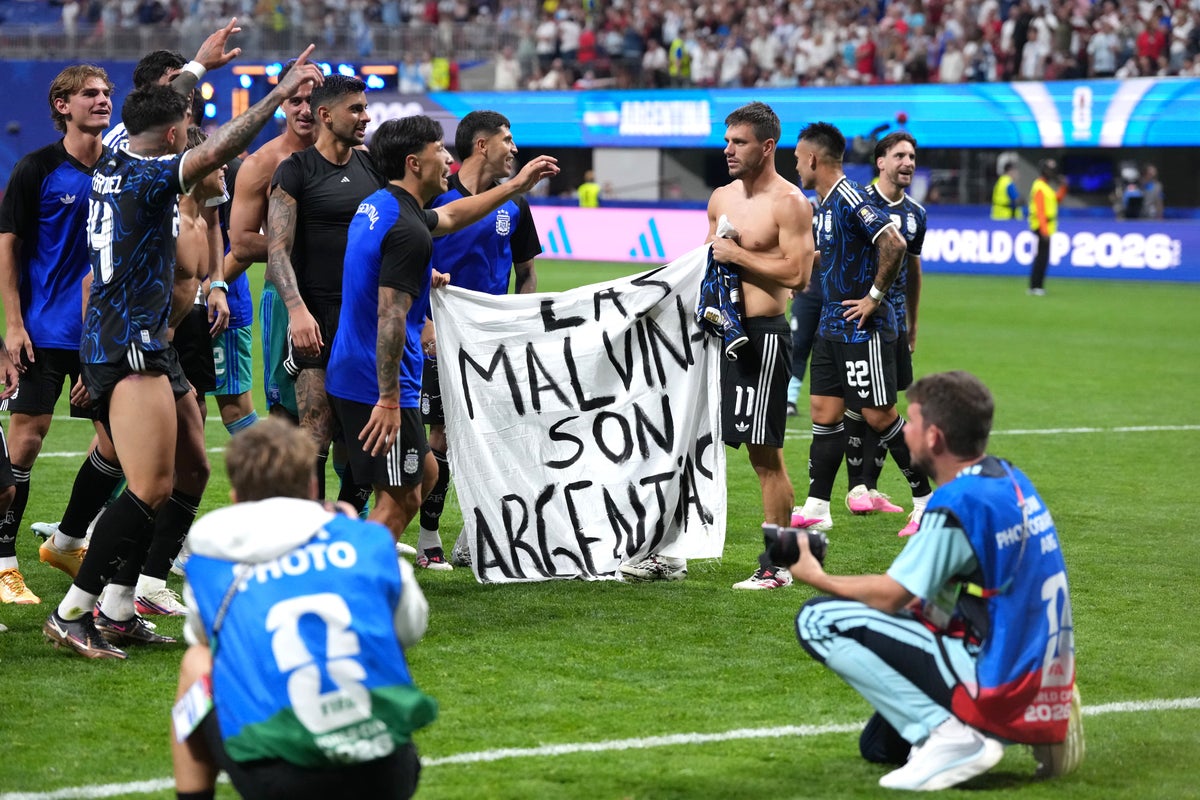
The final whistle had barely echoed through the Atlanta stadium before the real storm began. Argentina had just pulled off a ferocious late comeback, breaking English hearts with a 2-1 victory to secure a spot in the 2026 World Cup final. But as the players stripped off their sweaty shirts and ran toward the stands, they didn't just celebrate the win. They grabbed a banner from the crowd and held it high for the cameras.
The blue and white plastic read quite simply, "Las Malvinas son Argentinas".
To the British government, the English media, and Whitehall politicians, this was a calculated, toxic political stunt. Downing Street instantly backed furious calls for a FIFA investigation, pointing out that using a football pitch to claim sovereign British territory violates the game’s core code of conduct.
But if you talk to anyone on the streets of Buenos Aires, they’ll look at you blankly if you call it a political statement. To them, it isn’t politics. It’s patriotism. It’s a core layer of what it means to be Argentine, completely detached from whatever political party happens to be occupying the Casa Rosada at any given moment.
When Lisandro Martínez and Giovani Lo Celso held up that banner, they weren't trying to score points for President Javier Milei. They were acting on an emotional reflex that runs deeper than football itself.
The Cold Reality of the Atlanta Post Match Clash
Let's look at the facts of what happened. FIFA rules are explicitly clear about political gear inside stadiums. The governing body explicitly bans flags, banners, or apparel that carry an ideological or political message. Because of this, the Argentine Football Association faces a hefty fine, much like the one they received back in 2014 when the team pulled a similar stunt before a friendly match against Slovenia.
The British perspective makes logical sense on paper. The Falkland Islands are a British overseas territory. The roughly 3,500 people who actually live there voted overwhelmingly in a 2013 referendum to remain exactly that. From a London boardroom or a FIFA disciplinary office, waving a banner claiming those islands is an act of aggressive nationalism that ruins the sport's neutrality.
But logic fails to capture how Argentina functions.
Why the British View Misses the Entire Point
In Argentina, the Malvinas claim isn't some right-wing talking point or a left-wing distraction technique. It's written directly into the nation’s constitution. The 1994 constitutional reform states that the recovery of the islands is a permanent and unwavering objective of the Argentine people.
Children are taught this before they even learn fractions. It’s in school textbooks, on street signs, and painted on neighborhood walls across every province from Jujuy to Tierra del Fuego.
When an Argentine player holds that sign, they aren't making an argument. They are stating what they believe is an absolute truth. Martínez openly admitted that he thought of the war veterans weeping at home while watching the match. Midfielder Leandro Paredes echoed the sentiment, noting the deep pain that the 1982 chapter of history still brings to the country.
For them, playing England is never just ninety minutes of football. It's a symbolic re-enactment of an unresolved trauma.
The Ghost of Diego and the 1982 Scar
You can't understand this dynamic without talking about Diego Maradona and the 1982 conflict. The war lasted 74 days and cost the lives of 649 Argentine soldiers, many of them teenage conscripts who were poorly equipped and completely unprepared for the reality of facing the British military. It ended in a crushing, humiliating defeat for the Argentine military junta.
Four years later, Maradona scored his famous "Hand of God" and the brilliant solo goal against England in the 1986 World Cup. Maradona openly wrote in his autobiography that while they claimed before the match that football had nothing to do with the war, that was a lie. They felt they were defending a flag, avenging the dead boys who had been killed in the South Atlantic.
That single match permanently fused football with national redemption. When current players chanted about the Malvinas, Diego, and Lionel Messi in the dressing room after beating Switzerland, they were tapping into that exact lineage. Football is the only arena where Argentina can realistically defeat a major global power like Britain and feel a sense of poetic justice.
Prominent Argentine historians have pointed out that the Malvinas cause is practically the only thing left that unites an otherwise fiercely polarized country. Politics divides Argentines daily. Football and the Malvinas bring them together.
What Happens Next for the Argentine Team
If you are following this situation as a fan or an analyst, ignore the surface-level shouting match between Downing Street and Buenos Aires. Focus on the tangible steps that will follow this incident.
First, expect FIFA to hand down a financial penalty to the Argentine Football Association within the coming days. The players themselves are unlikely to be suspended for the final against Spain, but the federation will get a strict warning.
Second, recognize the shift in geopolitical messaging. The current Argentine government under Milei is using this massive footballing platform to bring the islands back into global conversation, using its leverage and ties with other world leaders to push the issue.
If you want to understand international football, you have to realize that to millions of fans, the pitch is never just a game. It is a mirror of history, and some scars simply refuse to fade.


