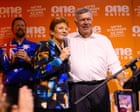
Winning a seat in the House of Representatives is hard. Keeping it without tearing your own party apart seems almost impossible if you're Pauline Hanson.
Just weeks after a historic lower house by-election win in the regional New South Wales seat of Farrer, One Nation is already facing the exact same internal friction that's crippled it for thirty years. The brand-new MP, David Farley, barely had time to pick out his office furniture before his party leader publicly dragged him for stepping out of line on key policy items.
The crack in the facade appeared at the Church and State summit in Brisbane. Hanson took to the stage and openly admitted she "had to have a conversation" with Farley because he dared to support local nuances on immigration and indigenous flag displays. It's a classic demonstration of the central flaw in Australia's most prominent populist movement. They want mainstream electoral success, but they refuse to tolerate the normal, pragmatic compromise required to hold a regional seat.
The Instant Rebellion in Farrer
During the by-election campaign, Farley did what any sensible candidate trying to win a massive regional electorate like Farrer would do. He tailored his message to local economic realities. He suggested that maybe, just maybe, the region could use targeted immigration to fill massive regional labor shortages.
That local pragmatism immediately hit a brick wall in Brisbane. Hanson's strict federal platform demands capping net migration at 130,000 people a year.
"He comes out during the election," Hanson told the Brisbane audience, clearly irritated. "What's my policy? Stop immigration at 130,000 a year. So he'd come and said, 'Oh no, allow immigrants in the country.' Well, didn't the media have a field day with that?"
It didn't stop with immigration. Farley also announced to the Border Mail that his electorate office would fly three flags: the Australian flag, the Aboriginal flag, and the Torres Strait Islander flag. For a regional MP representing a diverse constituency with a significant Indigenous footprint, it was a standard, respectful gesture.
For Hanson, it was a betrayal of the core brand.
One Nation's ironclad rule is one flag, and one flag only. Hanson told the summit that "you can't know everything about the person" during candidate vetting, before explaining how she pulled her new parliamentary asset into line.
The Retraction and the Family History
The pressure from the top worked instantly. Farley quickly pivoted, taking to Facebook to clarify that his office would only fly the Australian flag, promising that no other banner would stand above it or replace it.
When pushed on why he dumped the plan to display the Indigenous flags, Farley fell back on personal military nostalgia. He noted that his grandfather fought in World War I under the Australian flag and was buried under it. He said his father did the same.
"We are one Australia, we have one flag, we unite under one flag," Farley said. It was a neat rhetorical escape hatch, but the political reality is far messier. The local MP had to choose between representing his local community's open symbolism or bending the knee to party headquarters. Headquarters won.
Why Factions Terrify Pauline Hanson
This isn't an isolated argument about office decorum. It's an existential issue for One Nation. Hanson openly admitted at the Brisbane conference that internal bickering and defections "will destroy us."
The party has an atrocious track record of keeping the people it gets elected. Over the decades, a revolving door of senators and state MPs have quit or been expelled after falling out with Hanson and her tight inner circle. The moment a One Nation politician gets a taste of independent legislative power, they realize how restrictive the party's top-down control really is.
Hanson told the crowd that the last thing she wants is factions. She views factions as the corrupt disease of the major parties. But the irony is glaring. Factions are just how big political parties manage different viewpoints. By banning them completely, Hanson ensures that any policy disagreement becomes a zero-sum loyalty test. You either agree 100% with her, or you're out.
The Populist Trap
This is the ultimate trap for populist minor parties in Australia. To win a lower house seat like Farrer, a candidate needs to build a broad coalition of angry farmers, small business owners, and regional conservative voters. You have to be pragmatic. You have to promise to fix the local fruit picker shortage or work with local Indigenous corporations.
But the national brand relies entirely on rigid, uncompromising ideological purity. Hanson's recent National Press Club speech, where she pushed hard for a "monocultural" Australia, leaves absolutely no room for regional nuance.
Farley is now stuck in the middle. He's a local member accountable to a real geographic community, but he answers to a party leader who views any policy flexibility as a direct threat to her absolute control. History shows us how this movie ends. If Farley continues to look for practical, local compromises, his relationship with Brisbane will implode. If he acts as a rigid mouthpiece for Hanson's monocultural vision, the voters of Farrer will likely punish him at the next regular election.
For One Nation, winning Farrer was the easy part. Managing the actual human being who won it is proving to be much harder.
For a closer look at the historic moment David Farley entered federal parliament before these internal policy rifts spilled out into the open, check out this broadcast of David Farley being sworn in as the Member for Farrer, which highlights the high stakes of One Nation's first lower house victory.