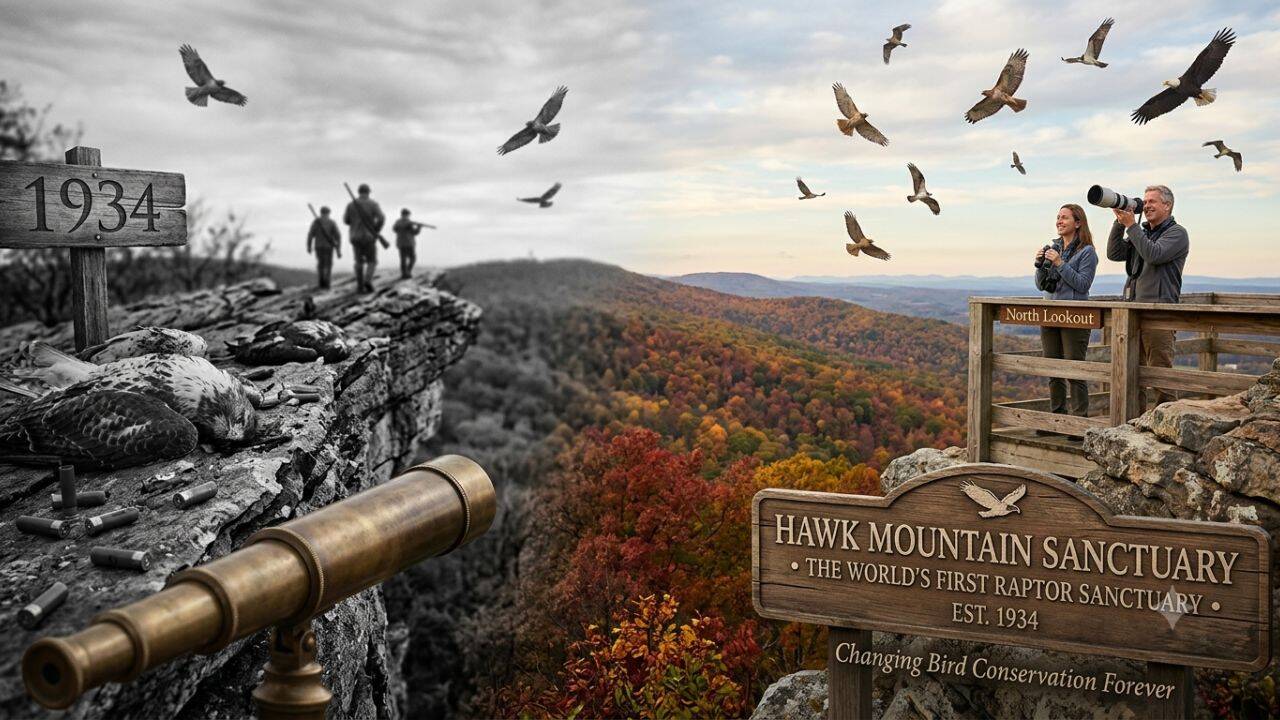
In the autumn of 1934, a rocky ridge along the Kittatinny Ridge in eastern Pennsylvania ran red with feathers and blood. For generations, local hunters hauled shotguns up the slopes of Hawk Mountain, waiting for autumn winds to funnel thousands of migrating hawks, eagles, and falcons right into their crosshairs. They shot birds out of the sky by the thousands, leaving carcasses to rot in piles or hanging them up as trophies.
Mainstream conservation groups knew about the slaughter. They did nothing. The established leadership of the era considered predators to be nuisances that deserved to die.
Then Rosalie Edge stepped in. A wealthy New York suffragist turned militant conservationist, Edge saw a photograph of the carnage and refused to look away. She didn't write a polite letter of complaint. She leased the mountain, hired armed wardens, and founded the world’s first sanctuary for birds of prey.
The Battle Against the Establishment
Edge was not your typical early 20th-century activist. Born in Manhattan in 1877, she spent her early years fighting for women's right to vote. When New York secured suffrage in 1917, she redirected that fierce organizational energy toward the natural world.
She quickly realized that the prominent conservation groups of the day were dangerously timid. The National Association of Audubon Societies actually condoned the killing of various predatory animals and birds, viewing them as unwanted competition for game species. Edge founded the Emergency Conservation Committee in 1929 specifically to call out these institutional failures. One contemporary famously dubbed her "the only honest, unselfish, indomitable hellcat in the history of conservation".
When conservationist Richard Pough showed her photographs of the bloody hawk shoots taking place on the Pennsylvania ridgeline in the early 1930s, Edge knew institutional leaders would drag their feet. Promises had been made to buy the mountain and stop the killing, but months passed with no action.
Edge took direct action. In June 1934, she used borrowed money to sign a lease on roughly 1,400 acres of the bloody ridge.
Stopping the Slaughter Overnight
Edge appointed a young naturalist named Maurice Broun and his wife, Irma, as the resident wardens of the newly minted property. Armed with legal backing and fierce determination, Broun arrived on the mountain ahead of the fall migration.
When the local hunters showed up with their shotguns expecting their usual autumn sport, the wardens turned them away. The shooting stopped almost immediately. Hunters grumbled, threatened violence, and tested the boundaries, but Edge backed her wardens without hesitation.
Instead of letting hunters drop the birds, Edge and Broun started counting them. That single shift transformed a mountain of death into a powerhouse of field science.
A Database That Saved Species
The daily migration counts started by Broun in 1934 turned into the longest continuous record of raptor migration anywhere on Earth. That unbroken dataset became an invaluable scientific instrument.
Decades later, environmental scientists used those exact numbers to prove how widespread agricultural pesticides like DDT were quietly destroying top avian predators. The data from Hawk Mountain provided clear, undeniable evidence that helped secure bans on toxic chemicals and guided the eventual recovery of bald eagles, ospreys, and peregrine falcons.
Today, Hawk Mountain Sanctuary spans 2,600 acres, drawing tens of thousands of visitors, researchers, and birdwatchers every single year. It operates as an international center for raptor conservation training, hosting scientists from dozens of countries.
Why Rosalie Edge Still Matters
Edge famously preached a simple, uncompromising doctrine: "The time to protect a species is while it is still common".
Most people wait until an animal teeters on the brink of absolute extinction before caring. Edge understood that waiting guarantees failure. She spent her own money, insulted complacent bureaucrats, and stared down hostile locals because she believed ordinary citizens have an absolute duty to defend wildlife.
If you visit the Kittatinny Ridge today during the autumn flight, look up at the sky. Watch the red-tailed hawks, eagles, and falcons ride the thermal currents past the rocky lookouts. Every single bird you see soaring overhead exists because one woman refused to accept a rigged status quo and decided to buy a mountain instead.
Plan a trip to Hawk Mountain in eastern Pennsylvania this fall to witness the migration firsthand, or support grassroots wildlife initiatives in your own backyard before your local ecosystems face the same avoidable crisis.