You can usually tell when a filmmaker is trying too hard.
After the raw, lightning-in-a-bottle success of Booksmart, director Olivia Wilde took a massive detour into the hyper-ambitious, gossip-fueled spectacle of Don't Worry Darling. It was a movie trying to say everything about society while saying almost nothing about human beings. It felt detached. It felt engineered.
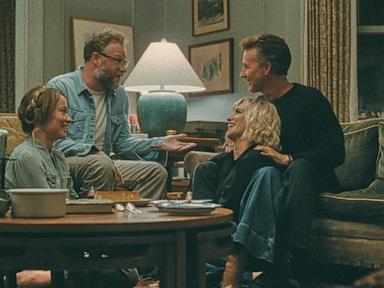
But her third feature film, The Invite, strips away the grand sci-fi sets and the internet drama. Instead, it locks four exceptionally talented actors inside a single, beautifully decorated San Francisco apartment for 107 minutes and lets them tear each other's emotional lives apart.
Distributed by A24 and written by the writing team of Will McCormack and Rashida Jones, this film is an English-language remake of Cesc Gay's 2020 Spanish hit The People Upstairs. On paper, a scene-for-scene adaptation of a theatrical sex comedy sounds like a lazy mid-career paycheck. In execution, it's the best thing Wilde has ever directed. It's sharp, deeply uncomfortable, and entirely alive.
The Brutal Anatomy of a Domestic Nightmare
The setup relies on a premise that feels instantly recognizable to anyone who has ever lived under a thin ceiling. Joe (Seth Rogen), a burnt-out music teacher and former indie frontman, and Angela (Olivia Wilde) are a middle-aged couple whose marriage has slowed down to a freezing, resentful crawl. They don't have sex. They barely communicate without trading passive-aggressive barbs. Their teenage daughter is away for the night, leaving them alone with the heavy silence of a dying relationship.
To make matters worse, Angela has sprung a last-minute dinner party on Joe. The guests? The upstairs neighbors, Piña (Penélope Cruz) and Hawk (Edward Norton).
Joe and Angela know these neighbors intimately, though they've never actually spoken. Every single night, the sounds of Piña and Hawk’s loud, uninhibited, joyous lovemaking shake the floorboards of Joe and Angela's flat. It's a nightly, acoustic reminder of everything the hosts are missing. When the upstairs couple finally walks through the door—looking impossibly chic, relaxed, and perfectly in sync—the psychological trap snaps shut.
What starts as a classic comedy of manners quickly turns into a high-stakes emotional thriller. Joe is defensive, bitter, and looking for a fight. Angela is frantically overcompensating, desperate to appear civilized, modern, and unbothered.
The real engine of the plot kicks in when the small talk dissolves. Piña, who happens to be a blunt, filterless psychotherapist, and Hawk, a suave ex-firefighter, lay their cards flat on the table. They aren't just there for the wine and cheese. They have an exceptionally active, non-traditional love life, and they've arrived with a casual, friendly indecent proposal for a spouse-swap.
Why the Performances Make the Discomfort Work
A movie that takes place entirely in one living room lives or dies on its casting. If the chemistry falters for even five minutes, the whole project begins to feel like a tedious acting exercise. Luckily, the central quartet delivers a masterclass in contrasting performance styles.
- Seth Rogen shines by leaning directly into his classic, cynical everyman persona. He plays Joe not as a caricature of a bitter husband, but as a guy who is actively drowning in his own unfulfillment. When Joe sneaks off to smoke a joint with Piña, Rogen balances his signature stoner comedic timing with a quiet, devastating vulnerability.
- Olivia Wilde gives her most vulnerable onscreen performance in years. Angela is a woman clinging to control by a thread, deeply insecure about her age, her appearance, and her stale routine. Watching Wilde play a character who is simultaneously terrified of and fascinated by her neighbors is deeply compelling.
- Penélope Cruz steals the entire film. She infuses Piña with a serene, total lack of judgment that makes her terrifyingly perceptive. She looks right through the hosts' marital facade within ten minutes of arriving.
- Edward Norton is an absolute riot as Hawk. He plays the character with a slightly slick, oily confidence that could easily become obnoxious, but instead becomes the funniest part of the evening. His schoolboy Spanish banter with Cruz and his immediate bond with Wilde over apartment decor provide massive, laugh-out-loud moments.
The script doesn't just treat the swinger premise as a cheap punchline. Instead, McCormack and Jones use the overt sexual tension to force Joe and Angela to confront the reality of their own isolation.
Escaping the Stage Play Trap
The biggest risk with an adaptation of a stage play is that it can easily feel static. It's hard to make a living room feel cinematic.
Wilde, working alongside cinematographer Adam Newport-Berra and production designer Jade Healy, solves this by treating the apartment like a chessboard. The camera tracks through doorways, lingers on reflections in windows, and uses depth of field to keep the audience locked into the claustrophobia. You constantly feel the physical distance between the characters, even when they're standing in the exact same room.
The secret weapon of the film's pacing is the musical score by Devonté Hynes. Rather than relying on generic comedic cues, Hynes crafts a twitchy, string-heavy soundtrack that mirrors the characters' internal anxieties. It builds tension so effectively that a simple conversation about a new living room rug carries the sonic weight of a psychological horror film. By the time the score weaves in the mischievous notes of Georges Bizet's Carmen, the movie feels completely intoxicating.
The Ambiguous Reality of Middle Age Romantic Disillusionment
Many traditional Hollywood comedies would take this premise and use it to magically fix the central marriage. The characters would try something wild, realize they only love each other, and live happily ever after.
The Invite is much smarter than that.
When the film slows down in its final act to deal with the fallout of the evening's revelations, it takes a sharp, bittersweet turn. The movie reminds us that a single wild night with the neighbors can't magically erase years of buried resentment, unsaid grievances, and emotional drift.
The conclusion doesn't offer easy answers or clean closures. It leaves the characters—and the audience—hanging in a space that feels messy, real, and hauntingly open-ended. Some viewers might find the abrupt shift in momentum frustrating, but it's an incredibly honest depiction of how long-term relationships actually fall apart. It’s a stalemate, not an explosion.
Your Next Steps
If you want to catch one of the sharpest, funniest adult relationship dramas of the year, here is what you need to do:
- Check the Release Schedule: The Invite lands in select limited theaters on June 26, 2026, before expanding to a wide national release via A24 on July 10, 2026.
- Watch the Original: If you want to see where the DNA of this story comes from, stream Cesc Gay's original 2020 film The People Upstairs (Sentimental) to appreciate how Wilde adapted the material for an American context.
- Listen to the Music: Keep an ear out for Devonté Hynes' phenomenal score, which is set to drop on major streaming platforms alongside the wide theatrical release.