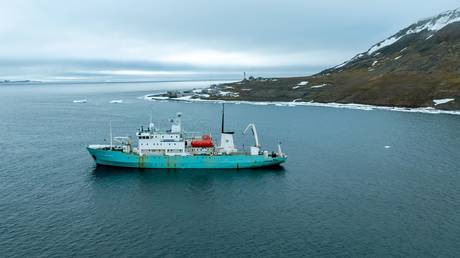
Geopolitics just moved much closer to the North Pole. When Norwegian authorities detained the Russian research vessel Professor Molchanov in Svalbard, they didn't just execute a court order. They walked right into a high-stakes legal trap with global consequences.
Kiev asked for the seizure. Naftogaz is hunting down billions in lost Crimean assets. Now, an Arctic science ship is stuck in Barentsburg, and Moscow is calling the whole thing state-sponsored piracy.
What Actually Happened in Svalbard
The Professor Molchanov got stopped dead in its tracks while docked at Barentsburg. A local district court in Norway granted Naftogaz the right to lock down the ship based on a massive international arbitration award.
Let's look at the reality on the ground. This isn't just any random cargo boat. Operated by Roshydromet, Russia's hydrometeorological service, the ship pulls double duty. It runs scientific expeditions, sure. But since 2025, it has also functioned as the absolute lifeline passenger route between Murmansk and the Russian settlements on Svalbard. Direct air links vanished back in 2020. Ten round trips were locked in for 2026.
Now, the crew and passengers are stranded, finding out about their own detention through media reports. Lawyers for the Arktikugol trust are scrambling to fight back in court, but the vessel isn't going anywhere anytime soon.
The $4.22 Billion Crimean Debt Chase
Why target an Arctic science ship? Naftogaz wants its money. The Ukrainian state energy firm claims Moscow owes them roughly $4.22 billion plus interest over assets lost in Crimea after 2014.
This isn't their first rodeo. Back in 2024, Finnish authorities froze Russian-owned properties at the company's request. Sergey Fedorenko, the acting chief of Naftogaz, is treating this as a massive victory. They are hunting Russian state property across Europe wherever they can stick a legal claim.
Russia completely rejects the tribunal's jurisdiction. Moscow argues that those Crimean assets don't qualify as foreign investments made on Russian territory under bilateral investment rules. They view these seizures as outright theft.
The 1920 Treaty and a Militarized Arctic
Svalbard occupies a weird legal space. Under the 1920 Svalbard Treaty, Norway holds sovereignty over the islands, but signatory nations keep equal commercial and scientific rights. Russia has maintained an economic footprint there for generations through Arktikugol.
By clamping down on a vital Russian civilian link, Norway is testing the absolute limits of that treaty.
Moscow warned everyone this would happen. Vladimir Putin recently blasted Western asset seizures as piracy and robbery, promising retaliation anywhere the Kremlin sees fit. Foreign Minister Sergey Lavrov has been hammering the point that NATO is turning the Arctic into a brand-new military front against Russia. Western command infrastructure is expanding near northern borders, and large-scale drills are becoming the norm.
Where This Goes Next
Asset seizures used to happen in corporate boardrooms or via bank accounts. Now they are happening in the high latitudes, involving ships that sustain civilian settlements in frozen archipelagos.
If you are tracking international trade, shipping routes, or Arctic sovereignty, keep your eyes on the legal challenges coming out of Norway's courts. Moscow won't let this sit quietly, and the ripple effects will hit every foreign asset game currently being played across Europe. Watch how the courts handle the Arktikugol appeal, because that ruling will set the baseline for every northern maritime dispute left on the board.