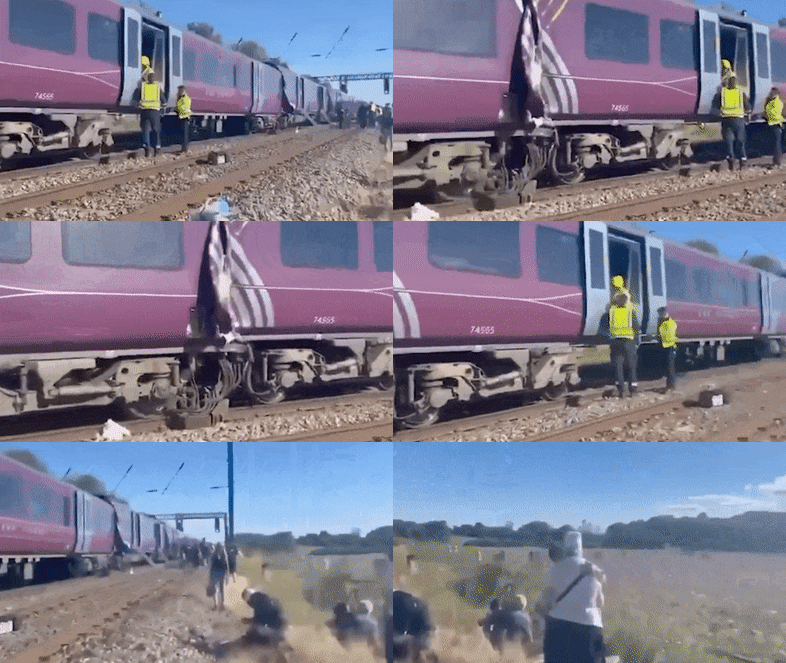
The British rail network is widely considered one of the safest transport systems in the world. Yet, late Friday afternoon, that reputation took a severe blow. When news broke that two trains collide north of London, it immediately sent shockwaves through the thousands of commuters heading home for the weekend. This wasn't a minor signal failure or a routine delay. It was a major disaster that left one person dead and dozens hospitalized, grinding central England's rail network to a complete halt.
If you regular travel on the lines running out of London St Pancras, this crash hits incredibly close to home. It exposes vulnerable gaps that safety regulators will be picking apart for months.
The Fatal Crash Outside Bedford Explained Simply
The crash happened just south of Bedford, a market town about 56 miles north of London. Around 5:15 p.m. on Friday, June 19, 2026, two southbound passenger trains traveling toward central London collided on the same stretch of track.
Both trains belonged to East Midlands Railway. One was the 3:50 p.m. service coming from Nottingham, and the other was the 4:40 p.m. service originating in Corby. Both were packed with weekend travelers, commuters, and families.
Emergency crews arrived quickly. The East of England Ambulance Service, local police, and fire crews rushed south of Bedford to find both trains still upright on the tracks but severely damaged. A major incident was declared almost immediately. Air ambulances landed nearby to airlift the most critical victims to regional trauma centers, while local hospital systems prepared for a mass influx of patients.
What Happened on the Tracks Friday Evening
While the Rail Accident Investigation Branch is on-site digging into data recorders, the core mechanics of the crash are starting to emerge. The two trains were traveling on the same line heading toward London St Pancras. In a modern rail system, this shouldn't happen.
Safety systems are built specifically to keep trains apart. Signal blocks use automated tracking to make sure a train can't enter a section of track if another train is sitting or moving ahead of it. Somewhere outside Bedford, that safety net failed completely.
Initial reports and images shared by passengers on social media show that one train ran into the rear or side of the other. The impact was violent enough to warp the steel carriages and smash internal glass, though it didn't cause a total derailment. The fact that the trains remained upright likely kept the death toll from climbing much higher.
Behind the Numbers of the Bedford Disaster
The scale of the injuries makes this one of the worst rail incidents in England in years. Emergency officials confirmed the toll late Friday evening.
- 1 person died at the scene.
- 11 passengers suffered very serious injuries.
- 22 people were listed with serious injuries.
- 56 individuals sustained minor injuries.
The sole fatality was the driver of one of the trains. Eddie Dempsey, the general secretary of the National Union of Rail, Maritime and Transport Workers, confirmed the loss. The driver was a long-standing member and a former union representative. The identity has not yet been released publicly out of respect for the family.
The lopsided casualty list shows just how violent the forces inside the carriages were. While 56 people managed to walk away with minor cuts and bruises, nearly three dozen passengers are dealing with major, life-altering trauma.
Eyewitness Accounts Describe Moments of Pure Terror
Passengers inside the carriages had absolutely no warning. Train travel is usually smooth, a background hum while you look at your phone or read a book. That peaceful routine shattered in a fraction of a second.
Peter Knapp, a passenger in the rear train, described being flung directly into the chair in front of him. He saw smoke immediately filling the carriage. People were crying, screaming, completely terrified and confused. He injured his own back but managed to squeeze out through a narrow gap in the broken doors. He reported seeing dozens of fellow travelers who couldn't move, many with obvious broken legs and deep facial lacerations.
Another traveler, Shola Mene, described a massive bang that echoed through the train. She saw a passenger literally fly across the carriage aisle and hit her husband square in the face. Blood was everywhere. The sudden stop turned unsecured luggage, laptops, and even human bodies into dangerous projectiles.
Why British Train Collisions Are Supposed to Be History
Train crashes like this are incredibly rare in modern Britain. The country spent billions upgrading its infrastructure after a series of deadly accidents in the late 1990s and early 2000s. Systems like the Train Protection and Warning System were installed nationwide to automatically apply brakes if a driver accidentally passes a red signal or travels too fast.
Because of these layers of protection, a collision between two moving passenger trains on an active mainline points to a catastrophic failure. Investigators will look closely at three main areas.
First, they will check the signaling system. Did a signal incorrectly display a green light when it should have been red? Software glitches or electrical faults can sometimes cause false readings, though the system is designed to fail safely by turning everything red if a fault occurs.
Second, they will examine human action. Driver fatigue, distraction, or medical emergencies are always part of a standard investigation. However, with modern safety overrides, human error alone usually isn't enough to cause a crash unless the automatic safety systems were overridden or failed simultaneously.
Third, they will look at track conditions and infrastructure. The Rail Accident Investigation Branch has already deployed a team of specialist inspectors to download data from the trackside boxes and the trains' onboard event recorders. They will reconstruct the exact speeds, braking actions, and signal states down to the millisecond.
Practical Next Steps for Stranded Passengers and Commuters
The fallout from the Bedford crash will impact travel for days. If you rely on this corridor, you need to change your plans right now.
- Avoid London St Pancras entirely if you are using East Midlands Railway or Thameslink services. The lines between Luton and Bedford are fully blocked.
- Do not attempt to travel on these routes today. East Midlands Railway confirmed that all services to and from London St Pancras are suspended. They cannot guarantee when normal schedules will resume.
- Check your compensation rights immediately. Under the Delay Repay scheme, you're entitled to full refunds if your journey was canceled or severely delayed due to this incident. Keep your physical tickets or digital booking references.
- Look for alternative routes using the West Coast Main Line out of London Euston or the East Coast Main Line out of London King's Cross if you must travel between London and the Midlands. Expect these alternative services to be extremely crowded as thousands of passengers get diverted.
- Monitor live departure boards and the official National Rail Enquiries website for real-time track clearance updates. Heavy lifting equipment and forensic teams will occupy the crash site for an extended period.