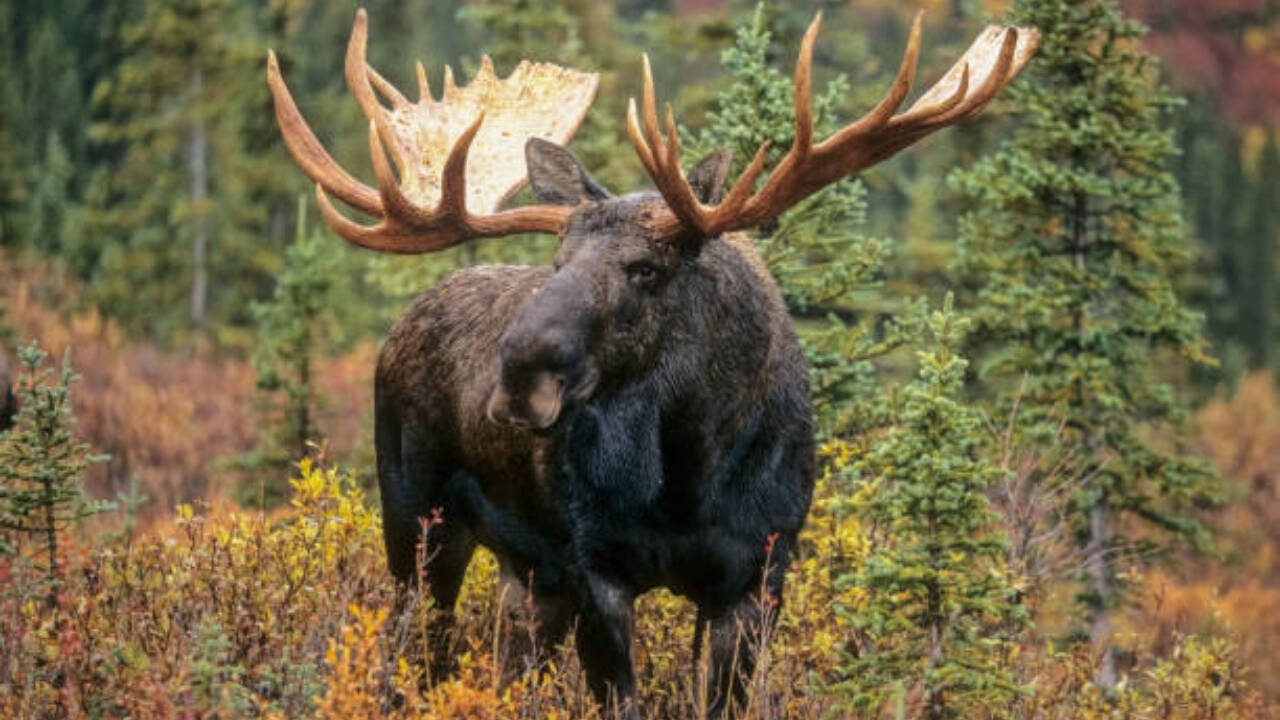
You can trace an entire ecological crisis back to a handful of animals released over a century ago. Back in 1878, and again with a crucial shipment of four moose in 1904, officials wanted a fresh supply of meat and a new game animal for hunters. They never imagined they were unspooling a biological time bomb. Today, an estimated 110,000 moose roam the island of Newfoundland, acting like a relentless biological lawnmower that is chewing the local boreal forests down to bare dirt.
If you wonder how a few large herbivores can completely destabilize an entire island ecosystem, the answer lies in simple math and a total lack of natural checks and balances.
The Anatomy of a Population Explosion
Moose aren't native to the island of Newfoundland. They belong on the mainland and in Labrador, separated from the island by saltwater. When humans ferried them across, the animals found paradise.
The island offered endless vegetation and, crucially, zero serious predators. The native Newfoundland wolf—the only apex predator capable of taking down an adult moose—was hunted into extinction by 1930. Without wolves to thin the herd or alter their grazing habits, the moose multiplied unchecked.
Commercial logging and natural forest fires actually made things worse. Disturbed earth sprouted dense thickets of young birch, willow, and balsam fir saplings. For a moose, this is high-end gourmet dining. By the late 1950s, the herd ballooned toward an astonishing 200,000 animals.
A Million Metric Tons of Appetite
An adult moose eats an immense amount of food daily. Winter brings a diet of 40 to 50 pounds of twigs and woody shrubs. Summer pushes that requirement to between 50 and 60 pounds of fresh green vegetation every single day.
Multiply those individual meals across a population of roughly 110,000 animals, and the numbers turn staggering. The herd consumes somewhere between 720,000 and 1 million metric tons of plant material annually.
Forests cannot regenerate under that kind of pressure. When a boreal forest experiences a disturbance, it relies on young saplings to shoot upward, knit their branches together, and rebuild the protective canopy overhead. Moose target these exact species. They snap the tops off young trees and strip the bark.
Repeated browsing kills the saplings. Instead of a thick, multi-layered forest floor, vast patches of Newfoundland are turning into open "moose meadows" dominated entirely by unpalatable ferns and coarse grasses.
Learning From Gros Morne
You can see the wreckage clearly inside Gros Morne National Park. Back in 1998, the park's moose density surged past four animals per square kilometer. The forest simply stopped growing. Saplings were kept microscopic by constant nibbling, creating strange, open landscapes where dense woods used to stand.
Parks Canada had to step in with a harsh population reduction program starting in 2011. By dropping the local herd down toward a target of 2,000 animals, forest regeneration finally started showing a pulse. Yet, many severely damaged sectors require active human tree-planting efforts just to recover.
Why Management Is a Tightrope Walk
Managing 110,000 large mammals on an island is messy. Wildlife biologists don't have the luxury of reintroducing wolves to a modern landscape crisscrossed by highways and towns. Instead, hunting remains the primary tool for population control.
The province sets complex area-based quotas using aerial surveys, hunter logs, and jawbone collection data. In regions near major highways, wildlife managers push for lower moose densities to cut down on catastrophic vehicle collisions. On the other hand, remote timber tracts see adjusted license numbers designed to give battered ecosystems breathing room.
The provincial hunting guide adjusted quotas upward recently, pushing island licenses to 28,705. Officials aren't trying to wipe the species out. Moose are deeply woven into the local culture, economy, and food supply.
The goal is a fragile equilibrium. If the herd grows too large, the forests vanish. If hunters drop numbers too drastically, the ecosystem rebounds in ways that might still leave permanent scars. Newfoundland's ongoing struggle proves that once you introduce a foreign powerhouse into an isolated habitat, you inherit responsibility for managing it forever.