For decades, standard atomic clocks have ruled supreme as humanity's ultimate timekeepers. Cesium and optical atomic clocks rely on electron shells, tracking energy transitions that dictate the modern definition of a second. But physics is hitting a wall with electrons. They are clumsy, sprawling, and far too vulnerable to stray magnetic fields and thermal noise. Enter the thorium-229 nuclear clock, a device that shifts the entire paradigm by tuning directly into the atomic nucleus instead.
Recent scientific breakthroughs have turned theoretical physics into hardware. Teams from Tsinghua University in Beijing and the Vienna University of Technology independently built working nuclear clocks, locking lasers onto the ultranarrow nuclear transition of thorium-229 embedded inside calcium fluoride crystals. While the European team led by Thorsten Schumm made waves with initial stability milestones approaching a part in a quadrillion, subsequent studies show that the Tsinghua University group achieved roughly six times higher stability in their specific configuration. It's an intense, friendly global race to rewrite metrology.
Why Nucleus Beats Electron Every Single Time
If atomic clocks are already precise enough to lose less than a second over billions of years, why bother building a nuclear alternative? The answer comes down to sheer physics. An atomic nucleus is roughly 100,000 times smaller than the surrounding electron cloud. Because it is so tiny and tightly bound, the dense collection of protons and neutrons acts as a natural armored shell against external environmental interference.
Stray electric fields, magnetic noise, and temperature fluctuations constantly nudge standard optical atomic clocks off-beat, requiring massive vacuum chambers and complex shielding. A nuclear clock based on thorium-229 is inherently more robust. Because the nucleus barely feels those external disturbances, the entire system can eventually shrink. Instead of filling an entire laboratory basement, future versions could exist as solid-state chips of doped crystal.
Inside the Race Between Beijing and Vienna
Building a working nuclear clock required solving a problem that baffled scientists for over twenty years. To trigger an energy state change in most atomic nuclei, you need high-energy gamma rays or X-rays—radiation so destructive it would instantly fry any precision laser setup. Thorium-229 is the rare exception, possessing a uniquely low-lying isomeric transition that can be reached with vacuum-ultraviolet lasers.
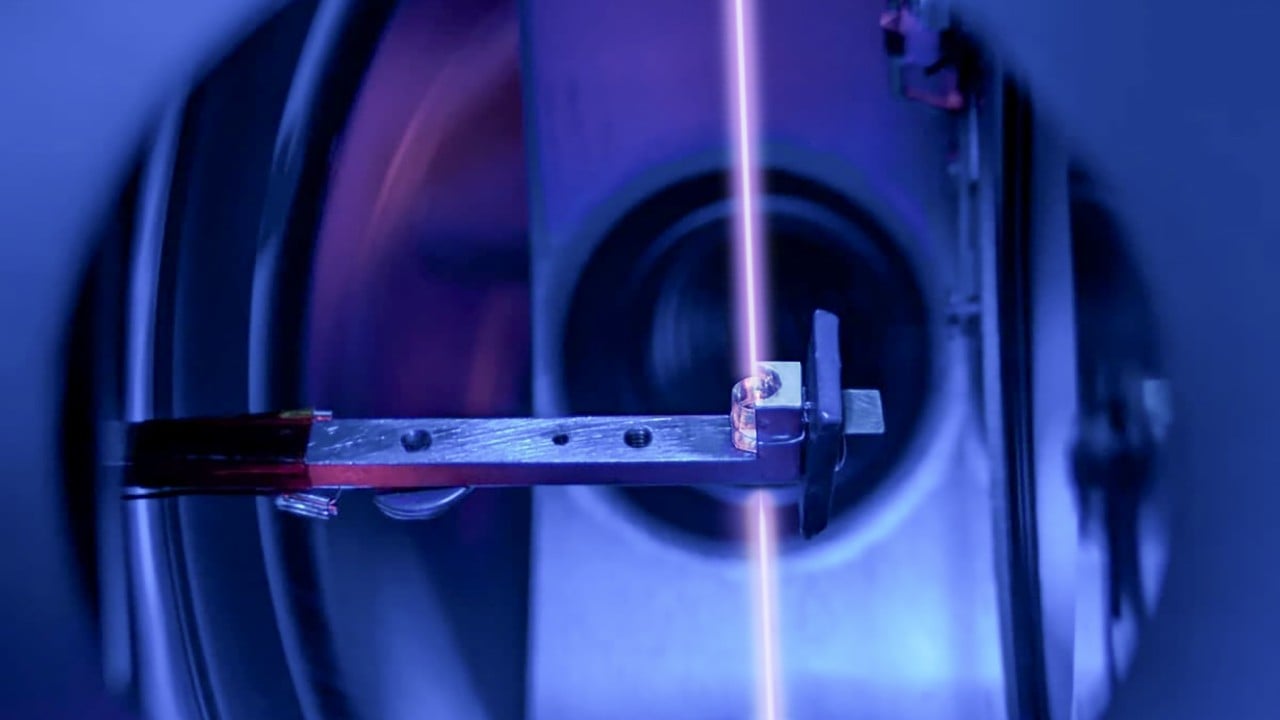
The breakthrough came together when researchers packed trillions of thorium-229 atoms into transparent calcium fluoride crystals at room temperature. By shining a finely tuned ultraviolet laser onto the crystal lattice and using a feedback loop to monitor light absorption, both the Beijing and Vienna teams successfully locked a laser onto the nuclear resonance.
The Tsinghua University team demonstrated exceptional reproducibility and stability, outperforming the Vienna baseline by roughly a factor of six in comparative studies. Furthermore, these results closely matched foundational groundwork from Jun Ye’s group at JILA in Colorado, proving that solid-state nuclear timekeeping is a repeatable reality rather than a fluke.
What This Unlocks Beyond Telling Time
Measuring time accurately is only half the prize. The thorium-229 nuclear transition operates on a frequency that is uniquely sensitive to subtle shifts in the fundamental constants of physics. If the fine-structure constant or the mass ratio of quarks were to drift even by a minuscule fraction over time, a nuclear clock would catch it instantly.
This sensitivity turns the clock into a multi-purpose sensor. Physicists can use these solid-state devices to search for dark matter candidates, test Einstein’s relativity under extreme constraints, and look for undiscovered fundamental forces outside our current standard model.
The Road Ahead for Solid-State Timekeeping
We aren't throwing away atomic clocks just yet. Current nuclear clocks are still catching up to the raw precision of the absolute best optical atomic clocks on Earth. Crystal production remains tricky because thorium-229 is a rare radioactive isotope, and growing crystals with a perfectly uniform distribution of the impurity is an ongoing engineering hurdle.
Researchers now need more powerful, reliable lasers and higher-purity crystal lattices to push stability limits even lower. As those manufacturing barriers fall, we are moving closer to portable, ultra-stable quantum sensors that will change navigation, telecommunications, and fundamental physics research.
Grab your data and start watching the crystal labs. The nuclear clock era is officially ticking.