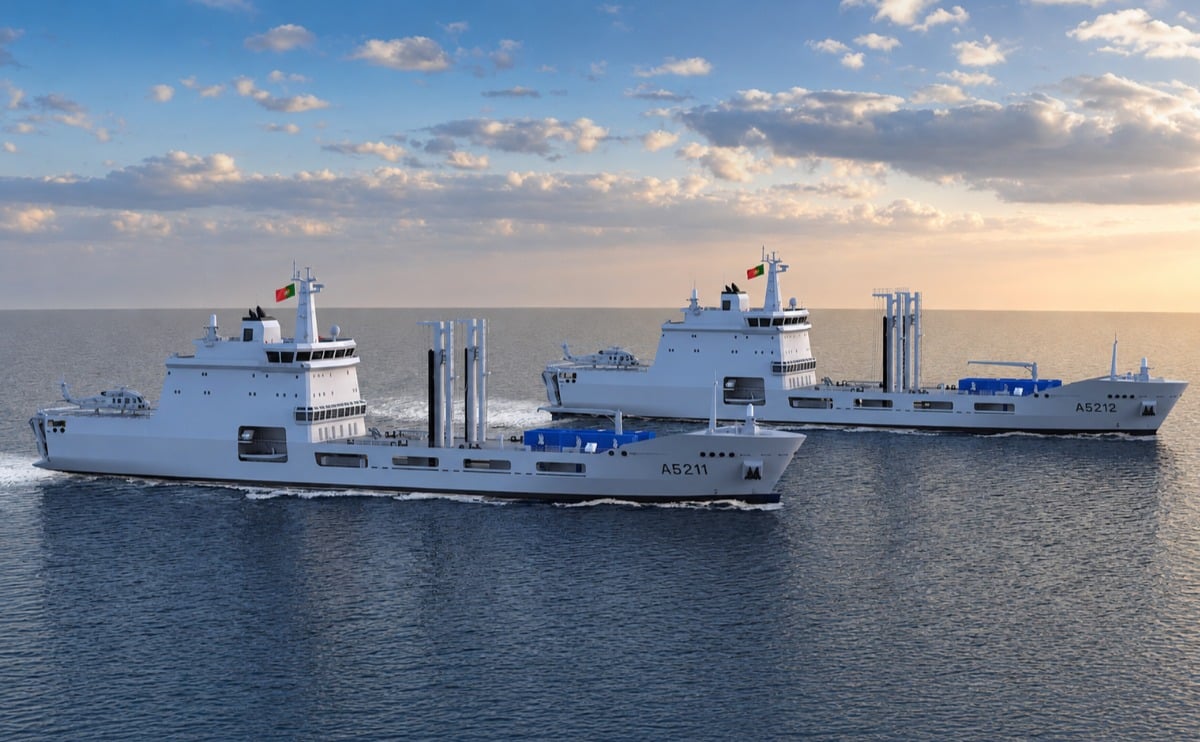
Portugal just officially kicked off construction on its second fleet support vessel in Istanbul. While a steel-cutting ceremony for an auxiliary oiler replenisher might sound like standard defense industry background noise, this specific hull marks a massive shift in how NATO members buy warships.
For the first time, a European Union nation bypassed traditional Western European shipyards to buy its primary naval logistics backbone directly from Türkiye.
On June 18, 2026, engineers and military officials gathered at the ADA Shipyard in Istanbul to watch the first plates of steel get sliced for the future N.R.P. D. Dinis. This follows the late 2025 steel cutting of the sister ship, Luís de Camões. Turkish engineering firm STM is managing the entire project as the prime contractor.
The deal isn't just about building two big gray ships. It is a loud signal that the old monopoly on European naval procurement is cracking.
What Portugal is Actually Buying
Let's look at the actual platforms. These are not basic cargo haulers. STM is building what the industry calls an Auxiliary Oiler Replenisher and Logistics Ship, or AOR+. They bridge the gap between simple supply ships and multi-mission amphibious support platforms.
The numbers give you an idea of the scale. Each vessel measures 137 meters in length and displaces over 11,000 tons. They are designed around a highly modular interior. This means the crew can swap out mission packages depending on whether they are heading into a combat zone or a humanitarian disaster area.
For standard operations, these ships are built to keep a fleet fighting. They pack massive internal storage:
- 4,000 cubic meters of F-76 ship fuel
- 350 cubic meters of F-44 aviation fuel
- 650 cubic meters of fresh water
- 700 cubic meters of dry general cargo
- Dedicated space for six standard 20-foot shipping containers and ammunition storage
But the real trick is the stern. STM integrated a roll-on/roll-off ramp right into the back of the vessel. That allows the ship to carry and quickly deploy up to 20 light tactical armored vehicles. If Portugal needs to land a force for an amphibious operation or send a secure peace-keeping team ashore, these vessels can do it without needing a specialized port.
Survival in High Threat Environments
Most logistics ships are soft targets. They usually sit far behind the front lines because they lack the teeth to defend themselves. Portugal wanted something different.
These platforms feature an integrated combat system that allows them to support air defense operations. Instead of relying entirely on frigate escorts, the ships carry their own close-in weapon systems, 12.7 mm remote-controlled weapon stations, and active chaff/decoy systems to spoof incoming missiles.
The propulsion layout is also built for flexibility. The main diesel engine pushes the ship past 18 knots for high-speed transits. When patrolling slowly or conducting quiet operations, the crew can switch to a dedicated electric propulsion system. That lets the ship cruise quietly at over 6 knots, stretching its maximum range to an impressive 14,000 nautical miles at a standard 14-knot cruising speed.
The flight deck accommodates medium naval helicopters and rotary-wing unmanned aerial vehicles. Unlike older logistics vessels that treat drones as an afterthought, these hulls feature a dedicated UAV hangar with integrated data links. This gives the command team a permanent eye in the sky for search and rescue or local surface surveillance.
Why This Contract Stunned European Shipbuilders
When Portugal opened this tender under its Military Programming Law, established shipyards in France, Germany, and the Netherlands assumed it would be business as usual. They didn't expect a Turkish firm to walk away with the prize.
STM won the contract in December 2024 because they offered something Western European yards have struggled with recently: predictable delivery timelines and highly competitive pricing without sacrificing NATO compatibility. The entire design is fully integrated into NATO tactical data systems and communication networks.
The schedule is remarkably aggressive. The first ship's keel was laid in January 2026. Now, just six months later, the second hull is officially under construction. STM plans to launch both vessels into the water by 2027 and hand the keys over to the Portuguese Navy before the end of 2028.
For comparison, similar naval auxiliary programs across Europe have frequently faced multi-year delays and ballooning budgets over the last decade. By keeping the design modular and leveraging the rapid production capacity of Turkish commercial-naval yards like ADA Shipyard, STM is proving they can build complex military vessels at a pace Western yards find difficult to match.
The Broader NATO Shift
This project is a massive win for Türkiye's defense export strategy. The country has successfully sold corvettes to Pakistan, milgem-class ships to Ukraine, and various patrol vessels to Malaysia. But breaking into the European Union and NATO market was always the ultimate goal.
Securing a contract from Portugal—a nation with a deep, historic maritime tradition—gives Turkish naval architecture instant legitimacy across the rest of the alliance. It proves that Turkish yards can meet strict European environmental regulations, labor standards, and complex naval military specifications.
It also changes the strategic dynamic within the alliance. As European nations rush to rebuild their naval fleets amid rising global tensions, they are looking for affordable options. If STM delivers these two vessels on time in 2028 and they perform as advertised, expect other mid-sized navies in Europe to look toward Istanbul for their next fleet renewal programs.
What Happens Next
Now that the steel has been cut for the N.R.P. D. Dinis, production will ramp up quickly in Istanbul. If you are tracking this project or analyzing naval procurement trends, watch for these milestones:
- The Keel Laying of Hull Two: Expect the formal keel-laying ceremony for the D. Dinis to happen before the end of 2026 or early 2027.
- First Structural Assembly: Watch for the integration of the modular internal tanks and the stern ro-ro ramp structural blocks over the next twelve months.
- The 2027 Double Launch: STM intends to put both the Luís de Camões and the D. Dinis into the water in 2027 to begin afloat outfitting and initial basin trials.