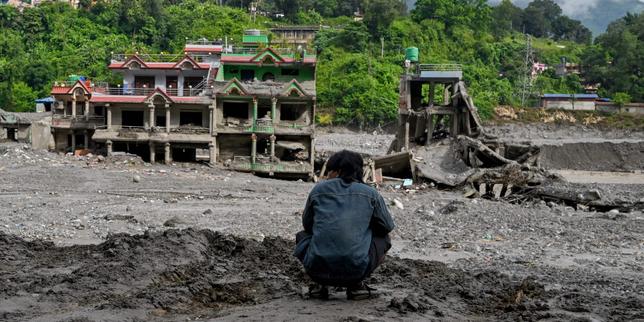
When a glacier on Mount Langtang Lirung fractured at an altitude of 5,200 meters on August 26, it didn't just cause a local landslide. It triggered an ice-rock avalanche that turned into a massive, tsunami-like debris flow, devastating valleys across the border in Nepal and Tibet.
The official numbers are staggering. As recovery operations press on through thick layers of mud, the death toll has climbed to at least 919 people, while 4,793 individuals remain missing. Entire settlements in districts like Rasuwa, Nuwakot, Dhading, and the Kathmandu Valley were simply wiped out.
If you look past the horrifying statistics, a much harder truth emerges. This Himalayan catastrophe reveals how fragile modern infrastructure is when matched against accelerating climate shifts, and why cross-border data sharing remains dangerously broken.
The Nightmare Inside the Hydropower Tunnels
Most mainstream news coverage focuses entirely on the flattened villages and the overflowing morgues. But a more specific, harrowing crisis has played out underground.
Over 900 workers at multiple hydropower projects across Rasuwa and Nuwakot were unaccounted for following the surge. Many were trapped inside blocked project tunnels. Rescue teams from the Nepali army, aided by international experts, have had to use controlled blasts, heavy excavators, and searchlights to clear out tons of dense mud.
Opening these concrete tubes is an unprecedented challenge. A massive amount of debris was deposited deep inside, sealing off exits completely.
Search crews have encountered severe hurdles:
- Decomposing bodies in the humid weather forcing authorities to rely on hasty mass burials and DNA sampling.
- Secondary flood risks caused by new natural lakes forming behind landslide blockages.
- Suspended rescue operations due to sudden bouts of bad weather.
These workers weren't just unlucky. They were caught in an industrial boom fueled by clean-energy demands that outpaced our understanding of cryosphere stability.
A Failure of Regional Data Sharing
You cannot talk about the destruction along the Nepal-China border without addressing the communication gap.
Following a bilateral meeting earlier this year to strengthen cooperation, expectations were high. Yet, local officials in Nepal have pointed out that vital information on glacier risks and upstream water levels wasn't effectively shared beforehand. When an ice-rock avalanche turns into a roaring wall of water within minutes, every single second counts.
Without open, real-time meteorological and hydrological data pipelines between neighboring nations sharing the same mountain ranges, early warning systems are effectively blind. China's foreign ministry maintains that Beijing continuously supplies data, but the operational reality on the ground tells a story of fragmented response and delayed warnings.
When your geography is dictated by the world's highest and fastest-melting mountain range, withholding hydrological metrics is a recipe for mass casualties.
The Climate Inequity No One Wants to Fix
Nepal contributes a tiny fraction of global per-capita carbon emissions. Yet, it faces the absolute brunt of cryosphere degradation.
Glaciers across the Himalayas are retreating and destabilizing at unprecedented rates as global temperatures climb. Ice-rock avalanches are becoming a prominent feature of high-altitude disasters, catching planners off guard.
International aid pledges—such as funding packages from the United States and Canada—offer short-term relief, but they do nothing to fix the structural vulnerability of the region. What local governments actually need are specialized technologies: heavy-lift drones, advanced geospatial sensors, rapid forensic testing kits, and proper cold-storage units to manage mass casualty events without health hazards.
If you are following disaster response trends or investing in infrastructure across high-altitude developing nations, the takeaway is clear. Standard environmental impact assessments are no longer enough. Civil engineering in mountain valleys must account for glacial collapse probabilities, or we will continue watching billions of tons of ice rewrite the geography of South Asia overnight.


