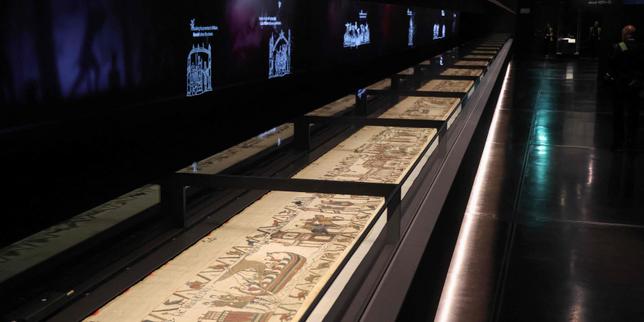
Moving a nearly one-thousand-year-old piece of embroidered linen across the English Channel sounds like a bad idea. Experts panicked. Critics shouted. Yet the historic transfer happened anyway, landing the famous medieval treasure right inside the British Museum for a blockbuster exhibition that kicked off in September 2026.
Almost immediately, the microscopic checks began. Officials confirmed a minor casualty: the rupture of two tiny wool threads. Naturally, internet outrage flared up instantly. But the reality on the ground tells a much more nuanced story about the physical vulnerability of ancient artifacts versus the massive cultural diplomacy behind the scenes.
What Actually Happened During the Transport to London
The legendary artifact left Normandy on July 10, 2026, packed inside a heavily guarded, ultra-secure transport system designed to shield the fragile linen from humidity, vibration, and temperature shifts. Measuring roughly 70 meters long and consisting of nine stitched linen panels, the masterpiece has survived nearly a millennium of wars, revolutions, and shifting borders. Moving it was never going to be easy.
When the crate arrived in London, an initial quick look showed nothing alarming. But conservators didn't stop there. They performed a meticulous, centimeter-by-centimeter analysis under strict laboratory conditions. That close inspection revealed the breaking of just two individual threads.
French cultural authorities, including Culture Minister Catherine Pégard, quickly stepped in to calm public anxiety. They confirmed that the general condition of the artifact remains completely intact, rejecting claims of any major structural damage. Two broken threads out of thousands of square centimeters of wool embroidery sounds scary to newspaper headlines, but textile conservators view this level of minor wear as an almost inevitable risk whenever historic fabrics change climate or undergo handling.
The Cultural Frenzy Across the Channel
While conservators worried over microscopic threads, the British public lost their minds. London entered a state of full-blown "tapestry-mania". Tickets vanished instantly. Local shops rolled out themed merchandise, from high-end cushions to quirky local pub decorations.
Historians note that British enthusiasm for the embroidery runs much deeper than typical museum tourism. Because the narrative stitches together the events leading up to the 1066 Battle of Hastings—culminating in the defeat of King Harold—many across the UK view it as a foundational piece of their own national history, with some experts even suggesting it was originally embroidered on English soil.
King Charles III and French President Emmanuel Macron viewed the masterpiece together during an exclusive preview in early September. Both leaders hailed the loan as a powerful symbol of trust and cross-border cooperation, bypassing decades of past failed attempts to move the artifact in 1953 and 1966.
Why This Loan Matters Despite the Risks
You might wonder why officials would risk damaging a priceless cultural asset just for an exhibition. The answer comes down to preservation and politics. The Bayeux museum in France is preparing for major structural renovation work, meaning the textile needed to be safely housed and studied anyway.
Furthermore, high-profile international loans force institutions to pool their best scientific resources. The collaborative monitoring between French and British experts sets a high technical standard for how fragile textiles should be handled in the twenty-first century.
The exhibition is scheduled to run at the British Museum until July 2027. Once the London run wraps up, the artifact will return straight to France, where it will go on permanent display at its home museum alongside a scheduled restoration phase. Two broken threads won't stop history from marching forward, but it serves as a stark reminder of how fragile our physical connection to the past really is.
Check your travel dates if you plan to visit London before July 2027, because ticket demand remains exceptionally high.


