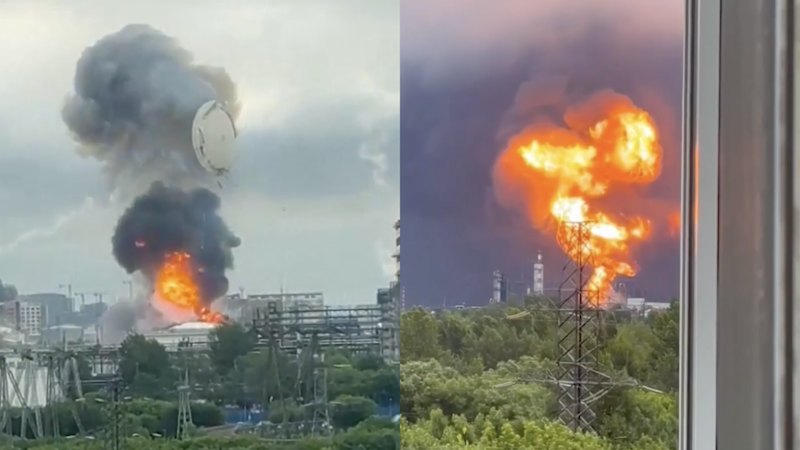
The video looked entirely fake. On the morning of June 18, 2026, a dome-shaped steel lid from a massive fuel storage tank rocketed straight into the sky above Kapotnya, riding a pillar of orange fire. It turned over and over in the air like a flipped coin before vanishing into a column of thick black smoke. Social media users immediately called it Hollywood CGI. It wasn't. It was the stark reality of the latest Moscow refinery drone strikes, a massive aerial raid that brought the economic realities of the frontline straight to the doorsteps of the Russian elite.
If you want to understand why Ukraine is launching hundreds of cheap, long-range drones deep into Russian territory, you don't need to look at complex military maps. You just need to look at Russia gas stations.
By hitting the Moscow Oil Refinery, known locally as the MNPZ, for the second time in a single week, Kyiv has answered a crucial question. Can long-range drones actually cripple a superpower energy infrastructure? The answer is a resounding yes. This isn't random symbolic bombing. It is a systematic, highly targeted dismantling of the refining capacity that keeps the Russian war machine moving and keeps Moscow lights on.
The morning the capital choked on soot
The attack started around four in the morning. For three agonizing hours, the sky above Moscow hummed with the sound of low-flying lawnmower engines. That sound is the signature of Ukrainian long-range strike drones. Moscow Mayor Sergei Sobyanin rushed to Telegram to claim that air defenses were working perfectly, later asserting that forces intercepted nearly 200 drones around the capital alone.
But air defense numbers don't mean much when the ones that get through find their targets perfectly.
Several drones slammed directly into the Gazprom Neft-owned facility in Kapotnya, located just 15 kilometers from the Kremlin. The refinery provides roughly 40 percent of the gasoline and fuel used in the capital region. Within minutes, columns of black smoke rose so high they altered the local weather. Residents in southeastern Moscow reported a bizarre, terrifying phenomenon: black rain. Drops of water mixed with thick oily soot fell from the sky, coating cars and parks in a grim layer of war residue.
This wasn't an isolated incident. While the capital burned, secondary strikes hit an oil storage facility in Gukovo, located in the Rostov region, igniting multiple commercial fuel tanks and cooking a locomotive on its tracks. The Russian defense ministry claimed to have downed 555 drones across the entire country overnight. Even if that massive number is true, the sheer volume of the swarm guarantees that a critical handful will always penetrate the defensive shield.
Why the Euro+ unit matters so much
To understand the sheer scale of the disaster for Gazprom Neft, you have to look past the dramatic footage of the flying fuel storage lid. The real damage happened deep inside the processing infrastructure. Industry sources confirmed that the June 18 strike heavily damaged the Euro+ combined oil refining unit.
This isn't just any piece of machinery. The Euro+ unit is the crown jewel of the refinery modernization program. It was commissioned in 2020 to replace old, inefficient equipment. It contains a primary crude distillation section with a capacity of 140,000 barrels per day. That single unit handles nearly half of the entire refinery total output. It also houses a catalytic reformer and a crucial diesel hydrotreating unit.
Compounding the problem, the refinery was already hobbled. Just two days earlier, on June 16, an initial drone wave hit the facility and set the ELOU-AVT-6 unit on fire. That strike knocked out one of the plant primary distillation columns, known as CDU-6. Engineers had spent 48 hours working frantically to reroute operations, planning to restart the Euro+ unit midweek to keep fuel flowing at half capacity.
This second strike completely vaporized those plans. With both primary distillation units damaged, inter-unit pipelines severed, and secondary units scorched, the MNPZ faces an extended, near-total operational shutdown. You can't fix these high-tech units with basic steel patches. They require highly specialized components that are incredibly difficult to source under international sanctions.
The lopsided math of modern drone warfare
The economics of this campaign are wildly uneven, and they favor the attacker completely.
Think about the math. A domestically manufactured Ukrainian long-range strike drone costs anywhere from twenty thousand to fifty thousand dollars. They are built using carbon fiber, basic fiberglass, and off-the-shelf civilian guidance systems.
On the flip side, a single interceptor missile fired from a Russian S-400 or Pantsir air defense system costs between several hundred thousand and several million dollars. When Ukraine sends a swarm of 137 or 180 drones toward a single city, they are intentionally trying to overwhelm the missile supply of the local air defenses.
If Russia fires all its interceptors to stop the first hundred drones, the remaining thirty or forty drones fly into defenseless airspace. Even if Russian guns shoot down ninety percent of the incoming targets, the ten percent that break through can cause hundreds of millions of dollars in structural damage. A fifty-thousand-dollar drone destroying a hundred-million-dollar refining unit is a trade Kyiv will make all day long.
A fuel crisis twenty-one years in the making
The long-term effects of these continuous drone raids are now hitting home across Russia. Experts tracking energy markets note that the country total oil refining capacity has plunged below four million barrels per day.
That is the lowest level recorded in 21 years.
Roughly one-third of the nation total refining capacity is currently sitting idle or completely offline due to fire damage. The supply shock has triggered widespread fuel shortages in more than 25 separate Russian regions. The situation has gotten so desperate that the Kremlin recently took the extraordinary step of rewriting environmental and quality laws. Refineries are now legally allowed to produce below-standard, low-octane gasoline just to keep pumps from running completely dry.
Imagine a major global oil exporter having to import fuel by sea. That is exactly what is happening in mid-2026. Russia is organizing fuel shipments to manage its domestic gasoline shortages. They are also facing massive aviation fuel restrictions.
Flight cancellations and gridlock in the capital
The immediate fallout of the Kapotnya strike extended far beyond the refinery perimeter. Rosaviatsiya, the Russian federal air transport agency, had to shut down the capital airspace completely during the attack.
All four major Moscow airports suspended operations:
- Sheremetyevo
- Vnukovo
- Domodedovo
- Zhukovsky
Sheremetyevo, the busiest hub in the country, took the rare step of evacuating thousands of passengers from its terminals into underground transit zones and safe areas outside the main flight paths. Aeroflot and its subsidiaries had to outright cancel more than 170 flights in a single morning, while leaving an additional 110 twisting in delays.
On the ground, authorities clamped down on the southeast capital. They closed major sections of the primary highway ring road running right past the burning refinery. Debris from intercepted drones also rained down on the Sadovod shopping center, a massive electronics and retail hub, setting a commercial pavilion on fire. In total, regional officials reported at least 17 civilians injured, including two children, mostly from falling shrapnel and shattered glass in residential high-rises.
What happens next for energy infrastructure
If you are tracking this conflict or looking at energy security, you need to prepare for a completely different environment over the coming months. The era of localized fighting is over. Long-range drone capabilities have effectively erased the geographic buffer zones that once protected deep Russian infrastructure.
Here are the immediate practical shifts you should watch for:
Anticipate localized fuel rationing
The loss of the MNPZ means a massive chunk of Moscow fuel supply is gone for the foreseeable future. Expect to see regional price caps, purchase limits at individual gas stations, and priority fuel routing for state and military vehicles. If you manage supply chains or logistics operating anywhere near western Russia, diversify your fueling nodes immediately.
Watch for rising global diesel premium prices
While Russia exports crude oil, the loss of its domestic refining capacity means it will consume more of its raw crude or export it unrefined, while pulling refined products out of global secondary markets. This structural shift will create volatile price spikes in diesel and jet fuel across international hubs.
Expect heavier security layers around critical assets
Any entity operating energy storage, power generation, or chemical processing plants in eastern Europe must re-evaluate its passive defense posture. Relying solely on military anti-air networks is a failed strategy. Facilities require localized physical netting, automated close-in weapon radar systems, and rapid-response industrial firefighting teams to survive the reality of modern drone swarms.
The black soot washing off the windshields of cars in Moscow isn't just dirt. It is proof that the economic foundations of the conflict have irrevocably shifted.