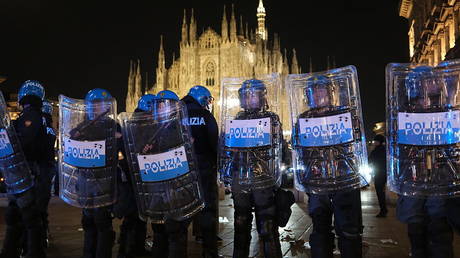
Tear gas filled the air around the iconic Duomo Cathedral as thousands of demonstrators squared off against riot police in downtown Milan. What started as a coordinated nationwide mobilization over the crushing cost of living quickly spiraled into chaotic street battles. High fuel and energy prices, skyrocketing rents, stagnating wages, and crumbling public services have pushed people to the edge. When peaceful intent collides with raw economic desperation, things break.
The protests were organized by Italia in Piazza, a movement largely driven by students and young workers. They wanted to draw attention to everyday survival struggles. Yet, as marches surged through major cities like Milan and Bologna, the atmosphere soured. Around 5,000 marchers took to the streets in Milan carrying banners demanding more money for families and less funding for foreign military campaigns. But peaceful demonstrations didn't stay peaceful.
When the march hit police cordons in the city center, a faction of masked participants turned aggressive. Stones, bottles, and homemade explosive devices flew toward officers. Police responded with baton charges and tear gas, splitting the crowd and pushing the chaos directly into tourist hubs.
Inside the Chaos at Piazza Duomo
The violence didn't stay contained to side streets. It spilled out into Piazza Duomo and the nearby luxury shopping arcade, the Galleria Vittorio Emanuele II. High-end retail stores rapidly lowered their security shutters as employees and shoppers scrambled for cover.
Protesters hurled metal security barriers, garbage bins, and furniture. They even lit barricades made from café tables on fire right in front of the historic cathedral. A police vehicle was kicked, pelted with stones, and forced into a frantic retreat amid shattered glass and thick smoke.
The human toll was immediate. Authorities detained roughly 50 people across Milan's hotspots, including Piazza Duomo and the San Babila district. Shockingly, almost half of those detained were minors. Local reports noted that at least four police officers and 20 protesters sustained injuries during the clashes.
Meanwhile, parallel riots unfolded in Bologna. Demonstrators marched from Piazza Minghetti toward the railway station, where another breakaway group pelted police with barriers and bottles. Officers fired over 400 tear gas canisters and deployed water cannons, forcing a precautionary shutdown of the rail hub. Thirty-six officers were injured in Bologna alone, highlighting how widespread the fury has become.
Political Fallout and Public Reaction
Prime Minister Giorgia Meloni didn't mince words after the smoke cleared. She accused violent agitators of hijacking legitimate public grievances to hold entire cities hostage. As she put it on social media, protesting remains a fundamental right, but setting urban centers ablaze is not.
Milan Mayor Giuseppe Sala took a slightly more nuanced stance. He admitted the underlying economic motivations of the protests were entirely understandable, but condemned the direct attacks on law enforcement and the vandalism of city landmarks.
These Italian riots don't exist in a vacuum. They mirror the fierce public sector and student unrest rolling through neighboring France, where citizens are similarly fighting back against deteriorating living standards and economic squeeze. When inflation outpaces wages by wide margins, street-level friction becomes inevitable.
Governments across Europe face a tough balancing act. Ignoring public rage fuels further extremism, while heavy-handed policing only hardens opposition lines. If economic pressures don't ease soon, downtown clashes will stop feeling like rare anomalies and start looking like the new normal.