Foreign policy speeches rarely take place against backdrops as heavy with history as the ruins of the Acropolis. Yet that is precisely where U.S. Secretary of State Marco Rubio chose to deliver his message on Western civilization. Standing in Athens, Greece, Rubio called on nations across Europe and North America to abandon modern complacency and return to their civilizational roots. It is a bold pitch, but it arrives at a time of intense friction between Washington and its traditional allies.
You don't have to look hard to see why this trip matters. Rubio's stop in Greece marks the second leg of a three-nation NATO tour that included Iceland and concludes in Portugal. The Trump administration is working overtime to mend fences and reassure European partners who feel sidelined or insulted by years of blunt diplomatic pressure. But behind the handshakes and diplomatic pleasantries lies a fundamental disagreement over what Western values actually mean in the modern era.
The Core Message from the Acropolis
Rubio’s speech focuses heavily on historical continuity. He intends to remind European listeners of the traits that built Western dominance: curiosity, courage, ambition, and a restless drive to explore the unknown.
According to excerpts distributed by the State Department, Rubio plans to address modern shifts directly. He argues that prioritizing an abstract "global community" over national loyalty weakens the state. He notes that the men of Ancient Greece understood that national loyalty isn't selfish, but rather a fundamental duty.
This isn't an accidental talking point. It reflects a broader ideological shift within the American right. Vice President JD Vance laid out similar themes at the Munich Security Conference, criticizing Europe for relying too heavily on American defense while ignoring its own security and immigration challenges. Rubio is delivering the same underlying philosophy, albeit with a smoother diplomatic touch.
Friction Points Across the Atlantic
Not everyone in Europe is buying the message. Relations between Washington and various European capitals have grown tense over recurring accusations that European democracies are backsliding. Washington frequently points to restrictions on conservative speech and lagging defense spending as proof of moral and strategic decay.
On the flip side, European leaders reject these lectures. They argue that American immigration policies and nationalist rhetoric clash with the very democratic principles the U.S. claims to champion.
The local reception in Athens showed just how raw those nerves are. Before Rubio even stepped up to deliver his remarks, roughly 1,500 demonstrators gathered to protest his visit and the ongoing war in Iran. Organized by a communist labor union and allied left-wing groups, protesters chanted slogans against American foreign policy. Police banned public demonstrations in central Athens for the day, but the underlying anger was impossible to ignore.
Navigating Local Scandals
Diplomacy rarely happens in a vacuum, and Rubio's trip is complicated by domestic turbulence surrounding the U.S. embassy in Athens. U.S. Ambassador to Greece Kimberly Guilfoyle has faced serious allegations of professional misconduct. Reports surfaced indicating she told guests at a reception that the United States could undermine the Greek government if it chose to, while also improperly promoting the commercial interests of a specific local construction and energy firm.
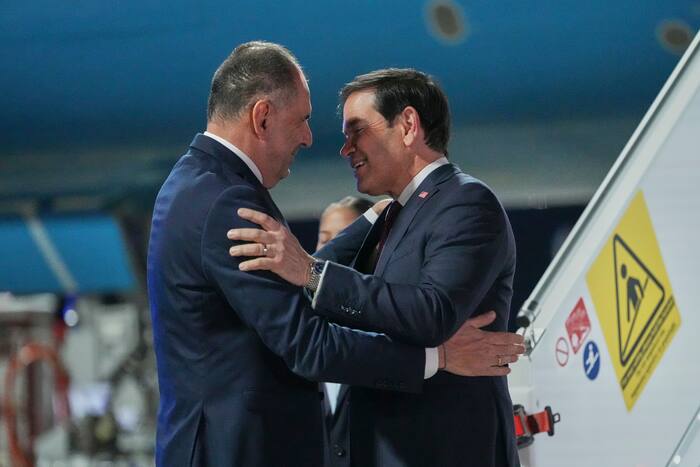
Top Democrats on the Senate Foreign Relations and House Foreign Affairs committees, including Sen. Jeanne Shaheen and Rep. Gregory Meeks, launched formal probes into the claims. Guilfoyle has denied any wrongdoing, and Rubio dodged reporters' questions on the matter during a joint news conference with Greek Foreign Minister George Gerapetritis. Instead, Rubio praised the embassy's output and backed the ambassador, but the controversy hangs over the visit like a persistent shadow.
What Iceland and NATO Reveal About Strategy
Rubio’s current tour offers a clear window into how the current administration conducts foreign policy. In Iceland, Rubio visited the site of the historic 1986 summit between Ronald Reagan and Mikhail Gorbachev. That stop was designed to ease Reykjavik's fears after President Donald Trump posted maps hinting at territorial ambitions in the Arctic and North Atlantic.
Rubio managed to calm those waters by promising that the U.S. would take no action in Iceland without local consent, emphasizing shared concerns over Russian activity in the High North.
The strategy is clear: project strength, demand accountability from allies on defense and values, but pull back before alienating them completely. Whether this tough-love approach can actually restore the founding principles of Western alliance systems remains an open question. The next decade will test whether these partnerships can adapt or break under the strain of competing national interests.