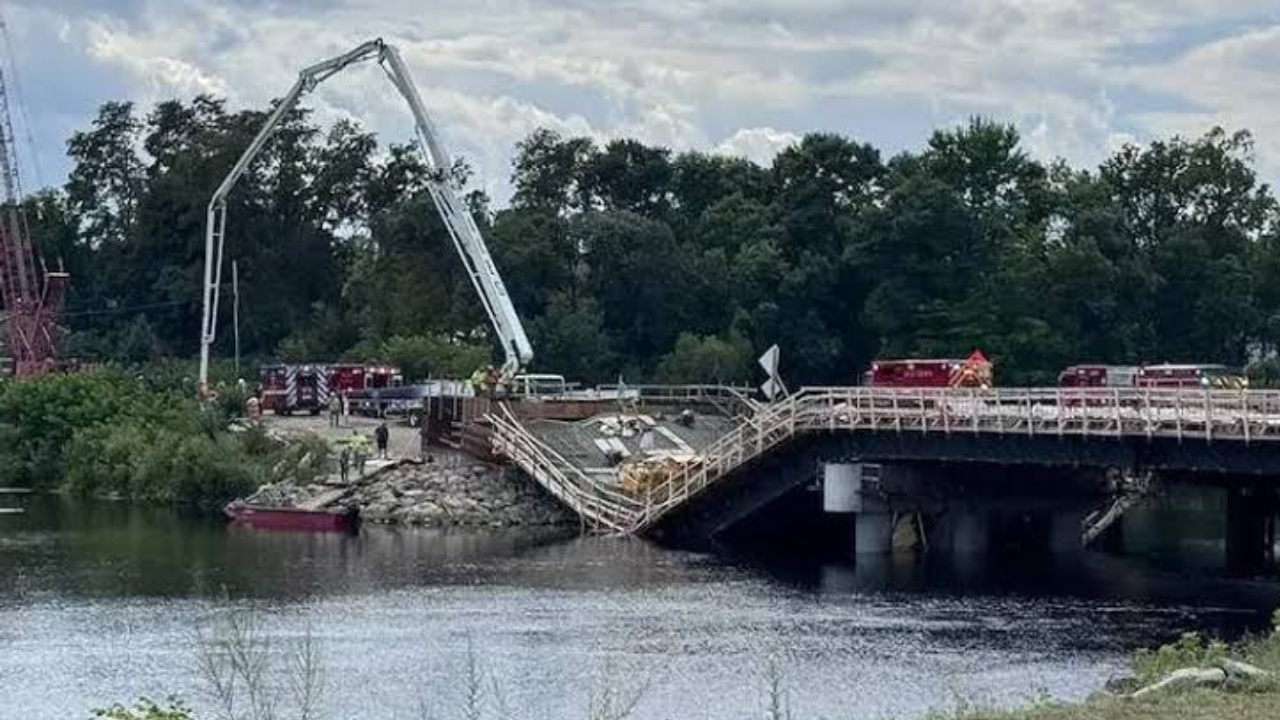
Civil engineering projects rarely collapse while people are watching, but that is precisely what happened on August 13 over the Stillwater River in Old Town, Maine.
Workers were in the middle of pouring wet concrete for the brand-new Llewellyn Estes Bridge deck when a major span buckled and crashed into the water below. Several construction workers were injured in the sudden drop, halting a critical infrastructure replacement project. Two months later, heavy equipment operators are back at the site—not to finish building, but to tear the damaged spans apart piece by piece.
If you have ever wondered how major civil engineering failures get handled in real life, the cleanup operation on the Stillwater River gives you a brutal front-row seat.
The Reality of Bridge Demolition Over Water
Tearing down a collapsed bridge is harder than building a new one. When concrete and steel fail under load, the structural integrity of the remaining pieces becomes completely unpredictable.
Crews from contractor Reed & Reed, Inc. started the tedious dismantling process by setting up heavy machinery above the river. Operating massive cranes near a collapsed site requires extreme caution. Operators must cut the ruined concrete and steel into manageable chunks while hanging over the water, making sure they don't compromise the surviving piers and abutments underneath.
Once cut, the heavy debris gets hoisted out of the river and hauled to dry land for processing. It's slow, expensive, and completely necessary. You cannot start pouring new concrete until every last ounce of the failed structure is gone.
Managing Traffic Chaos in Old Town
Demolishing a collapsed river crossing wreaks havoc on local logistics. To give cranes and transport trucks the working room they need, the Maine Department of Transportation had to roll out daytime road closures on the nearby temporary bridge carrying Stillwater Avenue.
Drivers crossing through Old Town face rolling closures between 9 am and 3 pm. State transportation officials set up a signed detour routing traffic along Bennoch Road, North Main Street, and College Avenue.
Local commuters quickly learned that patience is mandatory. While the temporary bridge itself survived the collapse without structural damage—verified by state inspectors right after the accident—the heavy lifting happening right next to it demands tight safety zones. Traffic teams expect these daytime disruptions to ease up as demolition crews move farther away from the active detour lane.
The Multi-Agency Investigation Into Why It Failed
Catastrophic structural failures trigger intense accountability. MaineDOT didn't just guess why the bridge failed; they launched a joint forensic investigation alongside the Federal Highway Administration's Turner-Fairbank Highway Research Center.
The review team reads like a Who's Who of structural engineering. It includes the prime contractor Reed & Reed, beam designer and manufacturer Basalt Engineering International, and the Advanced Structures and Composites Center.
Investigators gathered material samples straight from the river debris. They are pouring over design calculations, material fabrication logs, and the exact sequencing used during the concrete deck pour. A bridge span doesn't fail on a sunny August afternoon without a reason. Pinpointing whether the flaw sat in the concrete mix, the beam design, or the pouring procedure is the only way to ensure the replacement bridge doesn't suffer the same fate.
What Happens Next for Maine Infrastructure
Penobscot County relies heavily on these river crossings. The original Llewellyn Estes Bridge was old and aging out, which is why Maine started the replacement initiative in the first place.
Once the river cleanup finishes and all damaged spans are hauled away, engineers will inspect the exposed foundation piers. They need to verify that the sudden collapse shockwave didn't hairline-crack the foundational concrete below the waterline.
Rebuilding will only start after the joint investigation delivers definitive answers. Public safety remains the absolute priority, and state transportation officials are keeping local communities updated as cleanup milestones pass.
Infrastructure renewal is messy, expensive, and occasionally dangerous. When things go wrong, tearing it down and starting over is the only responsible path forward.