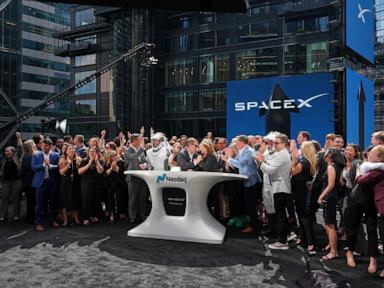
Wall Street banks want you to buy the newly public SpaceX stock, but retail investors aren't biting. The company went public on June 12, 2026, opening at $150 per share and quickly crossing $200 during its first week. Since that initial burst, the stock has limped back down to around $152. Underwriters are practically begging people to look at the upside, yet the market is flashing a clear sign of hesitation.
Why the massive disconnect between billionaire banking analysts and everyday traders? If you enjoyed this piece, you might want to look at: this related article.
Investment firms like J.P. Morgan and Raymond James view SpaceX as a generational infrastructure play, comparable to the expansion of railroads or the birth of the internet. They see a company with a near-monopoly on orbital rocket launches. Retail investors see something else entirely. They see a $2 trillion valuation built on tech that hasn't been perfected yet, paired with wild promises about putting data centers in orbit and colonizing Mars.
The Trillion Dollar Gap Between Hype and Reality
Big banks published their initial research notes recently, slapping the stock with aggressive buy recommendations. J.P. Morgan expects the price to hit $225 by late 2027. Raymond James went full moonshot, claiming the stock will eventually hit $800, cementing SpaceX as the definitive industrial giant of the 21st century. For another perspective on this event, check out the recent update from The Motley Fool.
Their bull case rests on three distinct pillars.
- Launch Dominance: The Falcon 9 rocket family handles the vast majority of all payloads heading into space, achieving an astonishing 99% success rate across roughly 670 orbital launches.
- The Starlink Cash Cow: Starlink broadband satellites bring in steady, predictable revenue right now, keeping the lights on while the company builds bigger things.
- AI and Space Infrastructure: Analysts love the idea of orbital data centers powered by AI innovations, a concept Elon Musk hopes to fund using public capital.
The problem is that the market cap already prices in perfection. At a $2 trillion valuation, Elon Musk briefly became the world's first trillionaire when the stock spiked. But values based on future fantasies rarely hold up when macro economic reality sets in.
Why Smart Money is Staying Grounded
Look at the underlying risks and you start to see why the stock is sitting flat. Equity research firm MoffettNathanson took a refreshing, skeptical stance, issuing a neutral rating with a price target of $131. They correctly pointed out that buying SpaceX today is a blind bet on a company whose grandest plans rely on unproven engineering.
The Starship Bottleneck
The Falcon 9 is a workhorse, but it's too small to carry the next generation of space infrastructure. The path to massive growth requires Starship. Right now, Starship is still heavily in its testing phase. If the company fails to establish a predictable, high-frequency launch schedule for Starship, the financial models used by big banks will completely collapse.
Orbital Data Centers Don't Exist Yet
Wall Street loves a buzzword. Right now, that buzzword is AI. Underwriters claim SpaceX will launch space-based data centers, avoiding terrestrial energy constraints. It sounds amazing over coffee. In reality, the technology to operate complex, liquid-cooled AI data centers in a vacuum does not exist.
Regulatory and Demand Unknowns
The Federal Aviation Administration (FAA) and international regulators don't move at the speed of Elon Musk. Environmental reviews, launch license delays, and geopolitical pushback present a constant drag on operations. Furthermore, we don't actually know if commercial demand for space infrastructure matches the massive supply SpaceX plans to build.
How to Handle the SpaceX Hype Cycle
If you're holding cash and wondering whether to buy this dip, stop overthinking it. The stock is volatile because it's caught between two opposing forces: institutional hype and retail skepticism.
Don't buy into the Raymond James $800 target assuming it's a sure thing. Treat this asset for what it is—a highly speculative, long-term infrastructure play with a massive regulatory target on its back.
If you want exposure to the space economy without taking on the extreme valuation risk of SpaceX, look toward established aerospace defense contractors or diversified tech firms that supply the components for satellite communications. For those determined to own a piece of Musk's rocket company, scale in slowly using dollar-cost averaging rather than throwing a lump sum at a stock struggling to hold its IPO opening price. Keep your position size small enough that a Starship testing setback won't break your portfolio.