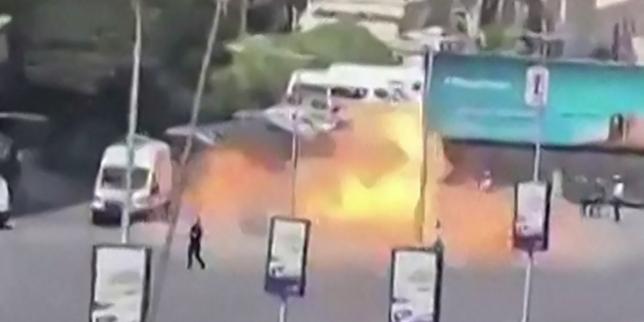
Two crude bombs exploded in central Damascus this morning. One was stuffed into a trash bin, the other rigged inside a parked car. The blast shattered windows, sent smoke billowing past the Ministry of Tourism, and left 18 people wounded, including four traffic cops who were standing right next to the dumpster when it detonated.
The real target wasn't the police. The improvised explosive devices went off right outside the Four Seasons Hotel. That is exactly where French President Emmanuel Macron had just spent the night.
Macron didn't hear the blasts. He had left for the presidential palace roughly 15 minutes earlier. By the time the smoke cleared, he was already shaking hands with Ahmed al-Shara, the transitional leader who took power after Bashar al-Assad fell in December 2024.
This is the chaotic, high-stakes reality of the new Syria. Macron’s visit makes him the first major Western leader to set foot in the country in nearly two decades. The Élysée Palace quickly rolled out the standard damage control, insisting the French delegation was completely safe and that the official program would continue as planned.
Honestly, nobody should be surprised by the bombs. Syria is in a fragile transition, and today’s blasts prove that projecting stability is a lot harder than signing diplomatic papers.
The Mirage of a Safe Damascus
The Syrian interior ministry scrambled to claim the explosions happened outside the official security perimeter. They wanted to make it look like a minor security hiccup rather than a targeted assassination attempt. It doesn't matter how they spin it. The Four Seasons is the most heavily fortified, heavily guarded building in Damascus. It houses UN staff, diplomats, and international delegations. If someone can plant two bombs right on its doorstep, nobody is truly safe.
This is the second major security breach in less than a week. Just last Thursday, a bomb ripped through a busy cafe near the Justice Palace, killing 10 people.
The security vacuum is real. Al-Shara’s government is desperately trying to signal to the world that the civil war era is over. They want foreign capital, they want tourists, and they want legitimacy. Instead, they are getting a harsh reminder that Assad’s remnants, Islamic State cells, and various armed factions are still highly capable of causing chaos.
Why France Is Leading the Charge
You have to look at what happened after the smoke cleared to understand why Macron is risking his life in Damascus. Instead of cutting the trip short, the French president doubled down. He posted a defiant statement on X about a "sovereign, safe, pluralistic" Syria. Then his delegation got straight to business.
This isn't just about diplomacy. It's about a massive economic gamble. Macron didn't travel alone; he brought a heavy-hitting economic delegation, including TotalEnergies CEO Patrick Pouyanné and Rodolphe Saadé, the billionaire head of shipping giant CMA CGM.
Before the day was out, French companies signed more than a dozen major agreements. Here is what France is walking away with:
- A major infrastructure deal to rebuild water and electricity networks in Homs.
- A capacity-building contract for Damascus airport, handed directly to CMA CGM.
- An agreement to provide technical assistance to Syria’s central bank.
- The framework to return over £43 million in illicit assets seized from Rifaat al-Assad, the late dictator's uncle who fled to France years ago.
Macron and al-Shara also announced they are officially appointing ambassadors, fully restoring diplomatic ties that France severed back in 2012.
The Dangerous Normalization of Ahmed al-Shara
The French strategy is incredibly controversial. Ahmed al-Shara used to be known as Abu Mohammad al-Julani, the head of Hayat Tahrir al-Sham, a group with deep historic roots in al-Qaeda.
France has quietly emerged as al-Shara's biggest champion in the West. Paris lobbied Washington to drop anti-Syria sanctions and even played a quiet role in mediating between the new Syrian government and Israel. Macron hosted al-Shara in Paris back in May 2025, paving the way for the Syrian leader's subsequent trip to Washington.
Critics say Macron is moving way too fast, sanitizing a former Islamist fighter in exchange for lucrative rebuilding contracts. Macron’s defenders argue that the alternative is letting Syria collapse back into total anarchy or watching Russia and China buy up the entire country's infrastructure.
What Happens Next
If you are watching Syria’s reconstruction, today’s events offer a stark blueprint of what to expect over the next few years. The political transition is moving at lightning speed, but the physical security on the ground cannot keep up.
For businesses and observers looking at the region, expect a highly volatile environment where multi-million dollar corporate contracts coexist with roadside IEDs. Damascus is open for business, but the price of admission is incredibly high.
Monitor the upcoming joint security statements from Paris and Damascus over the next 48 hours to see if any specific group claims responsibility for the Four Seasons blasts.