Lindsey Graham spent more than three decades in Washington proving that the only permanent thing in politics is survival. His sudden death on July 11, 2026, at the age of 71, brings down the curtain on one of the most fascinating, infuriating, and contradictory careers in modern American political history. He died following a brief and sudden illness, just days after returning from his tenth trip to Ukraine, where he met with President Volodymyr Zelenskyy.
For years, mainstream political analysts treated Graham as a puzzle to be solved. How does a man go from being John McCain’s loyal ideological co-pilot to Donald Trump’s favorite golfing buddy and Capitol Hill defender? The simple answer, favored by his critics, was pure opportunism. They saw a man who needed the shadow of a stronger figure to thrive. But reducing Graham to a mere political chameleon misses the deeper, more complicated reality of how he viewed power.
He understood that to change the world, you have to stay in the room where the decisions are made. When the Republican party shifted beneath his feet, he didn't fight the tide. He rode it.
From the Back of a Pool Hall to the Halls of Power
You can't understand his political trajectory without looking at where he started. Born in Central, South Carolina, Graham grew up in a room behind the pool hall his parents ran. It was a tough, working-class existence. When he was a college student at the University of South Carolina, both of his parents died within a year of each other. He had to adopt his sister to ensure she was cared for.
That kind of early trauma breeds a specific type of resilience. It also teaches you to value security and alliances. He found his first major institutional home in the military, serving as an Air Force Judge Advocate General lawyer. This background shaped his worldview permanently. For the rest of his life, he viewed international relations through a strictly legalistic and militaristic lens.
He entered the U.S. House of Representatives in the historic Republican wave of 1994. He quickly made a name for himself as a fierce partisan, serving as one of the managers during the 1998 impeachment trial of Bill Clinton. Yet, when he transitioned to the Senate in 2003, filling the seat of the legendary segregationist Strom Thurmond, he chose a completely different path. He allied himself with John McCain.
The Maverick Years and the Cult of Intervention
For over a decade, McCain and Graham were inseparable. Together with Senator Joe Lieberman, they were dubbed the Three Amigos. They traveled to global hotspots, routinely demanding a more aggressive U.S. foreign policy. If there was an international crisis, Graham’s solution almost always involved American military power.
During this era, he wasn't popular with the rising populist wing of his own party. He worked across the aisle on immigration reform, famously joining the "Gang of Eight" in 2013 to craft a compromise bill that included a path to citizenship. He voted to confirm Barack Obama’s Supreme Court nominees, Sonia Sotomayor and Elena Kagan. He believed the presidency deserved deference on judicial appointments.
Conservative activists back home hated it. They labeled him "Lindsey Grahamaham" and threatened to primary him every six years. He always survived. He outmaneuvered his opponents by maintaining deep ties to local South Carolina business leaders and military installations. He was a master of retail politics. He could charm a room full of skeptical Tea Party activists with sharp wit and self-deprecating humor.
Then came 2015. Donald Trump came down the golden escalator, and the ground shifted.
The Great Pivot of 2016
During the 2016 Republican presidential primaries, Graham was Trump’s most vocal critic. He didn't mince words. He called Trump a "race-baiting, xenophobic, religious bigot." He said Trump was a disaster for foreign policy and predicted the Republican party would get destroyed if they nominated him. He famously remarked that choosing between Trump and Ted Cruz was like choosing between being shot or poisoned.
When Trump won, most people expected Graham to join the permanent "Never Trump" resistance alongside figures like Mitt Romney. Instead, he did a complete about-face. Within months of Trump taking office, Graham was on the golf course with him.
This wasn't an accident. It was a calculated strategy. Graham saw that McCain's brand of internationalism was dying within the GOP. He realized that if he remained a vocal critic, he would lose all influence over foreign policy and judicial selections. By becoming a confidant, he could guide the new president.
He became a political whisperer to the president. When Trump wanted to pull all U.S. troops out of Syria, Graham intervened, convincing him to leave a residual force to protect oil fields. When Trump threatened to pull out of South Korea, Graham explained the strategic disaster that would follow. He traded public praise for private policy concessions.
The Kavanaugh Hearing and the Hardline Turn
The turning point that solidified his status with the MAGA base came during the 2018 Supreme Court confirmation hearings for Brett Kavanaugh. Up until that moment, many grassroots conservatives still viewed him with deep suspicion.
During a dramatic committee session, he dropped his usual folksy demeanor. He turned on his Democratic colleagues with genuine, shaking rage. He called the hearings the most unethical sham he had ever witnessed in his political life.
That single, explosive performance changed everything. He became a hero to the Republican base overnight. He won his 2020 re-election campaign against a heavily funded Democratic challenger, Jaime Harrison, by a comfortable margin. He had successfully remade himself as a warrior for the conservative movement.
Standing Firm on Ukraine Until the Very End
Even as he embraced populist domestic politics, his core commitment to American global dominance never wavered. This created a fascinating paradox in his final years. While a large portion of the modern Republican party moved toward isolationism, Graham remained an unyielding hawk.
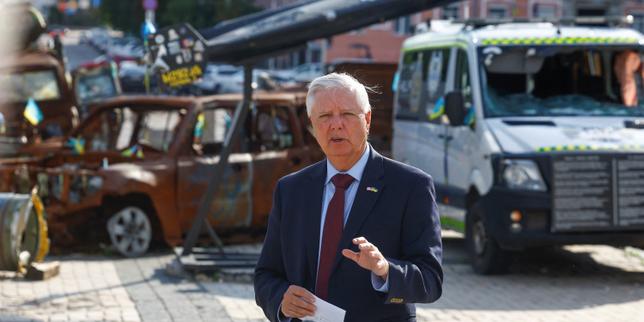
His dedication to Ukraine was the perfect example. While other lawmakers wavered on aid packages, Graham visited Kyiv repeatedly. He struck deals with Democrats to keep the weapons flowing. Just days before his sudden death, he stood next to Zelenskyy, pledging that America would not walk away. He was working on a major new sanctions bill against Russia at the very moment he fell ill.
Israeli Prime Minister Benjamin Netanyahu called him one of Israel's greatest friends. Trump released a statement calling him a true American patriot who was always working. This dual praise from both the populist leader of the GOP and traditional international allies shows the tightrope he walked.
The Empty Seat in the Senate
His passing leaves a massive void in the U.S. Senate and throws South Carolina politics into immediate turmoil. Governor Henry McMaster faces the task of appointing a temporary replacement to serve until a special election can be held.
The balance of power within the Senate Republican caucus is now fundamentally altered. Graham was a bridge between the old guard institutionalists and the new wave of populist firebrands. Without his deal-making skills and institutional memory, partisan gridlock on Capitol Hill will likely worsen.
He leaves behind no spouse or children, only a massive political legacy that will be debated for decades. He was a man who chose access over purity. He believed that holding power was more useful than holding a grudge. Whether history judges him as a pragmatist who saved the country from its worst impulses or an enabler who abandoned his principles, one thing is certain. We won't see another politician quite like him anytime soon.
If you want to understand the modern political landscape, look closely at the life of the senior senator from South Carolina. He didn't create the current era of American politics. He just figured out exactly how to survive it.