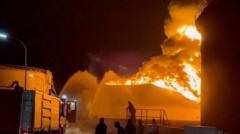
Thick black smoke billows into the sky over Zawiya, and nobody who watches Libyan energy politics closely is actually surprised. Another massive blaze broke out at the country's primary operating refinery, a facility handling tens of thousands of barrels daily. When a diesel storage tank holding millions of liters of fuel takes a direct hit, it's not just a local emergency. It's a flashing red light for an entire nation's economic lifeline.
Let's look at what's really happening on the ground.
The Reality Behind the Zawiya Refinery Blazes
The recent strike on the Zawiya oil depot—situated roughly forty kilometers west of Tripoli—wasn't an isolated accident. This facility, boasting a processing capacity of 120,000 barrels per day, functions as the beating heart of domestic fuel distribution. It links directly to the massive Sharara oilfield. When local safety crews scramble to contain these fires, they are fighting more than just flames. They're battling years of unchecked militia friction, security vacuums, and infrastructure neglect.
Just days prior to the major diesel tank fire, a drone incident targeted an untreated naphtha tank at the same complex. Emergency response teams managed to control that initial leak, but the escalation happened fast. State oil entities like the Brega Petroleum Marketing Company and the National Oil Corporation (NOC) found themselves forced to declare extreme states of emergency.
Why does this keep happening?
The Fragile State of North African Energy
Energy production in fractured political landscapes is always walking a tightrope. Libya has spent over a decade divided between rival political authorities, leaving critical infrastructure exposed to localized conflicts and shadowy security threats. Armed groups and shifting alliances treat strategic assets like chess pieces.
When storage tanks containing millions of liters of gasoline become direct targets, the economic fallout spreads instantly. Local engineers try to keep baseline operations going where possible, but continuous security breaches make stability impossible. Force majeure declarations become routine, and ordinary citizens bear the brunt of fuel shortages and environmental hazards.
What Comes Next for the Region
Fixing a burnt fuel tank is simple engineering. Fixing the security matrix around western Libya's oil hubs is an entirely different challenge. Until federal and local security forces establish a genuine perimeter of accountability around assets like the Zawiya complex, these emergency response brigades will keep finding themselves on the front lines of avoidable disasters.
Take a look at the operational updates from the National Oil Corporation to track how distribution recovery holds up against ongoing security threats.
Large fire breaks out at oil facility in crisis-hit Lebanon
This video provides context on how sudden industrial fires at critical fuel installations impact regional stability and emergency response efforts.
http://googleusercontent.com/youtube_content/1