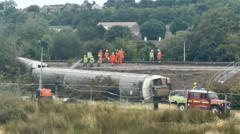
The recent train derailment in Lewes didn't come out of nowhere. We now know that a significant track defect existed well before the incident on August 13. An interim report from the Rail Accident Investigation Branch (RAIB) confirms that CCTV footage from previous services captured a "track geometry irregularity" at the exact location where the Southern train eventually went off the rails.
Honestly, it’s frustrating. People had been reporting "rough riding" on that specific stretch for a while. When passengers complain about a bumpy journey, they aren't just being difficult. They're providing real-time data that the infrastructure owners clearly failed to act on quickly enough.
The heat factor and why tracks buckle
The accident occurred during a sweltering stretch of weather, hitting 27C. Steel tracks expand in the heat. If they can’t expand properly, they buckle. That’s basic physics. The RAIB has already released imagery showing the track looking distinctly warped—a classic sign of heat-related stress.
But don't just blame the thermometer. The track sits on a clay embankment. Clay is notoriously temperamental. It expands and contracts based on moisture content. When you combine sustained hot, dry weather with an unstable clay base, you’re creating a recipe for geometric nightmares. The RAIB noted that while there's no immediate evidence of a massive embankment slip, there’s clear proof of previous ground movement.
Why this matters for the broader network
With 30 people injured—some seriously—we need to talk about accountability. Network Rail and GTR have apologized, which is the standard PR move, but apologies don't fix broken infrastructure.
The train was moving at 65mph, which was within the 70mph limit. That’s the scary part. The operator was following the rules, yet the equipment failed beneath them. If the infrastructure can't handle the weather conditions we're seeing in 2026, the speed limits are effectively meaningless.
The investigation isn't over
The RAIB report is only an interim look. They’re still digging into:
- The maintenance history of that specific section.
- How effective the heat-mitigation measures actually were.
- Whether the track inspection cycles are frequent enough for modern climate realities.
We’re likely looking at a year or more before the final verdict. That feels like a lifetime when you’re a daily commuter.
What happens next
If you travel this line, you’re dealing with closures until at least August 26. Recovery is a massive logistical headache. They have to lift carriages with cranes while preserving evidence for the investigation.
Moving forward, the industry needs to stop treating "rough riding" reports as customer complaints and start treating them as potential emergency warnings. If passengers feel the track is faulty, it probably is. The rail authorities need to tighten their inspection protocols and stop waiting for accidents to happen before they acknowledge that a stretch of track has become a hazard.
Check your local schedules before you head out. Don't assume that just because a line is open, it's operating at full capacity. We deserve a network that prioritizes safety over standard operations. It's time they prove it.