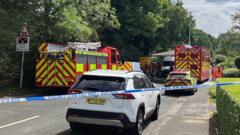
A devastating collision on Thursday morning reminds us that level crossings remain the most volatile intersections on our transport network. At roughly 8:50 am on 25 June 2026, a passenger train slammed into a car at a level crossing on Station Road in Hoghton, a village near Preston.
The consequences were swift and catastrophic. One occupant of the vehicle died at the scene. A child who was also inside the car sustained life-threatening injuries and had to be airlifted straight to Alder Hey Children's Hospital in Liverpool. It's a horrific scenario that makes you question how these intersections can still prove so incredibly deadly.
Emergency services descended on the Lancashire village in force. The North West Ambulance Service deployed several clinical teams, including their specialized hazardous area response team and two separate air ambulances. Fire crews and British Transport Police officers joined local South Ribble police to manage the chaotic scene. Onboard the train—the 7:51 am service traveling from Colne to Preston—no passengers or rail staff required medical treatment.
The Tragic Mechanics of Train and Car Collisions
The massive disparity in weight and momentum means a car stands absolutely no chance against a moving train. When a three-carriage passenger train travels at typical line speeds, it can take up to a full mile to stop completely, even after the driver slams on the emergency brakes.
In the immediate aftermath of the Hoghton tragedy, British Transport Police confirmed that two people have been arrested in connection with the incident. Investigations are currently underway to map out exactly why the vehicle was on the tracks when the Colne to Preston service arrived.
For local commuters, the crash triggered an immediate shutdown of the rail network. National Rail announced that all train services between Preston and Blackburn were canceled, forcing hundreds of passengers onto replacement bus services. Road closures around Station Road snarled local morning traffic for hours as investigators combed through the debris.
What Most Drivers Get Wrong at Level Crossings
We see them all the time, but most people don't actually understand how different types of crossings operate. The crossing at Hoghton is just one of thousands across the UK rail network. These intersections are generally split into automatic half-barrier crossings, full-barrier crossings, and passive user-worked crossings.
Many drivers assume that if a barrier isn't fully down, it's safe to edge forward. This is a massive mistake. At automatic half-barrier setups, the barriers only block the left side of the road to stop cars from getting trapped on the tracks. But impatient drivers frequently try to weave around them, misjudging the speed of an oncoming train.
Important Safety Reality: A train traveling at 75 mph covers about 110 feet every single second. By the time you spot the headlight rounding a bend, you often have less than ten seconds to clear the tracks.
📖 Related: noticias de hoy washington dc
Network Rail data consistently shows that the vast majority of level crossing incidents are caused by motorist error, distraction, or deliberate risk-taking. People use their phones, follow satellite navigation blindly, or simply try to "beat the lights" because they don't want to wait the two or three minutes it takes for a train to pass.
How to Protect Yourself and Your Passengers
If you ever find yourself approaching a level crossing, you need to change your driving mindset immediately. Treat it with the same caution you would use near a cliff edge.
- Never stop on the yellow box. If there's traffic on the other side of the tracks, wait behind the white stop line until there's enough clear space for your entire vehicle to exit the crossing safely.
- Obey the flashing red lights. The amber light means stop unless you've already crossed the stop line. The twin flashing red lights mean you must stop immediately, even if the barriers haven't started moving yet.
- Turn down your music. You need to be able to hear the audible warning alarms and the horn of an approaching train.
- If your car stalls on the tracks, get everyone out immediately. Don't spend time trying to restart the engine or save personal belongings. Move everyone away from the tracks at a 45-degree angle toward the direction of the oncoming train. This ensures that if the train hits the car, the flying debris will be pushed away from you, not toward you.
The tragic event in Lancashire highlights a brutal truth. No matter how much money is spent on upgrading signals, safety ultimately relies on the decisions made by the person behind the wheel.
If you travel routes with active rail lines, take an extra five seconds to look twice. Never assume the timetable dictates when a train will appear. Freight trains, engineering services, and delayed passenger trains can run at any time of the day or night.



/LouvresengchyeteoGettyImages-5a14669aaad52b00370c599e.jpg)