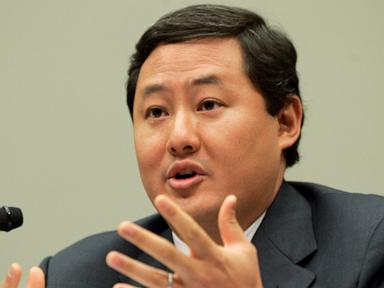
The Justice Department is digging into a massive conspiracy investigation, and they just brought in one of the most controversial legal minds of the last quarter-century. John Yoo confirmed he is officially advising the federal team looking into whether intelligence and law enforcement officials broke the law to target Donald Trump.
If that name rings a bell, it should. Yoo is the UC Berkeley law professor who wrote the infamous George W. Bush-era "torture memos" that greenlit waterboarding after September 11. He's arguably the nation's most famous champion of radical, near-limitless presidential power. Putting him on this specific team sends a massive signal about where this investigation is heading. Also making news in this space: Why Trump's Claim Of A Doha Meeting On The Denuclearisation Of Iran Is Raising Major Eyebrows.
The probe itself is run by Joe diGenova, a former U.S. attorney brought back into the Justice Department fold earlier this spring. When asked about Yoo's involvement, diGenova kept it brief. "He's a lawyer. He's going to be helping us," he said. They aren't tipping their hand entirely, but we can piece together exactly what this means for the legal chessboard. Further details on this are covered by TIME.
The Hunt for the Deep State Conspiracy
This isn't a casual review. The team based out of Florida is weaponizing a broad swath of subpoenas, hunting down internal records, and dragging former officials in for interviews. They want to know exactly how the January 2017 Intelligence Community Assessment came together—the landmark report concluding that Russia actively interfered in the 2016 election to boost Trump over Hillary Clinton.
Trump has spent nearly a decade calling that narrative a hoax designed to bring him down. He wants accountability, or more accurately, retribution. Acting Attorney General Todd Blanche made the administration's goals crystal clear during a Fox News appearance, flatly stating that a long-running conspiracy to target Trump is "exactly what we're investigating right now."
But here's the elephant in the room. Multiple high-level investigations have already picked apart the 2016 Russia probe. The inspector general looked at it. Special Counsel John Durham spent years looking at it. Did they find mistakes? Absolutely. A former FBI lawyer even pleaded guilty in 2020 to altering an email used for a surveillance warrant. But none of those multi-year, multi-million-dollar reviews ever found a sweeping criminal conspiracy by senior intelligence or law enforcement bosses.
Enter the Architect of Executive Power
To understand why Yoo is here, you have to look past the "torture memo" headlines and focus on his actual legal philosophy. Yoo doesn't view the presidency the way most constitutional scholars do. He believes in the unitary executive theory, an interpretation of Article II of the Constitution suggesting the president holds total control over the entire executive branch.
In Yoo's world, independent agencies like the FBI or the CIA don't really have the right to operate outside the president's direct command. If career officials use their power to actively undermine or scrutinize their own commander-in-chief, Yoo doesn't just see a policy disagreement. He sees a fundamental violation of constitutional order.
He's also shown a willingness to stretch legal boundaries to their absolute limits to serve an administration's goals. Years ago, he told Trump officials that a Supreme Court ruling on DACA actually opened a backdoor to massive new executive actions. He doesn't play defense; he designs offensive legal frameworks.
Why This Changes the Legal Landscape
By bringing Yoo onto diGenova's team, prosecutors are likely building a complex legal theory to criminalize bureaucratic resistance. They aren't just looking for simple procedural errors anymore. They are likely trying to construct a case that senior officials willfully crossed the line into an illegal conspiracy by weaponizing the machinery of the state against a political candidate and sitting president.
It is a high-stakes, incredibly dangerous strategy. If they fail to secure indictments, it looks like a purely political stunt using taxpayer dollars. If they succeed, it fundamentally alters how the federal bureaucracy operates, signaling to every career intelligence analyst and federal agent that crossing the White House can land you in a federal courtroom.
The Florida grand jury is still spinning, and the subpoenas are still flying out. We don't know yet if a single charge will stick. But with John Yoo writing the legal playbook, you can bet the arguments will be aggressive, expansive, and entirely focused on tearing down the traditional boundaries of federal law enforcement.
Action Steps for Following the Investigation
Tracking high-profile federal probes can get messy fast. If you want to cut through the political noise and follow this story like an expert, keep these specific strategies in mind:
- Monitor the Florida Court Dockets: This probe is operating out of federal courts in Florida. Watch for motion filings or sudden grand jury activity, which will leak through defense attorneys long before formal announcements.
- Check the Statutory Baseline: Read up on 18 U.S. Code Section 371 (Conspiracy to defraud the United States). This is the specific legal mechanism prosecutors use when arguing that government officials conspired to interfere with legitimate government functions.
- Look for the Demurrers: If indictments drop, the defense will immediately file motions to dismiss based on executive immunity or prosecutorial overreach. Pay close attention to how judges react to these structural constitutional challenges.