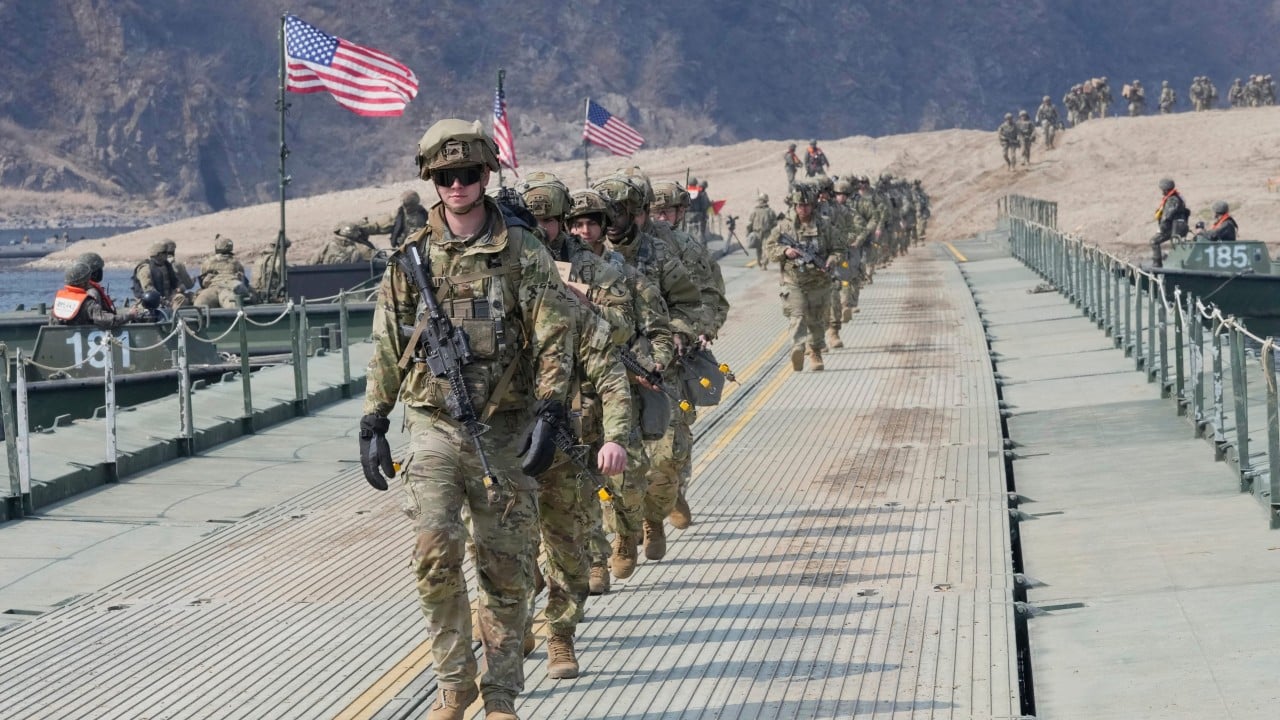
Geopolitics used to be relatively predictable in East Asia. Washington held the umbrella, Seoul and Tokyo built powerhouse economies under its shade, and everyone knew where the boundaries lay.
Those days are over.
With Washington shifting its priorities and domestic politics rewriting old rules, the security architecture of East Asia is fracturing. For decades, Japan and South Korea relied heavily on American defense guarantees to keep regional threats at bay. But the foundation of that trust has eroded, forcing the two neighbors to look at each other with fresh urgency.
During the June 2026 Jeju Forum for Peace and Prosperity on Jeju Island, former Japanese Foreign and Defense Minister Taro Kono made the situation blunt. He stated that when you strip away the distance and look purely at geography, Japan and South Korea only have each other.
The Reality of American Retreat
The growing unease across the East Sea—or Sea of Japan—is not a sudden panic. It is a calculated reaction to structural shifts in Washington that began during Donald Trump's first presidential term and have lingered long after.
Regional stability on the Korean peninsula historically flowed from the strength and political will of the United States. Today, regional leaders are openly questioning that long-term commitment. The security environment of the Cold War, or even the immediate decades following it, will not return.
Europe can theoretically manage a Plan B defense strategy without Washington due to the collective framework of NATO. The Indo-Pacific enjoys no such integrated cushion. The regional security footprint relies entirely on a "hub-and-spoke" system of bilateral treaties. If the American hub weakens, the spokes fall apart.
Geographic isolation worsens this vulnerability. While the Philippines offers strategic maritime access, it remains physically distant from the core flashpoints of Northeast Asia. Australia is even further south. This leaves Seoul and Tokyo standing on the front line of an increasingly volatile theater, facing immediate proximity to North Korean missile developments and shifting regional power dynamics.
Shifting From Trade Agreements to Real Security Cooperation
Economic ties between South Korea and Japan have survived decades of bitter diplomatic fights over colonial history and forced labor. Industrial supply chains in semiconductor manufacturing, electronic components, and automotive tech are deeply integrated because necessity demanded it.
Now, that necessity must migrate into hard power.
A viable defense relationship requires moving past simple trade arrangements. Kono emphasized that it is indispensable for peace that Japan and South Korea establish a formal, resilient security alliance. The immediate next step involves creating a joint defense industrial alliance.
South Korea has quietly built a global defense manufacturing engine, exporting highly rated artillery, tanks, and aerospace tech across Europe and Southeast Asia. Japan possesses elite maritime technology, advanced engineering capabilities, and a rapidly expanding defense budget.
Bringing these two industrial bases together makes immense practical sense, yet it remains incredibly difficult to execute.
Past efforts at deep military coordination have frequently stalled due to domestic political blowback in both capitals. If a real security architecture is to survive, the two countries must look beyond short-term political cycles.
Bringing Other Players to the Table
No regional security framework can function in total isolation. Even as Tokyo and Seoul discuss closer military coordination, regional realities require managing relations with major neighbors.
China holds substantial economic and diplomatic leverage over North Korea. Any functional effort to stabilize the Korean peninsula or manage Pyongyang's military ambitions must include Beijing. A purely exclusionary military bloc could inadvertently accelerate regional polarization, making communication during an active crisis nearly impossible.
Expanding global institutional ties offers another path forward. There is an increasing push among regional leaders to see nations like Japan, South Korea, the Philippines, Australia, and New Zealand coordinate directly with global security institutions. Integrating these Indo-Pacific democratic powers into a wider global defense network could act as a vital counterweight to regional instability, transforming traditional regional groupings into something far more comprehensive.
Immediate Practical Actions for Regional Security
Rebuilding a regional security framework requires concrete, incremental steps that build institutional trust before diving into formal treaties.
First, the two nations must secure their shared supply chains. Former Japanese National Security Secretariat head Shigeru Kitamura noted at the Jeju Forum that economic security will act as the bedrock for broader bilateral coordination. Establishing a joint task force to safeguard critical minerals and semiconductor components creates a reliable template for high-stakes cooperation.
Second, military intelligence sharing must be permanently insulated from political disputes. While agreements like the General Security of Military Information Agreement (GSOMIA) exist, their implementation has historically wavered during diplomatic freezes. Locking in automatic, real-time tracking data on ballistic threats ensures that immediate operational safety takes priority over political posturing.
Finally, expanding joint naval and air defense drills in international waters establishes a visible regional deterrent. These exercises should focus directly on anti-submarine warfare, maritime interdiction, and coordinated search-and-rescue operations. By standardizing communication protocols now, both militaries reduce the risk of critical friction if they are forced to respond to an emergency tomorrow.


/LouvresengchyeteoGettyImages-5a14669aaad52b00370c599e.jpg)