Summer temperatures are getting brutal. When the thermometer creeps past forty degrees Celsius, standard air conditioning barely makes a dent in the misery. If you have ever stood in front of an open kitchen fridge just to catch a stray breeze, you already understand the logic behind Japan's latest invention.
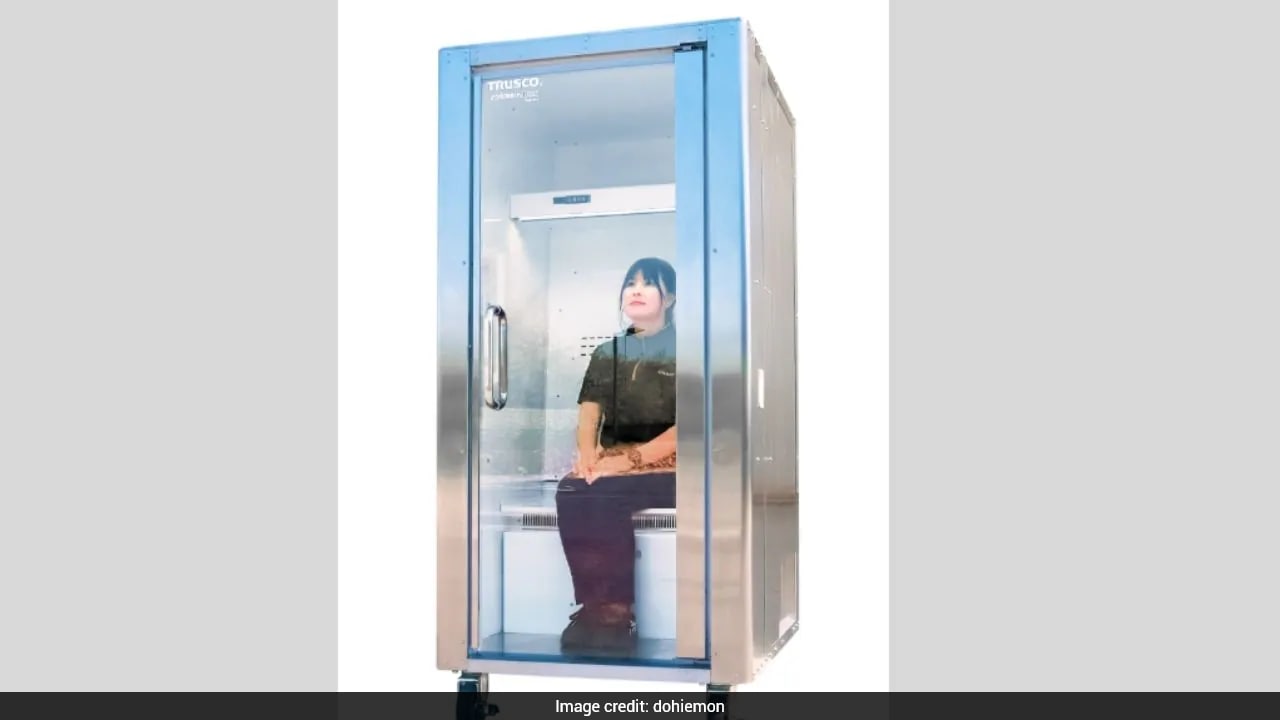
Industrial equipment supplier Trusco Nakayama and manufacturer SDRS didn't build a joke. They built the Do Hiemon Box. It is a stainless-steel, human-sized cooling booth that operates on a simple premise: treat overheated workers like cold storage items before heatstroke sets in.
What the Human Refrigerator Actually Is
Looking like an oversized commercial cooler on wheels, the Do Hiemon Box is designed for environments where traditional climate control fails. Think construction yards, heavy steel mills, sprawling warehouses, and outdoor event spaces.
You roll the unit into place, plug it into a standard wall socket, and step inside. The interior sits at a brisk fifteen degrees Celsius. Once you take a seat on the built-in bench, internal sensors trigger targeted jets of five-degree air directed straight at your head, neck, and shoulders.
It is not meant to be a lounge. You stay inside for roughly ten minutes. That short window is enough to pull core body temperatures down and stave off acute heat exhaustion. To prevent anyone from accidentally freezing or falling asleep, the intense airflow automatically cuts off after twenty minutes.
Why Normal Air Conditioning Is Failing
Japan's weather agency now routinely deals with temperatures that defy historical norms. The country even coined a fresh linguistic category—kokusho-bi—to describe dangerously cruel days exceeding forty degrees.
Standard portable spot coolers blow ambient air around large, open industrial spaces with little effect. They consume massive amounts of electricity while leaving workers drenched in sweat. The Do Hiemon Box takes a localized approach. By enclosing a single person in an insulated compartment, it requires about half the power of a conventional spot air conditioner. Operating costs sit around sixteen yen per hour, making it cheap to run during peak heat surges.
The Reality of Industrial Heat Stress
Working outside or in uninsulated factories is genuinely dangerous. Emergency rooms fill up every July and August as heatstroke cases spike nationwide.
Companies can no longer rely on paper cups of water and flimsy shade tents. Regulatory bodies are cracking down on workplace safety, forcing industries to adopt aggressive cooling interventions. Trusco Nakayama has already sold roughly two hundred units since the product launched, finding eager buyers among steel manufacturers, golf courses, and universities. They even dispatched units to emergency evacuation shelters following recent regional earthquakes.
Carrying a price tag of about 1.5 million yen, these booths are an investment. Yet, when weighed against worker safety fines, lost productivity, and medical emergencies, industrial operators are writing the checks.
Practical Steps for Extreme Heat Management
If you manage a hot workspace or find yourself battling brutal ambient temperatures, waiting for a breeze isn't a strategy. You need active cooling protocols.
- Target the neck and head: Cooling large muscle groups or the back of the neck drops perceived temperature faster than blowing air over limbs.
- Enforce short recovery intervals: Continuous exposure to extreme heat degrades cognitive function and reaction times. Force short, scheduled breaks in hyper-cooled zones.
- Audit your power loads: If you deploy high-draw cooling equipment, verify your local grid or generator capacity to avoid tripped breakers on peak load days.
Extreme weather requires extreme engineering. Stepping into a stainless-steel box might look bizarre, but keeping people alive when the planet cooks is practical business.