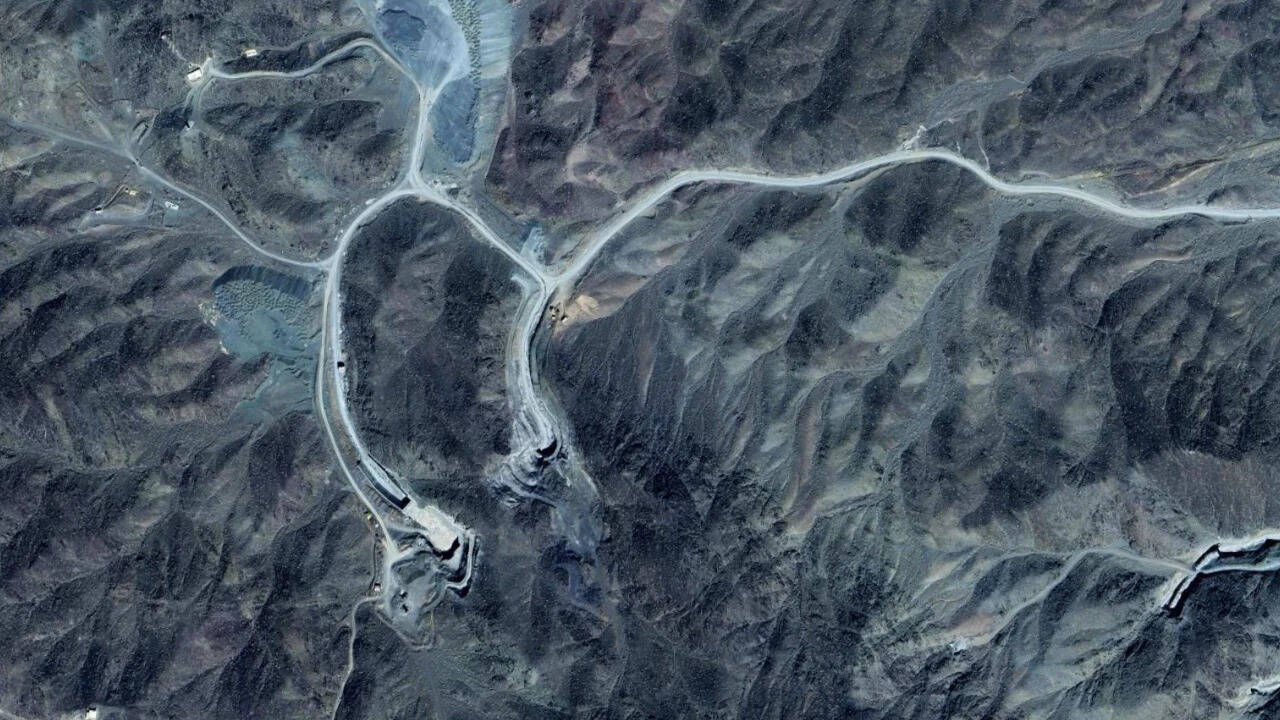
Intelligence reports coming out of the Middle East this week point to a massive shift under the granite peaks of Isfahan province. Israeli intelligence agencies just confirmed that Iran has quietly relocated thousands of uranium-enrichment centrifuges deep inside a subterranean facility at Pickaxe Mountain.
If you've been following the ongoing military strikes and diplomatic saber-rattling across the region, you know the main nuclear sites at Natanz, Fordow, and Isfahan have already taken direct hits. But Pickaxe Mountain is an entirely different beast. Carved roughly 300 to 450 feet underneath solid rock, this site was designed specifically to survive standard bunker-buster munitions. Also making headlines recently: Ce Que Le Procès Des Passeurs De La Manche Révèle Sur Le Trafic De Migrants.
The move isn't just a defensive maneuver by Tehran to save its remaining nuclear hardware. It fundamentally resets the strategic board for Washington, Jerusalem, and international inspectors who are now effectively locked out.
What Israeli Intelligence Actually Discovered Inside the Mountain
According to joint US and Israeli intelligence assessments, the transfer of equipment began last fall, shortly after the 12-day war in June 2025. During that conflict, American and Israeli airstrikes targeted three primary Iranian nuclear sites in an operation dubbed "Midnight Hammer". While those raids damaged surface structures and known enrichment halls, thousands of advanced centrifuges survived. Further details into this topic are detailed by The Guardian.
Satellite imagery from surveillance firms like Vantor and analysis from the Institute for Science and International Security (ISIS) revealed what came next. A steady stream of heavy transport trucks and construction equipment moved in and out of the tunnel portals at Pickaxe Mountain for nearly 15 months.
Israel now assesses that Iran didn't just store spare parts in those tunnels. They moved active, high-capacity centrifuges along with stockpiles of highly enriched uranium into the mountain's deepest chambers.
PICKAXE MOUNTAIN VS. LEGACY IRANIAN NUCLEAR SITES
----------------------------------------------------------------------
Site Name          Depth / Fortification      Status Post-2025 Strikes
----------------------------------------------------------------------
Natanz (Main)      ~25 meters underground     Heavily damaged
Fordow             ~80 meters underground     Partially degraded
Pickaxe Mountain   100-140+ meters (Granite)  Intact & expanding
----------------------------------------------------------------------
The location itself—known locally as Kuh-e Kolang Gaz La or Mount Kolang—is situated just 1.5 kilometers south of the original Natanz complex. Tehran started digging here back in late 2020 after an above-ground centrifuge assembly shop at Natanz was destroyed in a mysterious explosion. At the time, Iranian officials claimed the mountain buildout was simply a replacement shop for assembling civilian centrifuges.
The current reality looks far more serious.
Why Pickaxe Mountain Is Almost Impossible to Take Out
Air power has limits, and granite is one of them.
The main enrichment halls at Natanz sat about 25 meters under earth and concrete. Fordow was buried under roughly 80 meters of mountain rock. Pickaxe Mountain pushes past 100 to 140 meters of hard granite bedrock.
Even the heaviest ordinance in the American arsenal—the 30,000-pound GBU-57 Massive Ordnance Penetrator (MOP)—is tested to penetrate up to 200 feet of reinforced concrete or moderate soil. Pounding through nearly 450 feet of solid granite mountain structure is a completely different proposition.
President Donald Trump recently addressed the site directly, warning that the US is watching the tunnel entrances and preparing to strike. He noted that Washington would be hitting the area "pretty soon, and very heavily".
Hitting the "front door" means targeting the tunnel portals, ventilation shafts, and support infrastructure. A strike can collapse the entrances and trap everything inside. But collapsed tunnels can be dug out. The centrifuges themselves, sitting hundreds of feet under the mountain crest, could easily survive an overhead barrage intact.
The Blind Spot Problem for International Inspectors
While military planners calculate strike angles, nuclear watchdogs face a complete blackout.
The International Atomic Energy Agency (IAEA) hasn't had inspectors inside Pickaxe Mountain since construction accelerated. IAEA Director General Rafael Grossi pointed out that while Iran declared back in 2021 that it planned to conduct "nuclear activity" at the site, Tehran never provided design details or allowed verification visits.
Without inspectors on the ground, intelligence agencies rely almost entirely on satellite feeds, communications intercepts, and human sources. That leaves huge blind spots.
- Centrifuge origin points are uncertain. Nobody can say for sure which facilities provided these centrifuges. Were they saved from Fordow, pulled from clandestine storage, or freshly assembled in unmapped underground halls?
- Enrichment levels remain unverified. If Iran is running IR-4 or IR-6 advanced centrifuges inside the mountain, they can enrich uranium to 60% or weapon-grade 90% in a fraction of the time older IR-1 machines required.
- The risk of a covert breakout skyrockets. Nate Swanson, former US National Security Council director for Iran, highlighted this exact danger: when equipment sits inside an uninspected, strike-proof facility, the window to catch a dash toward weapons-grade material shrinks to near zero.
What This Means for Regional Stability in 2026
We're watching a rapid shift in strategic objectives. Israel and the United States agree that Iran must not acquire a nuclear weapon, but their operational priorities are drifting apart.
Israeli Prime Minister Benjamin Netanyahu has pushed for continuous, relentless strikes to dismantle Tehran's entire military and nuclear infrastructure. Washington, while ramping up targeted air campaigns across the Middle East, is balancing military pressure against regional escalation and diplomatic channels.
Meanwhile, Iranian forces have responded to recent air campaigns by firing drone and missile salvos at military bases and regional infrastructure. Tehran knows that as long as its core enrichment capability stays safe inside Pickaxe Mountain, it holds a massive bargaining chip.
If the centrifuges inside Pickaxe Mountain remain operational, Iran retains its breakout capability regardless of how many surface sites get bombed.
Key Tactical Indicators to Watch Next
Understanding where this conflict goes next requires keeping an eye on four specific technical and diplomatic triggers over the coming weeks.
1. High-Explosive Portal Strikes
Watch for targeted US or Israeli strikes aimed specifically at the reinforced concrete portals and air ducts of Mount Kolang. Collapsing the access roads won't destroy the centrifuges inside, but it halts physical transit and cuts off environmental cooling.
2. Emergency IAEA Board Resolutions
Keep an eye on Vienna. If the IAEA Board of Governors passes a formal non-compliance resolution regarding undeclared sites like Pickaxe Mountain, it provides the legal groundwork for broader international sanctions or coalition action.
3. Satellite Tracking of Heavy Transports
Monitor commercial satellite updates around Isfahan and Natanz. Any sudden drop or spike in heavy vehicle movement near the tunnel entrances usually signals an impending military strike or a fast-tracked relocation of nuclear material.
4. Backchannel Diplomatic Proposals
Pay close attention to third-party mediation efforts from countries like Qatar or Pakistan. Tehran often uses diplomatic pauses to seal off subterranean installations and lock in technical gains before returning to the negotiating table.