Wildlife trafficking isn't just an abstract conservation issue. Sometimes, it looks like a young eastern imperial eagle named Feliks being smuggled across international borders in a potato sack.
When Feliks took off on his first migration flight from Serbia, conservationists watched his tracker with high hopes. That hopeful journey quickly spiraled into a bizarre international crime drama involving desert poachers, WhatsApp black markets, border refugees, and a Serbian military transport plane. His eventual return home and subsequent release back into the wild offer a rare victory against the illegal wildlife trade, but the ordeal exposes just how vulnerable rare birds remain once they cross certain borders. Meanwhile, you can read other stories here: Planning Your Uae Long Weekend Around The Prophet's Birthday.
Tracking a Dangerous Migration Route
Feliks hatched as part of a fragile conservation success story. Back in 2017, eastern imperial eagles teetered on total extinction in Serbia, with numbers plummeting to a single breeding pair. Thanks to intense habitat restoration and round-the-clock nest monitoring by the Bird Protection and Study Society of Serbia (BPSSS), the population climbed to 29 breeding couples.
Researchers ringed Feliks and fitted him with a tracking backpack before he left the nest. He headed southeast, crossing North Macedonia, Greece, and Turkey without incident. Then, things went dark. To explore the bigger picture, we recommend the detailed article by Wikipedia.
His tracking signal vanished in late October while he was in Syria.
Uros Stojiljkovic from the BPSSS admitted researchers initially hoped for a simple hardware malfunction. The reality proved far worse. Poachers in the region routinely capture migratory birds using desert water traps, nets, firearms, or vehicle chases. Feliks had been caught, caged, and immediately advertised for sale on encrypted messaging apps.
Inside the Underground Bird Trade
Smugglers listed the young raptor on private WhatsApp groups dedicated to trafficking wild animals. Michel Sawan, head of the Lebanese Association for Migratory Birds, spotted the listing and mobilized a network of regional contacts.
The captors demanded a cash ransom for the bird's freedom. Conservationists drew a hard line. Paying smugglers only fuels the demand pipeline, ensuring more protected animals get trapped.
Instead of paying out, Sawan relied on local informants to track Feliks as he changed hands between buyers in Syria and Lebanon. Smuggling a massive bird of prey with a two-meter wingspan across active conflict zones sounds impossible. Yet, a group of refugees pulled off the unthinkable. They carried Feliks across the Nahr al-Kalb river on the border hidden inside an ordinary potato sack.
The Long Road Back to Serbian Skies
Getting Feliks out of Syria was only half the battle. Once safe inside Sawan's Beirut bird sanctuary, geopolitical conflicts froze standard transport options. Three separate attempts to fly the eagle home fell through.
Relief finally came from an unexpected quarter. Serbian military personnel participating in a United Nations peacekeeping mission in Lebanon stepped in. They arranged a spot for the famous raptor aboard a military transport plane, flying him straight back to Belgrade.
Upon arrival, Feliks spent weeks in quarantine at Palic Zoo. Zoo director Sonja Mandic and wildlife experts monitored his recovery closely, ensuring his feathers and stamina were back to peak condition. Workers even named one of this year's newly hatched eagle chicks "Michel" to honor Sawan's life-saving intervention.
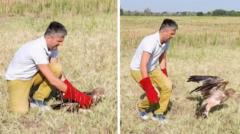
Months after his initial capture, conservationists finally opened the transport crate in northern Serbia, sending Feliks flying back into his natural habitat.
Wildlife experts are fitting him with a fresh tracking device before letting him roam too far. While illegal trapping, accidental poisoning, and dangerous electrical grid lines still threaten Serbia's recovering raptor population, Feliks's survival proves that grassroots international networks can beat the traffickers.
If you want to support efforts to protect endangered migratory birds, look into local conservation groups like the BPSSS. Donate directly to anti-poaching initiatives rather than private exotic animal markets, and report suspicious wildlife sales online whenever you see them.