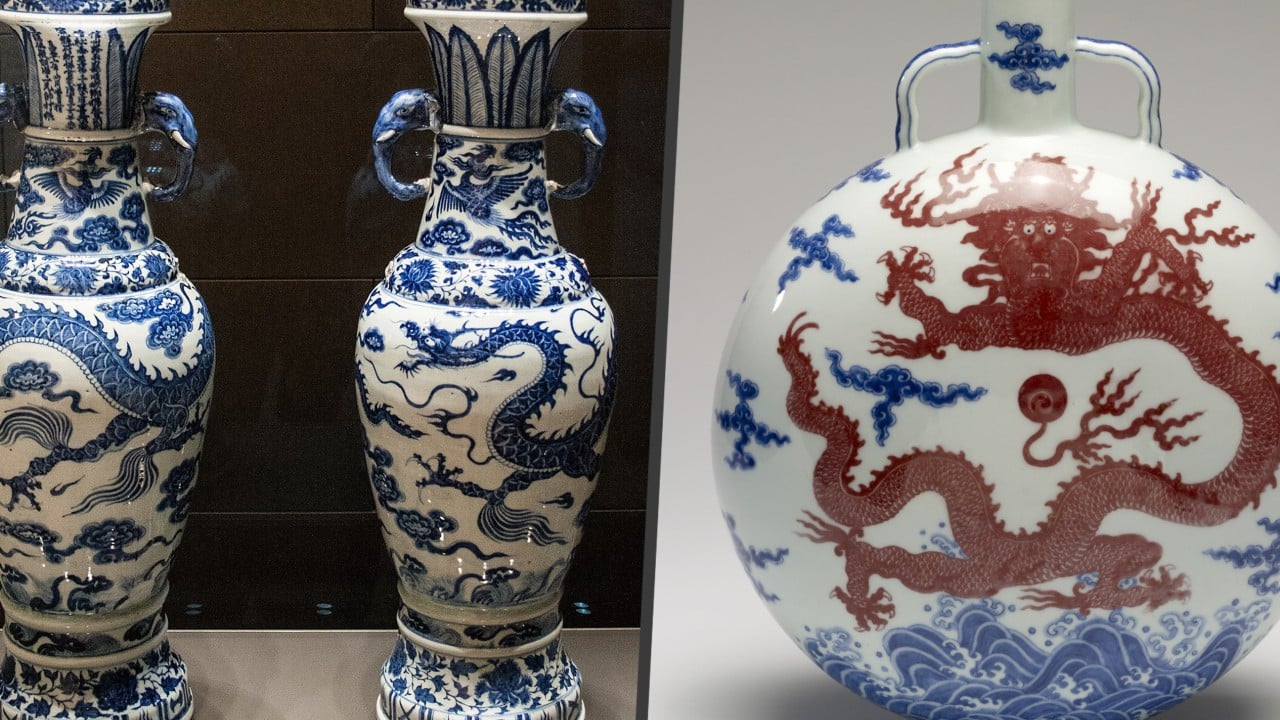
You can learn a lot about an empire by looking at its monsters. For thousands of years, the Chinese dragon wasn't just a cool design stitched onto silk or painted onto clay. It was a political barometer. When the empire was rich and stable, the dragons looked fierce, complex, and borderline exhausting to look at. When the treasury was empty, the dragons got lazy.
Historians and art collectors have long looked at ancient artifacts to piece together the past. But a fascinating shift in modern research shows us that the dragon itself was a direct reflection of a government's bank account. If you know what to look for, a simple blue-and-white porcelain bowl can tell you exactly when an emperor was losing his grip on power.
The Brutal Law of the Fifth Claw
Let's get one thing straight. You couldn't just paint a dragon because you felt creative. In imperial China, getting the details wrong on a mythical beast could get your entire family wiped out.
The dragon was the ultimate symbol of the emperor. Qin Shi Huang, the man who first unified China, called his seat the Dragon Throne. He basically branded the creature as his personal royal logo. As the centuries rolled on, the rules around this branding grew insanely strict. By the time late imperial dynasties took over, the five-clawed dragon was a strict royal exclusive.
If you were a high-ranking minister or a favored general, the emperor might gift you a special robe. But you had to look very closely at the feet. Your robe would feature a four-clawed dragon, technically called a python.
According to historical records from auction house Sotheby's, an artist was once executed along with his entire family simply because he painted a dragon with five claws without authorization.
The state took intellectual property to a terrifying extreme. The dragon was the state, and the state was the emperor. Every scale, claw, and horn had to reflect absolute authority.
When Art Tracks the Economy
Art requires money. It requires time. Most importantly, it requires a ruler who has the peace of mind to sit back and argue about the specific shade of cobalt blue on a vase.
A 2022 study published in the Journal of Education Humanities and Social Sciences proved this by looking closely at porcelain produced during the Qing dynasty. The researchers contrasted the dragon motifs from two very different eras: the reign of the Qianlong Emperor and the reign of the Guangxu Emperor. The results tell a clear story of economic survival.
The Peak of Opulence under Qianlong
The Qianlong Emperor ruled from 1735 to 1796. This was the absolute zenith of the Qing dynasty. The empire was massive, wealthy, and stable. Because the court was drowning in cash, the emperor's taste leaned toward the incredibly lavish.
Craftsmen working under Qianlong couldn't cut corners. The study notes that only the most tedious and ornate designs could win the emperor's approval. The blue-and-white dragon porcelain from this era shows impeccable brushwork. Every single scale on the dragon's serpentine body was painted with microscopic precision. The beasts looked muscular, powerful, and deeply intimidating. The artisans had the luxury of time, backed by a fully funded imperial kiln.
The Desperation of the Guangxu Era
Now flip the script to the Guangxu Emperor, who ruled from 1875 to 1908. By this time, the Qing dynasty was staring down its own demise. The empire was battered by foreign invasions, internal rebellions, and massive financial deficits.
When researchers looked at the dragon motifs from Guangxu's reign, the drop-off in quality was staggering. The lines were rushed. The details were messy. The dragons looked less like terrifying gods of rain and power, and more like hasty sketches.
This wasn't because the artisans suddenly lost their talent. It was because they were starving. The imperial kilns were facing extreme economic hardship. Potters couldn't spend weeks perfecting a single plate when they needed to churn out merchandise just to keep the lights on. Survival trumped excellence. The dragons on the plates looked exhausted because the society making them was exhausted.
The Long Slither of Evolution
The dragon didn't start out looking like the creature we see in festivals today. It took thousands of years of political shifting to build that specific look.
If you look back at the earliest examples, the dragon was a simple snake. The oldest known dragon motif on pottery comes from the Yangshao culture, dating back between 5000 BC and 3000 BC. Back then, it was just a primitive, winding line on a clay vessel.
During the Shang and Zhou dynasties, things changed. The snake started picking up traits from other animals. Some historians think it looked a bit like a Chinese alligator. Others argue it absorbed features from tribal totems as different factions conquered each other. A tiger's paws here, an ox's head there.
By the time the Tang dynasty took control around 618 AD, the dragon finally locked into its iconic form. It became a composite beast with a camel's head, stag's horns, carp's scales, and eagle's claws. This wasn't an accident. By combining the most powerful traits of different animals, the imperial court created a creature that represented absolute supremacy over nature and man.
How to Spot a Dying Empire on a Vase
If you're looking at Chinese porcelain in a museum or an antique shop, you can use these artistic shifts to read the history yourself. You don't need a degree in archaeology to spot the clues.
First, look at the composition. A wealthy empire fills the space. Qianlong-era porcelain rarely leaves blank gaps. The dragon is surrounded by tight swirls of clouds, crashing waves, and flaming pearls. The entire surface feels packed, reflecting a culture that has resources to burn.
Second, check the posture of the beast. Strong dynasties produced active dragons. They twist dynamically across the ceramic surface, full of tension and muscle. Weak dynasties produced static dragons. The lines are flatter, and the poses feel rigid and stiff.
Third, look at the paint quality. On high-end imperial pieces from prosperous times, the blue ink has incredible depth. Artisans used multiple layers of shading to give the dragon dimension. On pieces from declining eras, the blue is flat, washed out, or applied with jagged, impatient strokes.
Next Steps for History Lovers
History isn't just a list of names and dates of battles. It's written in the objects people left behind. Next time you visit a museum with an Asian art collection, bypass the information plaques at first. Go straight to the porcelain.
Count the claws on the dragons. Look at the precision of the scales. See if the creature looks genuinely terrifying or just mildly annoyed. You'll quickly start picking up on the invisible economic forces that shaped the ancient world, all through the eyes of a painted monster.