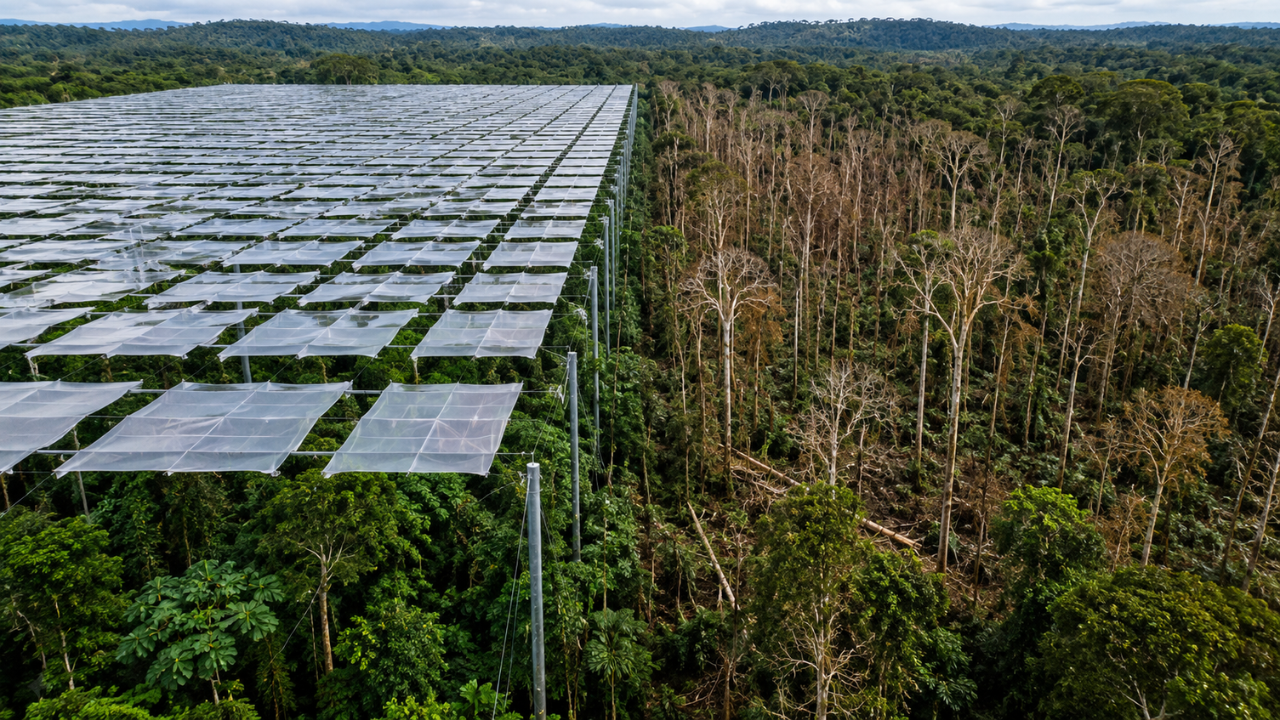
If you want to know what a dying tropical ecosystem looks like, look at a football pitch in the Caxiuanã National Forest of northern Brazil. For over two decades, researchers ran a brute-force climate simulation. They suspended nearly 6,000 transparent plastic panels above a hectare of pristine jungle, intercepting roughly half the incoming rainfall and diverting it into gutter systems.
This long-running drought experiment was designed to answer an uncomfortable question. How does the Amazon basin react when the skies dry up for good? The results weren't just concerning. They completely rewrote our understanding of how forest canopies handle stress, pointing to an ecosystem that fights back before hitting a brutal breaking point. Expanding on this idea, you can also read: Why Tonight S Deep Partial Lunar Eclipse Looks Like A Blood Moon.
Why Big Trees Fail First
You might assume that a thirsty forest simply fades away evenly, with every plant wilting a little bit each day. Nature doesn't work like that.
During the first several years of the experiment, the trees demonstrated surprising resilience. Their roots plunged deeper into the soil searching for hidden moisture, and some species even absorbed water directly through their leaves. But survival has strict limits. Around the eight-year mark, that resistance collapsed. Analysts at Live Science have provided expertise on this trend.
The casualties weren't distributed randomly. The oldest, tallest trees took the absolute worst of it.
We tend to think large trees are invincible because of their sheer size. In a severe drought, that size becomes a fatal liability. Pumping water hundreds of feet into the air requires massive hydraulic tension. When the soil runs dry, that tension shatters. Air bubbles form inside the internal water transport columns, blocking flow entirely. Scientists call this hydraulic failure. It's a swift internal strangulation that kills giants while smaller, understory plants manage to scrape by.
The Biomass Crash and Carbon Flip
By the time the plot hit fifteen years of artificial drought, the physical toll was staggering. The site had lost about a third of its original aboveground biomass.
Researchers tracked a loss of 85 megagrams of carbon per hectare. That translates to a 34 percent drop from the baseline of 248 megagrams. The forest stopped acting as a carbon sink and flipped into a net emitter. Every dying and rotting tree released decades of stored carbon straight back into the atmosphere.
As those massive canopy trees crashed down, they left gaping holes. Sunlight flooded parts of the forest floor that hadn't seen direct light in centuries. The soil baked, fallen leaves turned crisp, and the threat of catastrophic fire skyrocketed.
Computer models back then predicted a straight slide into a savannah-like wasteland. But ecosystems have strange self-preservation instincts.
The Unexpected Stabilisation Phase
Between 2017 and 2023, something weird happened. The downward spiral stopped.
The forest didn't bounce back to its original state, but the bleeding paused. With so many massive water-guzzling trees dead, the surviving vegetation suddenly had less competition. The remaining trees secured a larger share of the scarce remaining moisture, easing their internal physiological stress. Measurements of stem water content and sap flow finally stabilised.
The ecosystem reached a new, highly modified equilibrium. It is leaner, features a much more open canopy, and holds significantly less carbon than the surrounding untouched jungle. But it didn't collapse into grasslands.
In late 2024, researchers finally removed most of the plastic panels. The next phase of observation is currently underway to see if decades of trauma can ever be undone or if the Amazon is permanently rewritten.
If you're tracking climate forecasts, stop looking at global averages. Pay attention to how individual giants fall, because the future of the planet's lungs depends on whether these altered forests can hold their ground.