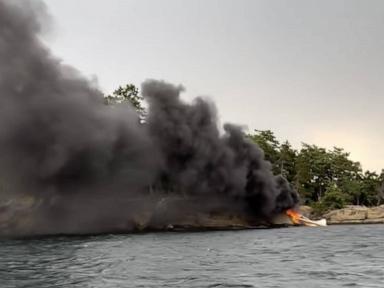
When a de Havilland DHC-3 Otter seaplane carrying 10 passengers and a pilot plunged into Shallow Bay off Sucia Island, it had all the markings of an absolute tragedy.
The aircraft had taken off from Lake Union in Seattle around late afternoon on Thursday, heading north toward the picturesque San Juan Islands. Within moments after making an emergency landing in the water near North Beach around 5:15 p.m., the plane burst into flames and began sinking fast. In related updates, read about: Why Seattle Fell In Love With Jimothy The Raccoon.
Yet every single person on board survived.
How 11 people made it out of a burning, sinking aircraft in the cold Pacific Northwest waters isn't just luck. It came down to immediate intervention by nearby civilian boaters, swift multi-agency coordination, and pilot maneuvering during an inflight emergency. Here is what happened, why the rescue worked, and what this high-profile incident tells us about seaplane safety in Washington state. The Guardian has also covered this fascinating topic in great detail.
The Chaos at Shallow Bay
Sucia Island sits near the northern boundary of the San Juan Islands archipelago, just south of the Canadian border. It's a popular destination for boaters, campers, and tourists seeking quiet coves. On a late Thursday afternoon, the quiet shattered when a Kenmore Air floatplane hit the water unexpectedly in Shallow Bay.
Eyewitnesses on the water reported seeing the de Havilland DHC-3 Otter make an forced touchdown. Immediately after impact, thick black smoke began billowing from the fuselage. Fire swallowed parts of the aircraft while it was still afloat.
Flight Details at a Glance
--------------------------------------------------
Operator          : Kenmore Air
Aircraft Type     : de Havilland DHC-3 Otter
Origin            : Lake Union (Seattle, WA)
Location          : Shallow Bay, Sucia Island, WA
Time of Incident  : Approx. 5:15 PM PDT
Total Onboard     : 11 (10 passengers, 1 pilot)
Outcome           : 11 rescued, multiple injured (1 critical)
The plane didn't stay on the surface long. As flame burned through the airframe, water began pouring into the cabin. Passengers scrambled to exit before the airframe slipped beneath the waves.
How Civilian Boaters Saved Lives Before First Responders Arrived
In water rescues, minutes feel like hours. Cold ocean water quickly induces hypothermia, and fire on a sinking plane creates total panic. San Juan County Sheriff Eric Peter credited everyday citizens on private boats for preventing a catastrophe.
When the plane touched down hard and caught fire, civilian boats cruising near Shallow Bay didn't hesitate. They throttle up and headed straight toward the fire.
Before official emergency assets could cross miles of open sound, those civilian crews pulled shocked, injured passengers directly out of the water.
"Swift actions from everyone prevented this from being worse," Sheriff Peter stated following the rescue.
By the time official responders arrived on scene, the plane was fully engulfed in flames and going under. Had those private vessels waited for official rescue boats, the outcome likely would have involved loss of life.
A Massive Multi-Agency Response
Once the call went out, a widespread rescue effort swung into motion across regional agencies.
- U.S. Coast Guard: Dispatched response boats and coordinated regional air assets while establishing emergency command.
- U.S. Navy: Deployed helicopters to airlift severe burn and trauma cases straight to advanced trauma centers.
- Orcas Island Fire and Rescue & San Juan County EMS: Stationed personnel, ambulances, and triage setups at Friday Harbor and nearby docks to evaluate survivors as they came ashore.
- Canadian Coast Guard & Regional Partners: Assisted across the nearby maritime border with search-and-rescue support.
Injuries were serious. Reports from the San Juan County Sheriff’s Office confirmed passengers suffered head injuries, severe lacerations, and broken bones. Four passengers required immediate hospital transport—two flown or ferried to Bellingham facilities, and two transported to Orcas Island for treatment. One passenger remained in critical condition.
The Workhorse Aircraft: Understanding the de Havilland DHC-3 Otter
The plane involved in the crash was a de Havilland DHC-3 Otter, a single-engine high-wing aircraft designed in Canada during the 1950s. It is basically the utility vehicle of wilderness aviation.
Floatplane operators like Kenmore Air—which was founded in 1946 and flies over 90,000 people annually—rely heavily on the DHC-3 Otter because of its high lift capacity and short-takeoff-and-landing (STOL) capability. Many of these planes are retrofitted with modern turboprop engines (often converting them to "Turbine Otters") to increase reliability, climb speed, and overall safety margin.
de Havilland DHC-3 Otter Profile
--------------------------------------------------
Role               : Utility transport / Floatplane
First Flight       : 1951
Capacity           : Up to 10-11 passengers + crew
Engine Types       : Radial piston OR Pratt & Whitney PT6 Turboprop
Key Strengths      : STOL performance, heavy payload, rugged design
Common Operations  : Pacific Northwest, Alaska, Canada bush flying
While these aircraft are extraordinarily durable, single-engine floatplanes present specific risks. If an engine fails, a fuel line leaks, or an in-flight fire starts, the pilot has limited time to find clear water, make a touchdown, and get everyone out before the aircraft sinks.
Kenmore Air CEO David Gudgel released a public statement shortly after the crash:
"We are grateful that everyone aboard has been accounted for, and our immediate focus is ensuring our passengers and pilot receive full care. Kenmore Air is fully cooperating with investigating authorities."
What the Federal Aviation Administration and NTSB Will Investigate
Federal safety investigators from the National Transportation Safety Board (NTSB) and the Federal Aviation Administration (FAA) face a complex job when investigating water crashes. Aircraft that catch fire and sink present tough physical evidence challenges.
Investigators focus on key areas during floatplane crash reviews:
1. Engine and Fuel Line Integrity
Because a fire broke out immediately before or during touchdown, mechanical inspectors look for fuel leaks, high-pressure line failures, or turbocharger fires. Recovering the submerged engine is critical for metallurgical testing.
2. Pilot Actions and Flight Data
Small floatplanes rarely carry traditional "black boxes" found on commercial jetliners, but modern GPS units, tablet flight bags, and ADS-B tracking data give detailed pictures of speed, altitude changes, and descent rates leading to the emergency landing.
3. Emergency Evacuation Procedures
Investigators look closely at how quickly doors opened, whether life vests were used, and if seat attachments held up during impact. When a plane fills with water and smoke simultaneously, disorienting passenger conditions make quick egress difficult.
The Reality of Seaplane Travel in Washington State
For thousands of residents and travelers in western Washington, seaplanes aren't just a novelty excursion. They're vital transit links connecting Seattle's urban core at Lake Union directly to Friday Harbor, Roche Harbor, Victoria, BC, and outer islands where ferry schedules can be slow or crowded.
Standard Travel Time Comparison: Seattle to San Juan Islands
-----------------------------------------------------------------
Option A: Ferry & Drive | ~3.5 to 5 hours (including ferry line wait)
Option B: Seaplane      | ~45 minutes direct from Lake Union
This efficiency makes floatplanes wildly popular. But flying over cold Puget Sound and Salish Sea waters comes with inherent risks that commercial jet travel doesn't face.
When a floatplane hits water violently, floats can break off, flipping the plane upside down. Once upside down under water, cabin orientation flips, dark water rushes in, and finding an exit door becomes a fight against panic.
What Every Floatplane Passenger Needs to Know Before Boarding
Safety briefings on floatplanes often feel routine, but paying attention can save your life if an emergency happens over water.
- Locate the exits visually before takeoff: Floatplanes don't all open the same way. Some use push-out handles, others use standard lever latches. Put your hand on the latch before the engine starts.
- Know where your life jacket is stored: Most seaplane operators place life vests directly beneath seat cushions or in clear pouches on seatbacks.
- Never inflate your life jacket inside the cabin: This is crucial. If the plane fills with water while you are inside, an inflated vest traps you against the ceiling, making it impossible to dive down and swim out through a window or door. Inflate only after clearing the airframe.
- Count the seat rows to the exit: If smoke fills the cabin or the plane submerged upside down, you won't be able to see. Know how many seatbacks sit between you and the egress point.
- Keep your safety belt buckled until the plane comes to a complete stop: Unbuckling too early during a rough water landing can throw you into the cabin bulkhead upon impact.
What Happens Next
Federal investigators will work to raise the burned airframe out of Shallow Bay to examine the wreckage. The NTSB typically issues a preliminary report within two to three weeks, detailing raw facts, radar logs, and initial inspection notes. A final determination of probable cause usually takes 12 to 18 months.
For now, the survival of all 11 people aboard stands as a testament to calm piloting under extreme pressure and the selfless bravery of local boaters who raced into danger without a second thought.
If you plan on flying on a regional floatplane anytime soon, don't let fear keep you grounded, but do take safety protocols seriously. Review the safety card, locate your exits, and keep your shoes tied tight before take-off. Safe flying comes down to preparation.