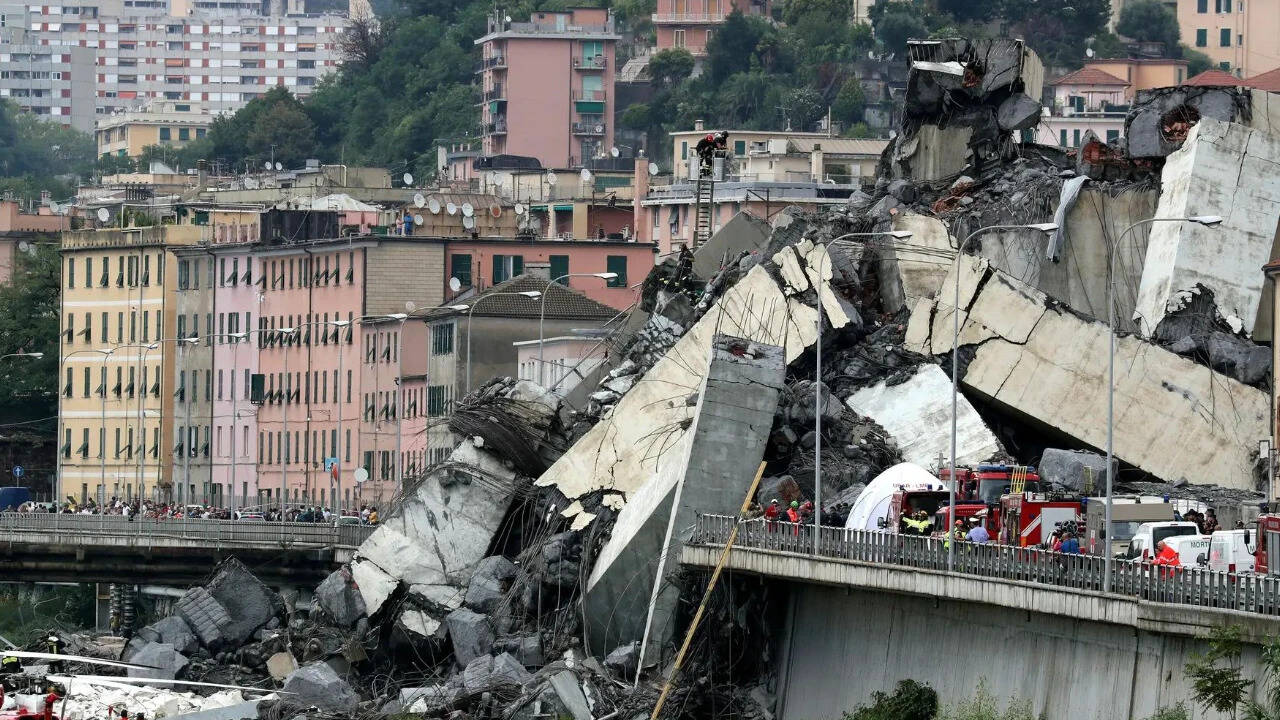
Forty-three people drove onto a highway bridge on a rainy August morning in 2018 and never made it home. They weren't risk-takers or thrill-seekers. They were families heading on vacation, truck drivers doing their jobs, and commuters going about their Tuesday. When a 200-meter section of Genoa’s Morandi Bridge snapped and plunged into the riverbed and warehouses below, it didn't just shatter lives—it shattered the illusion that our modern world is built on solid ground. Now, years after the tragedy, a courtroom in northern Italy has finally delivered a historic first-instance verdict. The dramatic culmination of the Genoa bridge collapse trial highlights Italy's ageing infrastructure issue in a way that should make every driver in Europe and North America deeply uncomfortable.
This wasn't a natural disaster. It was a failure of systems, a failure of oversight, and a blatant choice to prioritize corporate dividends over human lives. By looking at what happened in that Genoa courtroom, we can understand how bad things really are, and why the roads you drive on every day might be closer to the edge than you think.
The Verdict that Shook the Boardrooms
On July 16, 2026, chief judge Paolo Lepri read out a decision that sent shockwaves through the executive offices of Europe’s major infrastructure operators. In a trial that lasted four years and required 284 grueling hearings, prosecutors successfully argued that the disaster was entirely foreseeable and preventable. This was a massive win for the victims' families, who have spent nearly eight years fighting a wall of corporate deniability.
At the center of the storm was Giovanni Castellucci, the former CEO of Autostrade per l’Italia (Aspi), the company that managed the toll road. He was sentenced to 12 years in prison for manslaughter and negligence.
The court didn’t stop at the top executive. They convicted 32 people in total. Michele Donferri Mitelli, the former head of maintenance for the operator, received an 11-year sentence. Antonino Galatà, the former chief of Aspi's engineering subsidiary, Spea, was handed five and a half years. Even ministry of transport officials, the people paid by taxpayers to keep the operators honest, were convicted for failing to do their jobs.
The defense tried to blame the original 1967 design of the bridge. They argued that a hidden structural flaw in "stay cable number nine" made the collapse inevitable and that no amount of maintenance could have saved it. But the judges didn't buy it. The prosecution proved that the operators knew about the decay for decades. In fact, identical issues had been identified and repaired on the bridge's other two pylons back in 1993. They simply chose to ignore the third pylon—the one that eventually failed.
Why the Genoa Bridge Collapse Trial Highlights Italy's Ageing Infrastructure Issue
Italy is basically an open-air museum, but its modern transport network is a mid-century relic. During the post-war reconstruction boom of the 1960s and 1970s, the country built roads, tunnels, and bridges at a breakneck pace. It was a golden age of concrete. But concrete is not eternal.
Most reinforced and pre-stressed concrete structures built during this era have a lifespan of about 50 to 60 years. Do the math. We are living in the exact window where thousands of these structures are reaching the end of their design lives simultaneously.
Italy has an incredibly dense and complex topography. The country's motorway network features over 1,200 kilometers of bridges and viaducts. That is four times the average for the rest of the European Union. On top of that, Italy is home to half of all tunnels in Europe.
Maintaining this sprawling, mountain-hugging network is an engineering nightmare. But the real problem isn't just geography; it's how the maintenance was managed—or rather, ignored.
When the Italian government privatized its motorway network in the 1990s, they handed over the keys to private concessionaires. The Benetton family’s holding company, Atlantia, took control of Autostrade per l’Italia. In theory, private companies bring efficiency. In reality, this setup created a dangerous incentive structure. Every euro spent on inspecting concrete, reinforcing steel cables, or repairing foundations was a euro taken directly out of the pockets of shareholders.
For years, the operator collected fat toll revenues while deferring critical repairs. Prosecutors argued that the system was a ticking time bomb. They showed that warning signs were systematically swept under the rug to keep the profits flowing and the stock prices high.
The Dark History of Unfortified Concrete and Crony Capitalism
To make matters worse, Italy's infrastructure boom had a dark side that many politicians would prefer to forget. In the 1960s and 70s, construction contracts in southern and central Italy were frequently won by firms with ties to organized crime.
Anti-mafia prosecutors have long documented the use of "unfortified concrete" in public works. To maximize profits, corrupt contractors watered down cement with cheap sand. The result? Concrete structures that looked solid on the outside but were structurally compromised from day one. Over the decades, salt air, heavy rain, and truck traffic have eaten away at these substandard materials.
The Morandi Bridge itself was designed by Riccardo Morandi, a brilliant but controversial engineer. He pioneered a technique using pre-stressed concrete to encase the steel stay cables. This was supposed to protect the steel from corrosion. Instead, it did the opposite. The concrete casing hid the steel cables from view, making it almost impossible to inspect them visually. As water seeped through micro-cracks in the concrete, the steel cables rusted in secret.
When engineers did voice concerns, they were often ignored by a corporate culture that viewed safety checks as a bureaucratic nuisance. It’s a classic example of crony capitalism at its worst.
It is Not Just an Italian Problem
If you think this is a uniquely Italian tale of corruption and bad luck, you're dead wrong. The crisis of crumbling, mid-century infrastructure is a silent epidemic creeping across the entire Western world.
Let's look at the numbers.
In France, a government-commissioned report warned that up to one-third of state-maintained bridges are at risk of collapse if they don't receive immediate reinforcement. On average, French bridges are only repaired 22 years after the first signs of deterioration appear.
Germany, the industrial powerhouse of Europe, is facing a massive crisis with its western highway bridges. Built primarily in the 1960s and 70s, these structures were never designed to handle the weight and volume of modern heavy freight traffic. Bridges like the Leverkusen Bridge over the Rhine have had to be closed to heavy trucks for years after cracks were discovered, causing massive logistical headaches for the entire European economy.
Across the Atlantic, the United States is in a similar bind. Out of more than 614,000 bridges in the US, nearly four in ten are 50 years or older. Tens of thousands are classified as "structurally deficient," meaning they require significant repair or replacement to remain safe. Millions of Americans cross these deficient bridges every single day without a second thought.
We are all driving on the legacy of a generation that built fast and cheap, assuming future generations would pay for the upkeep. Well, the bill is finally due.
How We Stop the Next Collapse
The Genoa trial verdict has set a major legal precedent. For the first time, corporate executives cannot hide behind their engineering departments or claim they "relied on experts." Personal responsibility goes all the way to the top.
But court battles only assign blame after the bodies have been pulled from the rubble. To actually fix the problem, we need to radically change how we manage our public assets.
Here is what needs to happen immediately.
- Ditch the Concession Blindspot: Governments must stop handing over critical public safety infrastructure to private companies without heavy, independent, and aggressive oversight. Contracts must tie corporate profits directly to verified maintenance milestones, not just traffic volume or toll collections.
- Mandate Real-Time Digital Monitoring: We can no longer rely on engineers walking around with clipboards looking for cracks. Modern bridges should be outfitted with wireless sensors that measure tension, vibration, and structural shift in real-time. This data must be made public so that independent scientists and journalists can verify the safety of public works.
- Accept the Demolition Reality: In many cases, trying to patch up a 60-year-old concrete bridge is just throwing good money after bad. We need to accept that thousands of structures must be completely demolished and rebuilt from scratch. When Genoa built the new San Giorgio Bridge to replace the Morandi, they finished it in just 15 months. It can be done when political will is there.
- Fund the "Marshall Plan" for Infrastructure: Civil engineering societies have been calling for massive public investment programs to rebuild aging road networks. This isn't just about safety; it's about economic survival. If our transit arteries collapse, our economies collapse with them.
The 43 victims of the Morandi Bridge did not die because of a sudden, unpredictable storm. They died because of a slow-moving storm of corporate greed, political complacency, and deferred maintenance. The Genoa trial has finally delivered some semblance of justice, but the real work of securing our roads is only just beginning.
DW English report on Italy's aging infrastructure
This video provides an excellent visual breakdown of Italy's crumbling highway network and explores how deep the structural issues go beyond the Genoa tragedy.