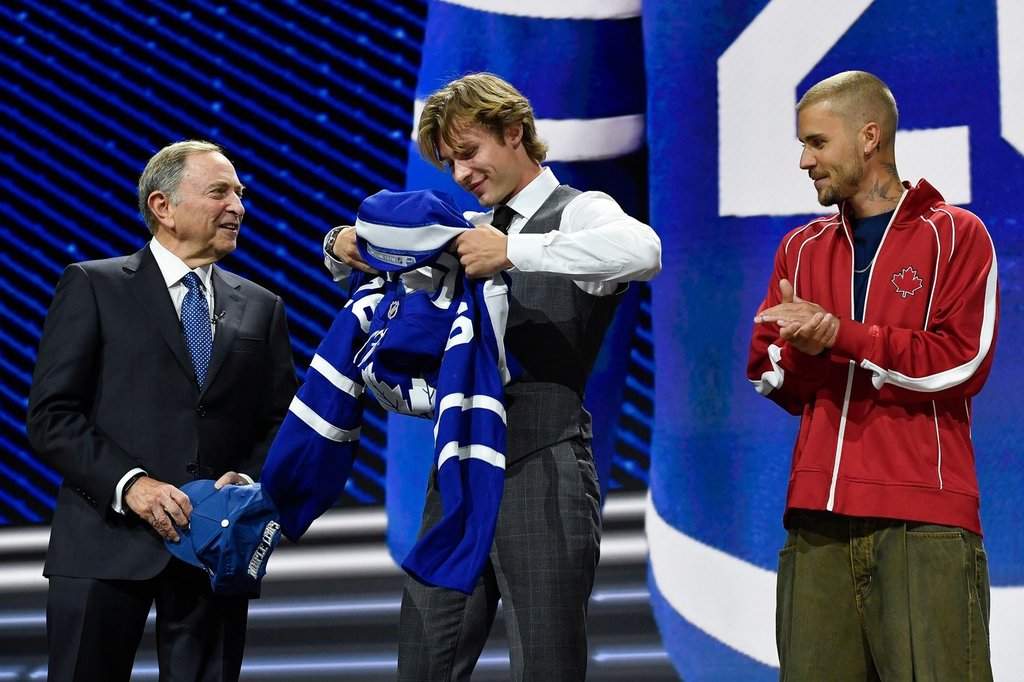
The ink is dry on Gavin McKenna's first NHL contract, and it is time to throw out the old Toronto Maple Leafs script. Friday afternoon's official announcement that the 2026 number-one overall pick signed his three-year entry-level deal isn't just a standard bureaucratic box checked by the front office. It's the moment Toronto resets its entire timeline.
Look at the numbers first. According to details reported by Chris Johnston, McKenna maxed out the league's collective bargaining agreement limits. The base salary scales from $1.025 million this upcoming season to $1.075 million in year two and $1.125 million in the third year. Toss in $1 million in Schedule A performance bonuses and another $2.5 million in Schedule B bonuses per season, and this contract represents the highest possible financial commitment the Leafs could make to an 18-year-old.
It's a massive payout for a teenager, but he earned every single dollar of it before even pulling a blue and white sweater over his head.
Turning Pro and Leaving College Behind
Signing this deal ends McKenna’s NCAA career at Penn State after just one historic season. He shattered assumptions last year by using new eligibility rules to jump from the WHL's Medicine Hat Tigers to college hockey. It was a gamble that looked brilliant by February, when he put up an eight-point game against Ohio State and finished the year with 51 points in 35 games. He walks away as a Hobey Baker finalist and the most dominant per-game scorer in Penn State history.
The big question now is where he plays. Technically, McKenna could be sent to the AHL's Toronto Marlies, but let's be realistic. Nobody draft-lotteries their way into a generational talent with an 8.5% chance just to stash him in the minors. He is too fast, his playmaking is too advanced, and his release is too deadly. He's heading straight to the NHL roster for opening night.
Where McKenna Fits on the Ice
The fun part for new management is figuring out how to deploy a player who draws constant comparisons to Patrick Kane. The competitor's lazy take is to just assume he locks into the top line next to Auston Matthews and William Nylander. That might happen on the power play, but throwing an 18-year-old left-winger straight into top-line defensive matchups in a market like Toronto can ruin a kid's confidence.
A smarter path is sheltering him on the second line next to John Tavares. Let the veteran center handle the heavy defensive responsibilities and dirty wall work. That frees up McKenna to do what he does best: process the game at high speed, manipulate defensemen with his agility, and create scoring lanes out of nothing.
Think back to how the New York Islanders handled defense-prospect Matthew Schaefer last year. They kept him on the bottom pairings early, let him adapt to the pace of grown men, and ramped up his ice time as his comfort grew. Toronto should copy that blueprint.
The Jersey Number Saga
You can tell how dialed-in McKenna is by looking at what happened off the ice this week. He wore number 72 with Penn State and Medicine Hat. It's his brand. But when the Leafs went out and signed veteran free-agent goaltender Sergei Bobrovsky on Wednesday, McKenna didn't hesitate. He immediately offered the number to the two-time Vezina winner.
Bobrovsky accepted the offer on Friday, leaving the rookie looking for a new number. It sounds minor, but it reveals a ton about McKenna's maturity. He understands NHL hierarchy. He isn't walking into the locker room acting like a savior, despite the media circus surrounding him. Assistant General Manager Hayley Wickenheiser noted his quiet confidence at development camp, pointing out that his off-the-chart hockey IQ is paired with a surprisingly grounded personality. That mindset will be crucial for surviving the Toronto media fishbowl.
What Needs to Happen Next
The honeymoon period ends when training camp opens in September. If you want to track McKenna's readiness for the grind of an 82-game season, watch these specific factors over the next two months:
- Strength Conditioning: McKenna has elite agility, but the NCAA schedule is much shorter than the NHL grind. He needs to put on lean muscle this summer to survive the physical board battles against heavy NHL defensemen.
- Defensive Reliability: Junior and college stars are used to having the puck all the time. In the NHL, he will have to play without it. Watch how quickly he adapts to back-checking tracking during pre-season games.
- Power Play Integration: Expect Toronto to test him immediately on the right half-wall during summer skates, letting him use his vision to feed Matthews in the circle.
The Leafs are coming off a miserable 28th-place finish that cost people their jobs. This signing officially closes that dark chapter. McKenna has the contract, the talent, and the mindset to transform this franchise. Now it is just a matter of dropping the puck.