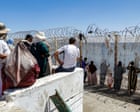
Hopes fade fast when you stare at a concrete wall for days. Hundreds of people are currently gathered near the Moroccan border of Ceuta, sharing the same heavy silence. They are waiting. They are looking for news about family members who vanished trying to cross into European territory.
It is an agonizing situation that exposes a much wider humanitarian failure at Europe's southern gates. If you look past the official press releases and border statistics, you see real human grief playing out on the dusty roads of northern Morocco. Let's look at why this crisis near the Ceuta border keeps repeating and what it actually means for the families left behind. Expanding on this idea, you can also read: Why Benjamin Netanyahu Insists Israel Will Not Leave Gaza Without Total Disarmament.
The Reality of the Border Wait
People don't gather at borders like this unless every other option has failed them. Families arrive from different parts of Morocco and sub-Saharan Africa. They carry crumpled photographs of sons, daughters, and siblings. They sleep on cardboard or thin blankets near Fnideq, hoping a local official, a hospital worker, or a returning migrant will give them a single clue.
The information vacuum is cruel. When boats capsize or unauthorized border attempts fail, tracking systems break down. Local authorities often struggle to process the sheer volume of missing persons reports. Families find themselves stuck between Moroccan administrative delays and European opacity. Analysts at The Guardian have shared their thoughts on this matter.
- Information flows slowly or not at all.
- Rumors spread fast through social media channels.
- Financial resources dry up within days of waiting.
This creates a brutal cycle of false hope and deep despair. You can't just pack up and go home when a piece of your family is missing.
Why Ceuta Remains a Magnet and a Trap
Ceuta and Melilla are Spain's two North African enclaves. They share land borders with Morocco, making them unique flashpoints for migration. Thousands view these fences and breakwaters as the direct doorway to Europe.
Reality hits hard. Heavy security, surveillance cameras, and regular patrols make unauthorized entry dangerous. Yet, desperation overrides fear. Economic hardship at home pushes young people to take massive risks.
"We are not looking for trouble. We just want to know if our son is in a hospital, a cell, or somewhere worse."
That quote from a grieving father outside Fnideq captures the core sentiment. People aren't thinking about geopolitical strategy or immigration quotas. They want basic human accountability. When a loved one goes missing during an attempted crossing, families face a bureaucratic maze that treats human lives like administrative anomalies.
The Burden of Missing Migrants
Governments rarely talk about the aftermath of failed crossings. Search and rescue operations grab headlines for a day, but the long-term tracing work falls flat. Non-governmental organizations try to fill the gap, but they are overwhelmed.
DNA databases for unidentified remains near the Strait of Gibraltar are fragmented. Morocco and Spain share a border, but coordinating missing persons data across jurisdictions takes months. Bureaucratic red tape leaves families in limbo for years.
You need specialized forensic anthropology to identify bodies washed ashore or found near harsh terrain. Without proper resources, unidentified remains end up in unmarked graves. That denies families closure and keeps psychological wounds wide open.
What Needs to Change Right Now
Fixing this situation requires immediate policy shifts rather than empty diplomatic talks.
First, transparent communication channels must open up between Moroccan authorities and families searching for missing relatives. Setting up dedicated family support centers near border zones would stop people from sleeping on the streets in agonizing uncertainty.
Second, cross-border forensic cooperation needs a massive upgrade. Spain and Morocco should establish a joint tracing mechanism to match missing persons reports with unidentified bodies swiftly.
Finally, human stories deserve immediate attention instead of political avoidance. Ignoring the people waiting at the fence won't make the migration crisis disappear. It only deepens the human cost of broken borders.
Check local human rights monitors and cross-border missing persons networks if you want to support families searching for answers. Real change starts when we look at the human cost behind the headlines.