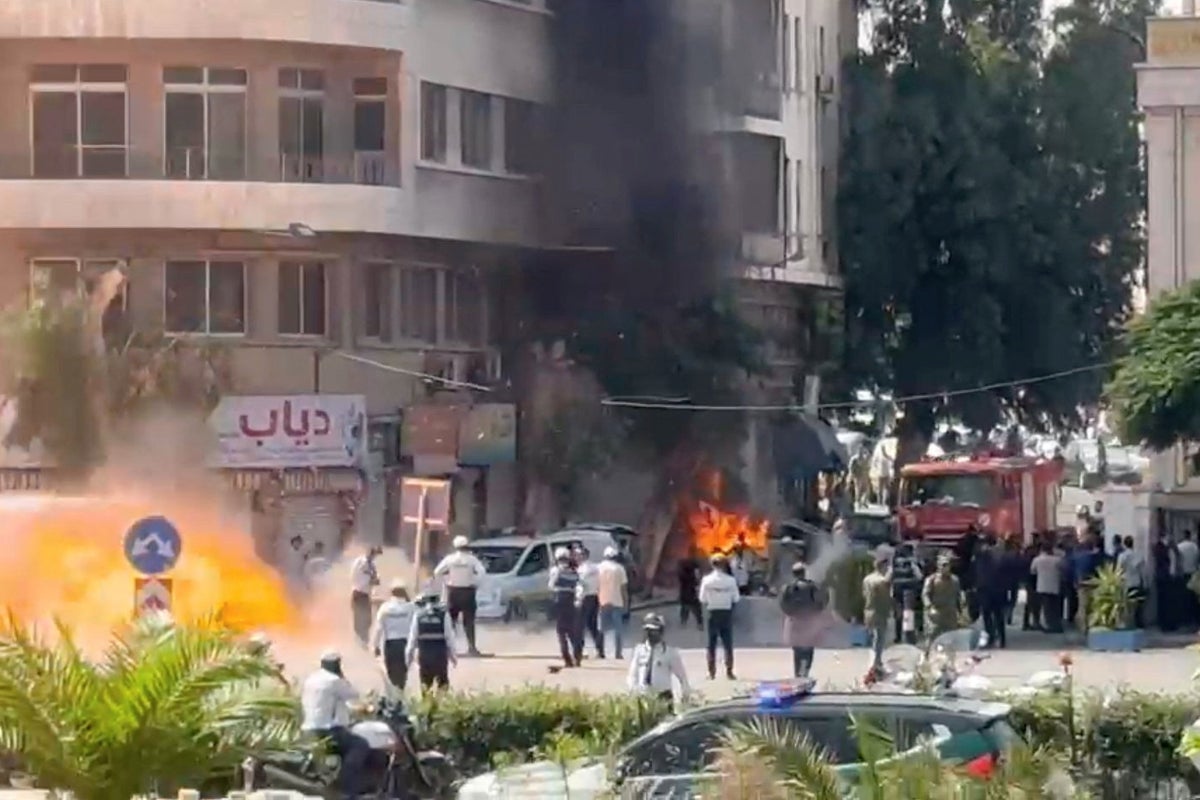
French President Emmanuel Macron just walked away from what looks like a sophisticated assassination attempt in Syria. When bombs go off near hotel where Macron is staying in Damascus, you don't just look at the smoke. You look at the message. The explosions ripped through a bustling area right between the Syrian tourism ministry and the national museum. It happened right across the street from the Four Seasons Hotel. That's exactly where Macron spent the night and met with local civil society groups. The timing wasn't an accident. The first blast detonated minutes after the French presidential motorcade pulled away toward the presidential palace. 18 people are injured. Four of them are police officers. Blood stained the streets, and emergency crews fought fires next to a bombed-out ambulance.
Macron didn't hear the blasts. His office claims his schedule didn't change. But don't let the diplomatic calm fool you. This security failure exposes the raw, bleeding reality of post-Assad Syria. Macron went to Damascus to legitimize a new regime. Instead, he almost became its most famous casualty.
The Shocking Reality When Bombs Go Off Near Hotel Where Macron Is Staying in Damascus
Western leaders don't usually stroll into active combat zones without ironclad security. Macron took a massive gamble. He became the first major EU leader to visit Damascus since the dramatic fall of Bashar al-Assad. The goal was simple. France wanted to show the world that Syria is open for business under its new leadership.
The security apparatus utterly failed.
An unnamed security official confirmed that the attack involved two separate explosive devices. The first bomb was hidden inside a vehicle parked near the Four Seasons. The second went off shortly after, packed inside a dumpster right as onlookers and first responders gathered around the first blast site. That's a classic, brutal double-tap tactic. It's designed to maximize human casualties and terrorize the public.
Look at how close this came to altering global politics. The French press pool traveling with Macron reported they didn't notice any disruption. The motorcade was already rolling toward a high-stakes meeting with Syrian President Ahmed al-Sharaa. But a delay of five minutes could have put the French head of state directly in the kill zone. Reuters footage captured the raw chaos of the second explosion. Flames shot out of a trash can while people ran for their lives.
Who Actually Governs the New Syrian Capital
To understand why this happened, you have to look at who is sitting in the presidential palace. Ahmed al-Sharaa is trying to reinvent himself. He's a former Islamist rebel commander who used to fight under the banner of hardline militant groups. Now, he's wearing pristine suits, shaking hands with European leaders, and promising a pluralistic, united Syria.
It's a tough sell.
Sharaa claims he wants to build an inclusive political order for all Syrians, including the religious and ethnic minorities who spent decades relying on the Assad family for protection. But the reality on the ground tells a completely different story. The state has no monopoly on violence. Hundreds of people died last year alone in clashes between various pro-government factions, leftover rebel cells, and ethnic militias.
The capital city isn't safe. Just last week, another bomb ripped through a cafe near the Damascus Justice Palace. That attack killed nine people and left 20 others mutilated. No group claimed responsibility for that one either. When nobody claims an attack, it usually means one of two things. Either the perpetrators are terrified of the government's retaliation, or Damascus is crawling with so many competing shadow factions that tracking them down is virtually impossible.
The Failed Logic of Western Re-engagement
France has a long, complicated history with Syria dating back to the post-World War I mandate era. Macron's decision to fly into Damascus wasn't just a courtesy call. It was a calculated geopolitical move to counter regional rivals like Russia, Iran, and Turkey, who have all spent the last decade carving up Syrian territory.
Macron wanted to be the visionary leader who welcomed Syria back into the international community. He posted on X shortly after the attack, stating that nothing could smother the aspiration of Syrian citizens to live in a sovereign, safe country. He insisted his visit would continue.
That's great rhetoric. It's terrible strategy.
Sharaa's government is struggling to rebuild a country shattered by 13 years of civil war. The infrastructure is gone. The economy is non-existent. Worst of all, radical insurgent groups like Islamic State still maintain deep underground cells throughout the country. By rushing to embrace Sharaa, France is signaling that it cares more about stability than actual security. This bombing proves you can't have one without the other.
What This Means for Global Security Moving Forward
If a Western nuclear power's president can't be protected in the heart of the Syrian capital, no diplomat is safe. This attack will likely freeze Western diplomatic efforts in the region for months, if not years. Foreign ministries across Europe are looking at the smoke rising from the Four Seasons and rewriting their travel advisories.
The immediate next steps for anyone analyzing or operating in the Middle Eastern security sector are clear:
- Expect a massive, brutal crackdown in Damascus as Sharaa attempts to prove his forces can maintain order. Internal security forces have already sealed off major thoroughfares and launched sweeping search operations.
- Watch the minority factions. If Sharaa's government uses these bombings as an excuse to purge political rivals or target specific ethnic groups, the fragile peace will completely disintegrate.
- Track the diplomatic fallout. France will likely downplay the incident publicly to save face, but behind closed doors, Paris will demand sweeping changes to security protocols before any other European official sets foot in Syria.
The illusion of a stable, post-war Syria is dead. Macron got lucky today, but the people of Damascus have to live in the ruins of a transition that is turning out to be just as violent as the war that preceded it.