We live in an age obsessed with clean, mechanized perfection. Video Assistant Referees dissect every millimeter of grass, automated tracking chips measure the exact rotation of the ball, and corporate public relations teams scrub every ounce of raw emotion from modern athletes. It is sterile. It is predictable.
That is exactly why we cannot stop talking about June 22, 1986. Recently making headlines recently: Why School Water Safety Lessons Are Falling Dangerously Short.
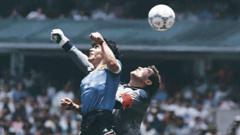
Exactly forty years ago at the Azteca Stadium in Mexico City, Diego Armando Maradona pulled off the most magnificent heist in the history of global sport. In the 51st minute of a brutally tense World Cup quarter-final between Argentina and England, a short, stocky genius rose into the high altitude air against a goalkeeper who had an eight-inch height advantage. Maradona did not win the ball with his head. He punched it into the net with his left fist.
When the world looked for answers, Maradona delivered a line that became more famous than the match itself, claiming the goal was scored "a little with the head of Maradona and a little with the hand of God". Additional information on this are explored by Yahoo Sports.
English fans still call it blatant cheating. Argentine fans call it poetic justice. But forty years later, most people still miss the true brilliance of what happened in those chaotic few seconds in Mexico. To understand Maradonas Hand of God goal, you have to stop looking at it through the narrow lens of the rulebook and start looking at it as an act of pure, unadulterated theatre that defined a nation, broke an empire's pride, and fundamentally altered how we view sports heroism.
The boiling political pressure behind the match
You cannot separate the Hand of God from the cold reality of geopolitical trauma. Four years before the 1986 World Cup, Argentina and the United Kingdom went to war over the Falkland Islands, known to Argentines as Las Malvinas. It was a brief, bloody conflict that ended in a crushing Argentine defeat, leaving deep emotional scars across the South American country. Hundreds of young Argentine conscripts lost their lives.
When the two football teams walked out onto the pitch in 1986, diplomatic relations between the two countries had not even resumed.
The players claimed publicly that it was just a game of football. They lied. Maradona later admitted in his autobiography that the Argentine players were hyper-aware of the political stakes. They felt they were representing the mothers who had lost their sons, the soldiers who had been humiliated, and a country that felt bullied by a global superpower.
The English team, led by manager Bobby Robson and featuring brilliant goalscorer Gary Lineker, approached the match with a purely athletic mindset. They wanted to reach a World Cup semi-final. The Argentines, however, wanted something much heavier. They wanted revenge.
Anatomy of the perfect sports crime
The first half was a scoreless, physical battle. The English defenders, particularly Terry Fenwick, spent forty-five minutes tracking Maradona, kicking his ankles, and trying to physically intimidate the little number ten. It did not work.
Six minutes after the half-time break, Maradona picked up the ball outside the penalty area. He danced past three English players with his characteristic low center of gravity before slipping a pass to Jorge Valdano. Valdano miscontrolled it slightly. English midfielder Steve Hodge tried to clear the danger but sliced his kick, sending a looping, high ball backward into his own penalty box.
In that moment, time slowed down.
Peter Shilton, the towering English goalkeeper, rushed off his line to punch the ball away. He was the favorite to win it. Maradona kept running, tracking the flight of the ball. He knew he could not outjump Shilton legally. His brain made a split-second calculation. He leaped, raised his left arm close to his temple, and flicked his wrist.
The ball zipped past Shiltons outstretched hands and rolled into the empty net.
Look closely at the archival footage. The immediate reaction of Maradona tells the whole story. He did not freeze. He did not look guilty. Instead, he ran toward the corner flag to celebrate, casting a quick look over his shoulder to see if the referee had noticed. He later told his teammates that he had to scream at them to come celebrate with him, because if they stood there looking shocked, the referee would realize something was wrong.
The human failure of the officials
How did an entire refereeing crew miss a blatant handball in front of 114,000 spectators? The answer lies in a tragic breakdown of communication between two men from entirely different parts of the world.
The central referee was Ali Bin Nasser of Tunisia. The linesman on that side was Bogdan Dochev of Bulgaria.
Bin Nasser was positioned behind the play. From his angle, he could see the bodies of Shilton and Maradona colliding, but Maradonas head obscured the exact point of contact with the ball. He immediately looked over to his linesman, Dochev, expecting a signal. Dochev kept his flag down and began walking back toward the center circle, which under FIFA guidelines at the time signaled that a legitimate goal had been scored.
The two men spent the rest of their lives blaming each other. Bin Nasser claimed he was waiting for the linesman to report the infraction because Dochev had a clearer view. Dochev countered by saying that FIFA rules at the time prohibited linesmen from discussing decisions with the referee unless specifically asked, and since Bin Nasser blew his whistle for a goal, the matter was closed.
It was a perfect storm of bureaucratic hesitation and physical positioning. The English players surrounded Bin Nasser, screaming and gesturing wildly, but without VAR, the historical record was set in stone.
Four minutes to immortality
If Maradona had only scored the handball goal, history might remember him as a cynical villain. He would be lumped together with players who cheated their way to victory and left an ugly stain on the tournament.
What happened four minutes later changed everything.
In the 55th minute, Maradona received a pass from Héctor Enrique inside his own half of the field. He was sixty yards away from the English goal. With a sublime, effortless spin, he left Peter Beardsley and Peter Reid stranded in the Mexican dust. Then he took off.
He picked up speed, sprinting down the right flank while keeping the ball glued to his left foot. Terry Butcher rushed out to confront him; Maradona dropped his shoulder and glided past. Terry Fenwick tried to cynically hack him down; Maradona absorbed the pressure and kept his balance. He reached the edge of the box, feinted to shoot, which sent Peter Shilton flying wildly onto his backside, and calmly prodded the ball into the back of the net.
It was the Goal of the Century.
The contrast between those two goals explains the entire mythos of Diego Maradona. In the span of just four minutes, he showed the world the two sides of his soul. First came the street-smart thief from the slums of Villa Fiorito, a boy who learned early on that when the world is rigged against you, you use whatever trick you can to survive. Second came the footballing deity, a man possessing a level of technical mastery that no other human being on earth could match.
The lasting scars of the English team
While Argentina went on to win the 1986 World Cup, the English players were left to stew in a volatile mixture of anger and regret. Decades have passed, but the bitterness has barely faded.
Peter Shilton, the legendary goalkeeper who earned 125 caps for his country, famously refused to ever forgive Maradona. For forty years, Shilton turned down invitations to media events, interviews, and dinners if Maradona was going to be present. He argued that Maradona lacked sportsmanship because he never truly apologized to the English team during his lifetime.
Ironically, the man who suffered most from the goal also became the man who benefited most financially. Steve Hodge, the midfielder whose misplaced aerial clearance set up the handball, ran up to Maradona in the tunnel after the final whistle and asked to swap shirts.
Hedges teammates were furious with him at the time. They were sitting in a silent dressing room, nursing the heartbreak of a World Cup exit, while Hodge walked in carrying the jersey of the man who had cheated them. Hodge ignored the criticism and kept the shirt safe for decades, eventually loaning it to the National Football Museum in Manchester.
In 2022, Hodge put the famous blue number ten shirt up for auction at Sotheby's. It sold for a staggering £7.14 million ($9.3 million), breaking records for sports memorabilia. The ultimate act of footballing deception turned into the most valuable piece of cloth in sports history.
Why we need the Hand of God today
As we look back from the vantage point of 2026, football has changed completely. The game is faster, safer, and infinitely more corporate. If Maradona tried that stunt today, a high-definition camera from an overhead crane would spot the wrist movement instantly. A silent room of video technicians miles away would buzz the referee's earpiece, the goal would be wiped off the scoreboard, and Maradona would receive a yellow card.
The system would work perfectly. The rules would be upheld. And the world would be a little bit more boring.
We don't watch sports merely to see people follow rules. We watch sports to witness human drama at its absolute limits. Maradonas Hand of God goal lingers in the global consciousness because it was a moment of profound narrative friction. It was an intersection of war, poverty, artistic genius, and systemic failure. It reminds us that football is a game played by flawed human beings, not optimized machines.
To truly understand that hot afternoon in Mexico City, you must accept both goals as part of a singular masterclass. You cannot appreciate the divine elegance of the Goal of the Century without recognizing the gritty, survivalist instinct of the Hand of God. They are two sides of the same coin, minted by a flawed genius who refused to let reality limit his ambition.
If you want to experience the modern legacy of this legendary moment yourself, do not just watch the short video highlights online. Find a full broadcast recording of the 1986 match with the original Spanish audio commentary by Victor Hugo Morales. Listen to the genuine, hysterical tears of a commentator losing his mind as Maradona weaves past the English defense. That raw emotion is something no modern algorithm can ever replicate. Use that historical perspective to look at the next big sporting controversy not as an error to be corrected, but as a chapter of human history unfolding in real time.