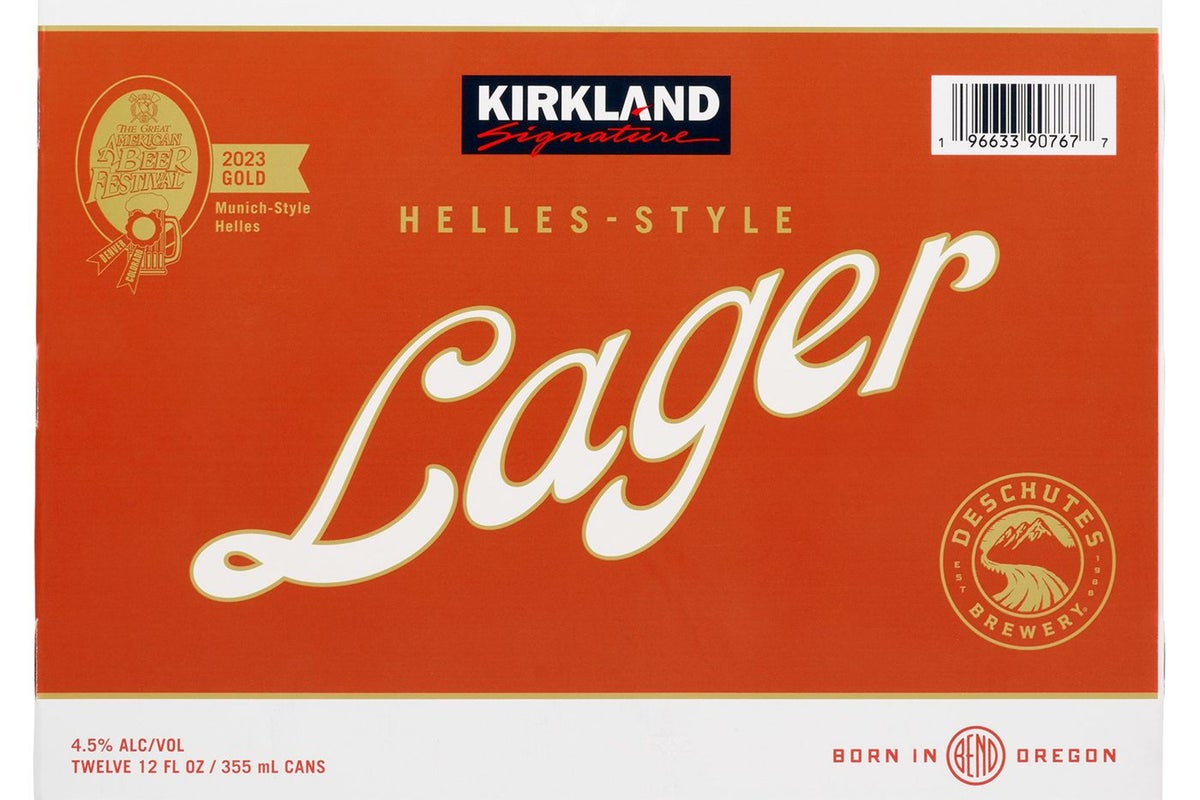
Costco is breaking up with its most successful beer experiment ever. If you walk into your local warehouse looking for that legendary 12-pack of Kirkland Signature Helles Lager, you're running out of time. Production is grinding to a halt. By autumn, these boxes will vanish entirely from shelves.
The internet is already mourning. On paper, the decision looks completely backwards. Costco is officially discontinuing beer created with an Oregon brewery, despite winning major global awards for it. We are talking about the World Beer Cup here. This isn't some small local county fair ribbon. The collaboration with Bend, Oregon-based Deschutes Brewery yielded a silver medal in 2025 and a bronze medal in 2026. Experts loved it. Regular folks obsessed over it. A premium craft-level lager priced at a jaw-dropping $13.99 for 12 cans seemed like a permanent win for everyone involved.
Then the corporate axe fell.
Many shoppers assume a product gets canceled because it failed to sell or because the quality slipped. That's a massive misunderstanding of how big-box retail works. This termination wasn't a failure of quality or consumer passion. It was a victim of cold, hard retail economics, capacity limits, and the brutal reality of private-label margins.
Why Costco Discontinuing Beer Makes Total Business Sense
To understand why a retail titan walks away from an award-winning darling, you have to look at the math behind the warehouse model. Costco doesn't care about accolades. They care about volume, margin, and velocity.
The $13.99 price point for a craft Munich-style Helles is insanely low. Under normal circumstances, an independent brewery sells a four-pack of sixteen-ounce craft lager for that exact same price. Shifting that equation to a 12-pack of twelve-ounce cans requires an extreme sacrifice of profit margins. Costco squeezes its suppliers tight. They don't tolerate high wholesale costs because their entire corporate identity revolves around passing rock-bottom pricing to members while leaning heavily on membership fees for their actual profit.
Standard Craft Lager Retail: $13.99 per 4-pack
Kirkland Signature Helles Retail: $13.99 per 12-pack
For Deschutes, the partnership served a very specific purpose at a very specific moment in time. Look at the timeline. In 2023, Deschutes experienced a rough patch, watching its year-over-year volume sales slump by 11%. They had excess brewing capacity sitting idle in their massive Oregon facilities. Idle tanks cost money. When Costco knocked on the door looking to revamp its private-label beer program in late 2024, Deschutes had the physical space and the operational incentive to say yes.
The strategy paid off immediately. In 2024, the year the partnership launched, Deschutes saw their volume sales jump by 9%. They filled their empty tanks and kept their production staff busy. They put liquid in cans and moved millions of gallons of product through Costco's massive distribution network.
But high volume with razor-thin profit margins is a dangerous long-term strategy for a craft brewer. Recent data from market research firm Circana shows that Deschutes' own independent brand sales are up over 8% in grocery stores. Their core lineup is growing. They don't need to fill empty tanks with low-margin private-label liquid anymore. When your own higher-margin flagship beers start selling well again, dedicating massive chunks of your brewing schedule to a super-cheap contract for a retail giant becomes a massive operational burden.
The Mythical Liquid Wearing a Different Jersey
The biggest secret of the Kirkland Signature Helles Lager is that it wasn't a new recipe cooked up in a corporate test kitchen. It was an elite, pre-existing craft beer wearing a different jersey.
Deschutes took one of their top-tier, award-winning creations named Prinz Crispy and packaged it inside those familiar red, white, and black Kirkland boxes. Prinz Crispy had already won a gold medal at the Great American Beer Festival back in 2023. It was a known winner. Costco simply used its massive buying power to buy the rights to distribute that exact fluid at a steep discount to their club members.
This model worked brilliantly for a short window. Beer geeks quickly figured out the trick. They realized they were buying genuine, top-shelf Oregon craft lager for less than the price of a generic macro-brew light beer.
The partnership also produced a second, far rarer product: Kirkland Signature Vintage Ale, an imperial stout aged in bourbon barrels. That beer was so rare it felt like a mythical creature to most shoppers. Many warehouses never even saw a single shipment. While the Helles Lager dominated the spotlight, the barrel-aged stout proved that Costco wanted to elevate its reputation among serious beverage enthusiasts.
Moving Past the Ghost of Kirkland Light
This wasn't Costco's first rodeo in the beer world, but it was certainly their most respectable one. To understand why this cancellation hurts fans so much, you have to remember what came before it.
For years, Costco offered Kirkland Signature Light Beer. It was sold in massive 48-packs for an absurdly low price. It also tasted notoriously terrible. Brewed by a subsidiary of Minhas Craft Brewery in Wisconsin, that old light lager became the butt of endless internet jokes. Reviewers compared the taste to wet cardboard, metal, and skunked water. It was eventually dragged off the market, leaving a massive void in the warehouse's house-brand alcohol portfolio.
When Costco teamed up with Deschutes, it was an explicit attempt to scrub that bad reputation away. They wanted to prove that Kirkland Signature could do for beer what it already did for vodka, wine, and golf balls. They proved it. The World Beer Cup medals validated the entire concept.
They accomplished their goal. They rescued their reputation. Now, they are stepping away while they are ahead.
What Happens to the Beer Supply Now
Deschutes CEO Peter Skrbek recently sent a formal memo to distributors confirming that production is winding down. Costco will continue to purchase the remaining inventory that has already been brewed, but no new batches are being scheduled for the warehouse chain.
If you love this specific liquid, don't panic completely. The end of the Costco contract doesn't mean the recipe is dead. Industry insiders have already hinted that Deschutes has alternative plans for the underlying lager. Because the beer is essentially Prinz Crispy, the brewery can easily pivot production back to its own branded packaging.
You'll still be able to drink it. You just won't be able to buy a giant flat of it for fourteen bucks anymore.
Your Actionable Playbook for the Final Costco Beer Run
If you want to secure your share of this award-winning lager before it disappears into the history books, you need to act intentionally. Do not assume your local warehouse will have stock sitting around until winter.
- Check the regional status: The Deschutes collaboration was widely distributed across the country, though certain states like Texas missed out entirely due to complex local liquor distribution laws.
- Look for the October cutoff: Most industry distribution reports indicate that existing inventory will be entirely exhausted by September or October.
- Scan the lower shelves: Warehouse workers frequently consolidate expiring or discontinued product lines onto the bottom racks of the alcohol aisles or place them near the center aisle endcaps to clear space for seasonal fall items.
- Track the original name: Once the Kirkland boxes disappear, keep your eyes on local independent bottle shops and grocery stores for Deschutes Prinz Crispy. It is the exact same liquid experience, just sold in traditional craft packaging.
The era of elite, award-winning craft beer sold at budget warehouse prices is officially over. Buy what you can find right now, because once the remaining inventory clears out, this legendary bargain is gone for good.