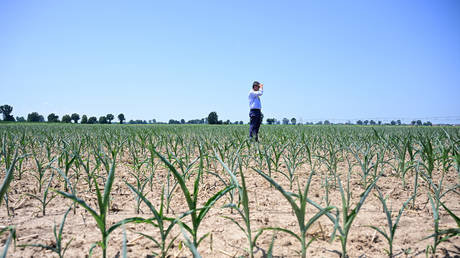
The fields of Europe aren't just dry this year. They’re effectively broken.
If you’re looking at the headlines and assuming this is just another dry summer, you’re missing the point. We aren’t talking about a temporary dip in production. We are talking about a systemic failure of the agricultural heartland. From the grain-heavy plains of France to the rice paddies of Italy, the continent is reeling from a drought that’s erasing harvests at a scale we haven't seen in decades.
This isn't just about the weather. It’s about a 180 billion euro hit to the economy and a supply chain that’s choking on its own lack of water.
The anatomy of the 2026 harvest collapse
Forget the "drought" buzzword for a second. Look at the data. In France, Europe’s biggest grain producer, the maize harvest is expected to be 35% lower than 2025 levels. To put that in perspective, that’s about 9 million tonnes—a quantity that takes us back to 1980 levels of production.
It’s not just maize. Vegetable yields are getting shredded. We’re seeing shortfalls of 40% for peas, 60% for broccoli, and in some areas, artichoke production has vanished entirely. When you see numbers like that, it’s not a "bad year." It’s an existential threat to food security across the bloc.
I’ve spent time looking into the logistics of these agricultural failures, and the reality is ugly. It isn’t just that plants aren’t growing; it’s that the infrastructure to move what does grow is crippled.
Take the Rhine. It’s the industrial artery of Germany, carrying 80% of its inland waterway freight. Right now, it’s effectively a puddle in sections. Oil tankers are carrying a fraction of their capacity—350 tons instead of 1,500—because the water is too shallow to support the weight. When you can’t move fertilizer, fuel, or feed efficiently, the entire food system becomes exponentially more expensive and less reliable.
Why this time is different
You might be thinking, "We’ve had droughts before." And you’d be right. But this one is hitting differently because it’s relentless.
Climate research indicates that these conditions are now 80 times more likely in western Europe due to human-induced heating. This isn't a statistical anomaly anymore. It's the new operating environment.
Farmers are stuck in a catch-22. In the Netherlands, many are banned from using stream water to irrigate. Even those who can irrigate are seeing yields drop by a third because the ambient heat—often pushing past 35C—literally cooks the crops. It’s not just lack of water; it’s the combination of scorching air and parched soil that turns a productive farm into a dust bowl.
The ripple effect on your wallet
The cost of this crisis will land squarely on your kitchen table.
Livestock farmers are hurting because the price of winter feed is skyrocketing. Hay production is down by roughly 30% compared to the 1989-2018 average. If a dairy farmer can't afford to feed their cows, or if the cows are suffering heat stress—which, mind you, begins at just 25C—the milk yield drops. When milk, grain, and vegetables all hit a supply wall simultaneously, prices don't just "go up." They spike.
We are seeing:
- Milk yields down 10-15% across several regions.
- Wine production in Spain projected to fall by 20%.
- Hops yields for beer production stunted in the Czech Republic.
The impact isn't just felt by the farmers. It hits the industrial food processors, the local grocery stores, and eventually, everyone's household budget.
What happens next
If you are waiting for a sudden return to "normal," you’ll be disappointed. The current situation demands a radical shift in how we approach European agriculture.
Start paying attention to supply chains
If you’re involved in food or retail, stop assuming your suppliers will deliver on time. Look for regional diversification. If your grain comes exclusively from the Po Valley or the central French plains, you’re exposed to massive risk. Start vetting suppliers in cooler, more water-secure zones or those with proven drought-resistant crop rotation.
Support infrastructure adaptation
We need to talk about water management, not just planting seeds. Farmers who are surviving right now are the ones who invested in high-efficiency irrigation and soil moisture retention years ago. It’s expensive, and it’s a pain to install, but the alternative is total loss.
Diversify your food sources
At a household level, stop betting on single-region staples. We’re seeing a shift where even the most "reliable" crops are failing. Pay attention to labels and sourcing. If you see prices for staples like potatoes, corn, or dairy moving, understand that this is the market adjusting to a structural supply drop.
This isn't a temporary glitch. It’s a systemic warning shot. The days of assuming food will always be cheap and plentiful in Europe are effectively over. Adapt your expectations accordingly.