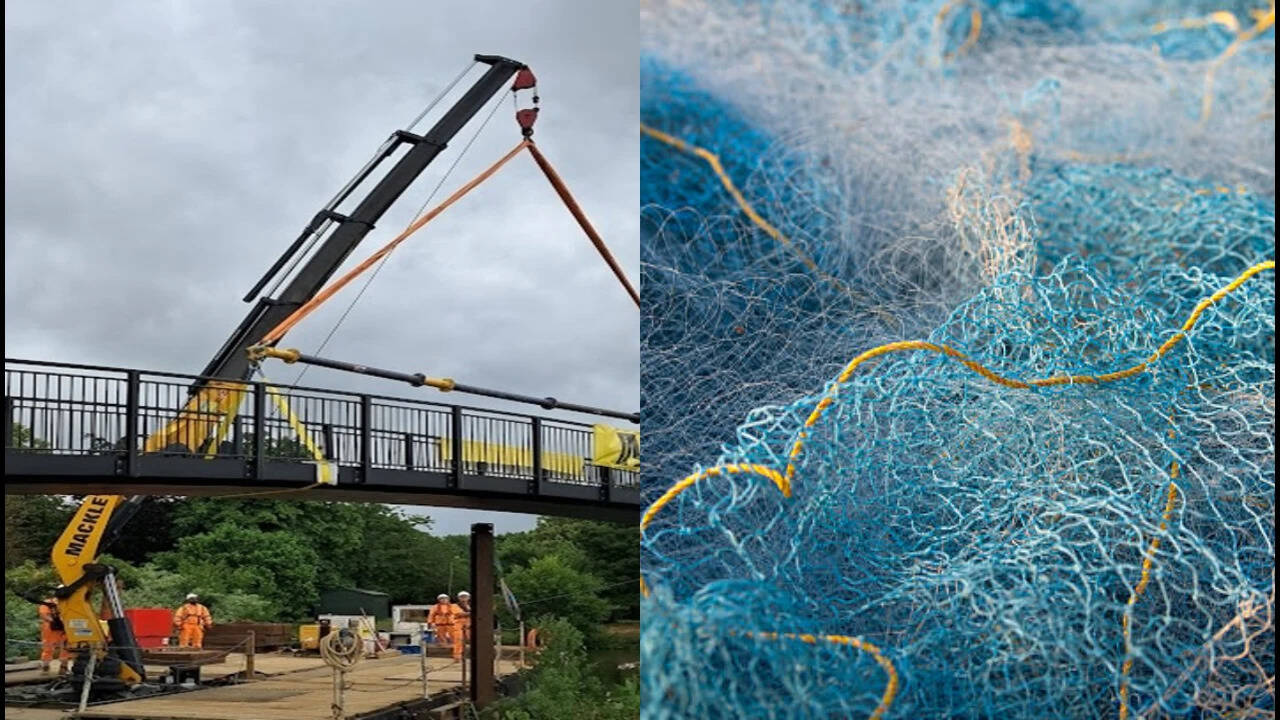
Discarded commercial fishing gear usually ends up rotting in marine ecosystems or burning in energy-recovery facilities. But a project completed by the Environment Agency in Kent, England changed that narrative completely. Engineers took old fishing nets and turned them into a functional 16-metre footbridge crossing the entrance to Twyford Marina in Yalding.
If you are wondering why civil engineers are suddenly getting excited about waste materials, the answer comes down to weight, emissions, and logistics. Traditional infrastructure projects rely heavily on massive quantities of reinforced concrete and steel. These conventional methods demand heavy machinery, large deep-set foundations, and constant long-term maintenance.
This Medway Valley Walk footbridge operates differently.
The Engineering Behind the Recycled Net Bridge
The core structure and deck of this crossing are built from fibre-reinforced polymer, commonly known as FRP. This specific polymer blend incorporates recycled old fishing nets. Why does this matter? FRP offers an exceptional strength-to-weight ratio.
The entire bridge weighs only 3.5 tonnes. Compare that to a conventional concrete-and-steel structure of identical dimensions, and you will see a massive difference. Because the bridge is remarkably lightweight, engineers didn't need to dig massive, invasive foundations into the riverbank. Smaller footings mean less excavation, lower carbon emissions during manufacturing and installation, and significantly less site disruption.
Furthermore, construction teams utilized modular blocks that fit together like a Lego set with little to no mortar required, replacing traditional reinforced-concrete retaining walls. Most of these blocks can even be placed by hand.
Transporting a Bridge by Land and Sea
Building the bridge was only half the challenge; getting it to a tight, awkward site required some creative logistics.
The deck fabrication happened in the Netherlands before the structure shipped to Nottinghamshire for handrail installation. From there, a truck hauled the 3.5-tonne structure by road directly to Yalding. Its final leg of travel involved a barge journey up the River Medway. A crane hoisted it smoothly into place once it arrived at the marina.
This multi-modal journey highlights a major benefit of lightweight composite materials. If you try to deliver heavy, prefabricated concrete slabs to a restricted rural waterway site, you usually face massive logistical hurdles, road closures, and heavy carbon output. Lightweight structures open up new possibilities for sites where heavy machinery cannot go.
What This Means for Future Infrastructure
Civil engineering projects have a reputation for being slow to adapt to circular economy principles. Concrete production alone accounts for a staggering share of global carbon dioxide emissions. Projects like the Yalding footbridge prove that alternative materials can handle structural loads effectively.
You might wonder about durability. FRP does not rust like traditional steel, meaning it demands far less maintenance over its design lifespan. Salt, moisture, and heavy pedestrian traffic degrade conventional materials quickly, but composite polymers resist these environmental stressors with ease.
If you walk across the Medway Valley route today, you are stepping on waste pulled straight from the sea. It is a pragmatic shift toward sustainable civil engineering that actually works in practice, not just on paper.