He isn't there.
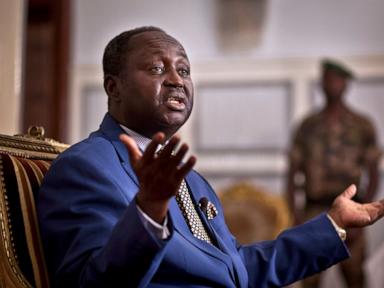
That is the blinding, inescapable reality inside the Special Criminal Court in Bangui right now. François Bozizé, the former president who ruled the Central African Republic with an iron fist for a decade, is currently 2,000 miles away lounging in Guinea-Bissau. Meanwhile, judges in his home country just started his trial for crimes against humanity.
Trying a dictator in absentia always feels a bit like punching a ghost. It looks dramatic on paper, but the courtroom lacks the emotional gravity that victims deserve. Yet, dismissing this trial as empty symbolism ignores a massive shift in how African nations handle high-level war crimes. For the first time, a specialized hybrid court—built with both local and international judges—is actively dissecting the dark underbelly of a living former president's regime on his home turf.
The immediate question driving this global interest is simple. Can you actually deliver justice when the man who pulled the strings is missing?
The Bossembélé Black Hole
The prosecution's case centers on a specific four-year window between February 2009 and March 2013. During this time, Bozizé’s infamous Presidential Guard turned a civilian prison and a military training camp in the town of Bossembélé into a literal slaughterhouse.
We aren't talking about abstract administrative choices here. The court records detail brutal, systemic atrocities:
- Enforced disappearances where political opponents simply vanished into thin air.
- Systemic torture used as a routine tool for interrogation and intimidation.
- Extrajudicial executions carried out by state forces with zero oversight.
The judges aren't arguing that Bozizé personally swung the hammer. Instead, they are using the doctrine of command responsibility. The prosecution holds "serious and consistent evidence" that Bozizé, acting as the supreme military leader, knew exactly what his guard was doing in Bossembélé and chose to let the blood flow.
Three Men in the Dock
While Bozizé's chair remains empty, the trial isn't entirely a ghost show. Three of his former top military enforcers are sitting in the courtroom, wearing prison jumpsuits instead of dress uniforms.
Eugene Barret Ngaikosset, Vianney Semndiro, and Firmin Junior Danboy were arrested between 2021 and 2022. Unlike their former boss, they couldn't escape the country. Their presence changes the dynamic entirely. They can't run, and they can't hide behind diplomatic immunity.
Bozizé's Reign: Seized power in a 2003 coup. Overthrown in 2013.
The Charges: Murder, rape, torture, and disappearances (2009–2013).
The Enforcers: Three co-defendants are currently in custody facing the court.
Human rights groups like Amnesty International argue that the absence of the main architect seriously wounds the trial's legitimacy. Victims want to see the man himself look them in the eye. But having his top lieutenants present means the inner workings of his terror machine will still be fully exposed to the public.
The Race Against Time and Money
Setting up the Special Criminal Court (SCC) in 2018 was a massive gamble. Hybrid courts—mixing local Central African judges with international magistrates—are notoriously difficult to run. They require immense funding, tight security in volatile regions, and absolute political willpower.
Right now, the SCC is bleeding cash.
The court's current mandate expires in 2028, and international donors are getting fatigued. There is a very real threat that the court could run out of money before finishing its work. Over 30 suspects with active SCC arrest warrants are still roaming free across Central Africa. If the international community pulls funding now, those warrants become useless scraps of paper.
This trial is as much about proving the court's own viability as it is about judging Bozizé. They need a landmark conviction to prove to global donors that investing in local hybrid justice works better than shipping suspects off to the International Criminal Court in The Hague.
What Happens Next
Don't expect Bozizé to catch a flight to Bangui anytime soon. He has already been sentenced to life at hard labor in a separate 2022 trial for conspiracy and rebellion. He knows exactly what waits for him if he returns.
If you want to see how this story unfolds, keep your eyes on Guinea-Bissau. The real test of this trial isn't what happens inside the courtroom in Bangui; it's whether regional diplomatic pressure forces Guinea-Bissau to finally honor the international arrest warrant and extradite the 79-year-old former dictator. Until that happens, justice remains half-served.
To better understand the region's long struggle with accountability, check out this detailed look at previous CAR court rulings which highlights how the judicial system has historically handled political actors accused of war crimes.