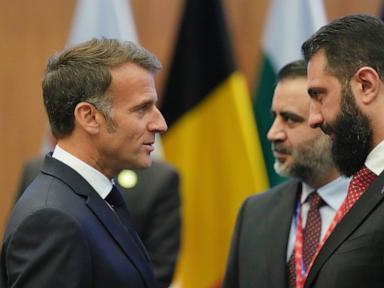
French President Emmanuel Macron just touched down in Damascus. It is a massive deal. By stepping onto Syrian soil, he became the first major Western leader and European Union head of state to visit the country since rebels overthrew Bashar al-Assad in late 2024.
While some capitals hesitate, Paris is diving straight in. Macron wants to position France as the primary Western broker in the new Middle East. He is standing side-by-side with Syrian President Ahmad al-Sharaa, a man who once led Islamist militants but now wears tailored suits and courts global investors. For a closer look into this area, we recommend: this related article.
This isn't a sudden whim. It is a calculated, high-stakes gamble. If you want to understand why France is moving so fast while the rest of the West watches from the sidelines, you have to look at the business contracts, the upcoming NATO summit, and a deep-seated historical obsession.
The Business Behind the Diplomacy
Macron did not travel alone. He brought a heavy-hitting delegation of French corporate titans with him. The chief executive officers of energy giant TotalEnergies and shipping colossus CMA CGM are right there on the tarmac in Damascus. That tells you everything you need to know about France's true intentions. To get more details on this topic, extensive analysis is available on USA.gov.
Syria is shattered. Thirteen years of brutal civil war left the country's infrastructure in absolute ruins. Rebuilding it will take hundreds of billions of dollars. While other nations offer vague promises, French companies want to lock down concrete deals immediately. They want to rebuild the ports, restart the energy grids, and secure supply chains before American or Chinese firms can squeeze them out.
Syria has already signed multiple memorandums of understanding with various states. None of those early deals have yielded actual results yet. Macron knows this. By showing up in person with corporate backing, he is trying to turn paper promises into real, active projects that benefit French commerce.
The Ghost of the French Mandate
You cannot understand French foreign policy in the Levant without looking at history. France ruled Syria under a League of Nations mandate from 1923 until 1946. That history runs deep. Paris has always viewed itself as a natural protector and major player in the region.
Macron spent the last few years trying to reassert this historic role. He visited Lebanon in early 2025. He made high-profile trips to Saudi Arabia. Now, he is completing the circle in Damascus. To the French diplomatic elite, this visit is a return to form. They see it as fulfilling a historical responsibility to guide Syria back into the international community.
Critics think it looks desperate. They argue Macron is chasing a bygone era of global influence that France no longer possesses. But for Paris, staying quiet while Turkey, Russia, and Gulf states carve up the new Syria was never an option.
Laundering a Militant Past
The most controversial part of this entire dynamic is the man Macron is meeting. Ahmad al-Sharaa was not always a diplomat. He used to go by the name Abu Mohammed al-Jolani, the commander of Hayat Tahrir al-Sham, a militant group that once held formal ties to al-Qaeda.
For years, Western intelligence agencies hunted him. Now, he is the recognized leader of a transitional Syrian state.
Macron has been working to normalize al-Sharaa for a while. He hosted the Syrian leader at the Elysee Palace in Paris back in May 2025. During that meeting, Macron openly pressured the European Union and the United States to dismantle their heavy sanctions packages against Damascus. He succeeded. Most of those restrictions are gone now.
Many Western governments remain deeply uncomfortable with this arrangement. They worry about the treatment of religious minorities. They worry about women's rights under an Islamist-led administration. They wonder if al-Sharaa's promises of a pluralistic, democratic transition are just a front to secure foreign cash.
Macron is choosing to ignore those anxieties in favor of pragmatism. His logic is simple. A stable, secular-leaning Islamist government is better than total chaos or a return to ISIS.
Frontrunning Donald Trump in Ankara
The timing of this trip is highly strategic. Macron leaves Damascus and heads straight to Ankara, Turkey, for a critical NATO summit. Syrian President al-Sharaa is also traveling to that summit. More importantly, al-Sharaa is scheduled to hold a high-profile meeting there with US President Donald Trump.
Macron wants to get ahead of the Americans. By holding bilateral talks in Damascus first, Macron ensures that France sets the terms of Western engagement before Trump can dictate the narrative.
The political environment in the Middle East is currently experiencing a rare window of calm. The brief, intense war involving Iran and Lebanon has cooled down. Syria managed to stay out of that specific fight, proving to Western observers that the new government in Damascus can exercise restraint. Macron is using this precise moment of stability to solidify alliances before the regional dynamics shift again.
The Opposition from Jerusalem
Not everyone is cheering for Syria's new look. While Washington and Paris show willingness to let Damascus rebuild, Israel remains highly skeptical. Some Israeli officials still view the new Syrian government as an inherently hostile actor. The rhetoric coming out of Jerusalem has occasionally been more aggressive toward al-Sharaa's administration than it ever was toward Assad.
This creates a delicate diplomatic tightrope for France. Macron has to balance his economic push into Syria with his security commitments elsewhere in the region. One misstep could provoke cross-border tensions that ruin all of France's hard-won commercial agreements.
What Happens Next
The success of this trip will not be measured by the handshakes at Damascus International Airport. It will be measured by what happens in the coming months. If you are watching this situation unfold, look for these specific developments to judge whether Macron's gamble pays off.
Watch the port investments. If CMA CGM takes over operations at major Syrian ports like Lattakia or Tartous, France has won the economic race.
Track the oil and gas sector. Look for whether TotalEnergies secures exploration rights in eastern Syria, which would signal a total shift in regional energy control.
Monitor the NATO summit outcomes. See if the joint statements from Trump and al-Sharaa echo the framework that Macron established during his Damascus visit.
France has made its move. It stepped out ahead of the global community to embrace a transformed Syria. Now, the rest of the world has to decide whether to follow Macron's lead or let Paris run the show alone.