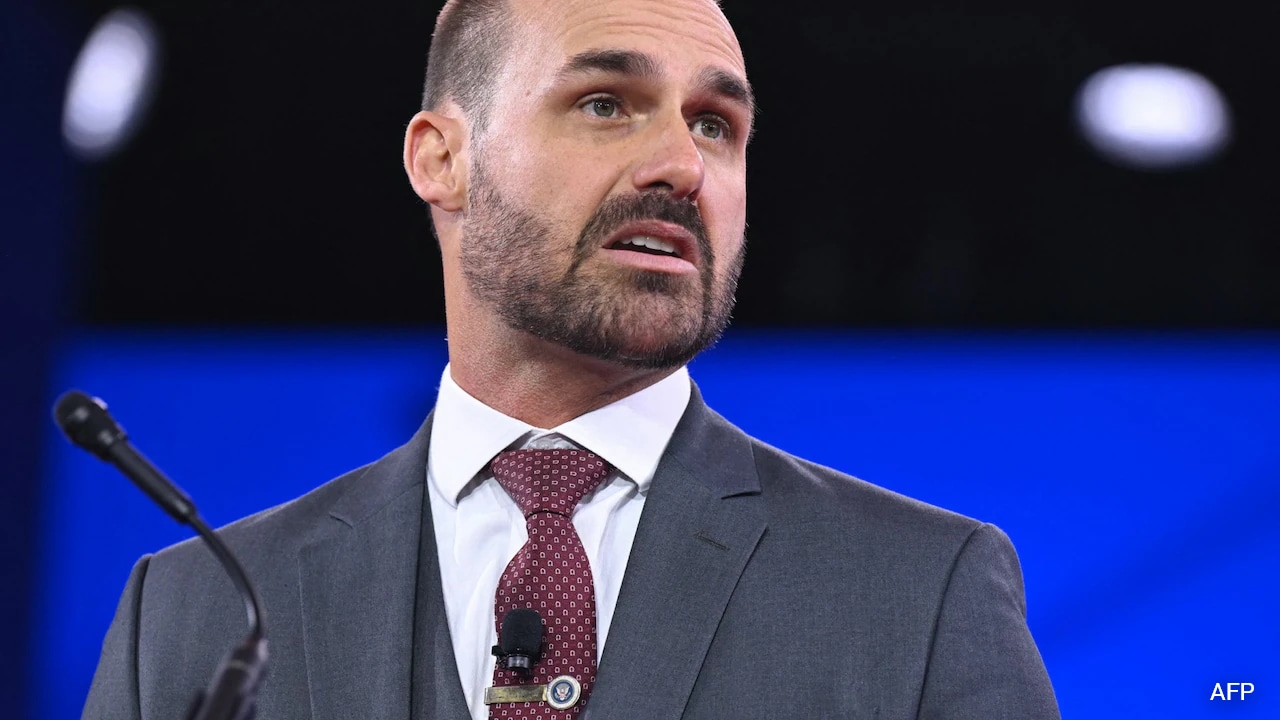
Eduardo Bolsonaro just landed permanent residency in the United States. It wasn't a standard diplomatic arrangement or a routine visa approval. The son of former Brazilian President Jair Bolsonaro was granted an EB-1A green card—a category typically reserved for people with extraordinary ability in fields like science, arts, or sports.
That detail raised eyebrows immediately across Brasilia and Washington. How does a former Brazilian lawmaker, who was recently convicted by his home country's highest court, land one of the most coveted immigration statuses in America? For another view, read: this related article.
To understand what happened, you have to look past the standard political spin. This isn't just about an individual relocating. It highlights a sharp diplomatic divide, a legal nightmare back home, and a calculated political move that keeps the Bolsonaro family active on the international stage.
The EB-1A Classification and How He Got It
The United States Citizenship and Immigration Services (USCIS) reserves the EB-1A visa for individuals who demonstrate extraordinary ability in their field. Usually, that means Nobel laureates, Olympic athletes, top-tier scientists, or renowned artists. Applicants don't need a specific job offer, but they do have to prove sustained national or international acclaim. Further analysis on the subject has been provided by USA.gov.
Eduardo Bolsonaro claimed his qualification stems from his political career and his foreign policy leadership during his time as a federal deputy in Brazil. He applied about a year before approval, right around the time he decided to stay in the United States.
Critics argue the approval feels distinctly political. Supporters argue his work building cross-border conservative coalitions qualifies as high-level political strategic work. Either way, securing EB-1A status gives him permanent residency and a clear path toward US citizenship.
A Safe Haven Facing Legal Convictions
The timing of this green card isn't coincidental.
In Brazil, Eduardo Bolsonaro faces severe legal penalties. Brazil's Supreme Court recently sentenced him in absentia to four years and two months in prison. The charges centered on coercion and illegal lobbying efforts aimed at convincing foreign officials—specifically within the United States—to impose trade tariffs and sanctions against Brazilian institutions.
His father, Jair Bolsonaro, is serving a 27-year sentence in Brazil after being convicted for plotting a military coup following the 2022 elections.
Eduardo Bolsonaro left Brazil for the US in early 2025, claiming political persecution. He openly stated that he won't return home unless granted full political amnesty. From his perspective, staying in America is his only way to avoid prison. From the perspective of Brazilian prosecutors, he's a fugitive evading a lawful sentence.
What Green Card Status Actually Gives Him
Having permanent residency changes the entire legal dynamic.
- Protection from routine deportation: A green card holder cannot be removed from the country without formal administrative procedures.
- Full employment rights: He can work, run businesses, or set up organizations without temporary visa restrictions.
- Travel flexibility: He can travel internationally and re-enter the US without applying for new entry visas.
- Path to citizenship: He becomes eligible for naturalization after five years of permanent residency.
Does a green card shield someone from extradition? No. Extradition depends on treaties between nations and executive decisions by the US State Department and Department of Justice. However, permanent resident status makes quick removal almost impossible, giving legal teams plenty of room to fight extradition requests in court.
Diplomatic Fallout Between Brasilia and Washington
This development places significant strain on US-Brazil relations.
For the Brazilian government led by President Luiz Inácio Lula da Silva, seeing a convicted former lawmaker receive green card status in the US feels like direct interference. Brazilian officials view Eduardo Bolsonaro's lobbying activities in Washington as attempts to undermine Brazil's judicial sovereignty and economic stability.
On the flip side, American political factions see him as an ally. During his time in the US, Eduardo cultivated deep ties with conservative groups, speaking at major events and pushing for policy decisions that align with his family's political stance.
The situation shows how political figures can use immigration pathways to shield themselves during intense legal battles in their home countries.
What You Should Watch Next
If you are tracking international politics or legal diplomacy, key indicators will reveal how this case develops:
- Formal Extradition Requests: Watch whether Brazil's Supreme Court issues a formal request to extradite Eduardo Bolsonaro to serve his prison sentence.
- State Department Responses: See how US officials handle requests regarding foreign nationals who hold permanent residency status.
- Political Activity in the US: Track how Eduardo uses his permanent residency status to build financial and political backing from abroad.
Eduardo Bolsonaro secured a stable foothold in the US. Whether that status holds up against international legal pressure remains the real test.