Municipal planning sounds boring until a bulldozer shows up outside your front door.
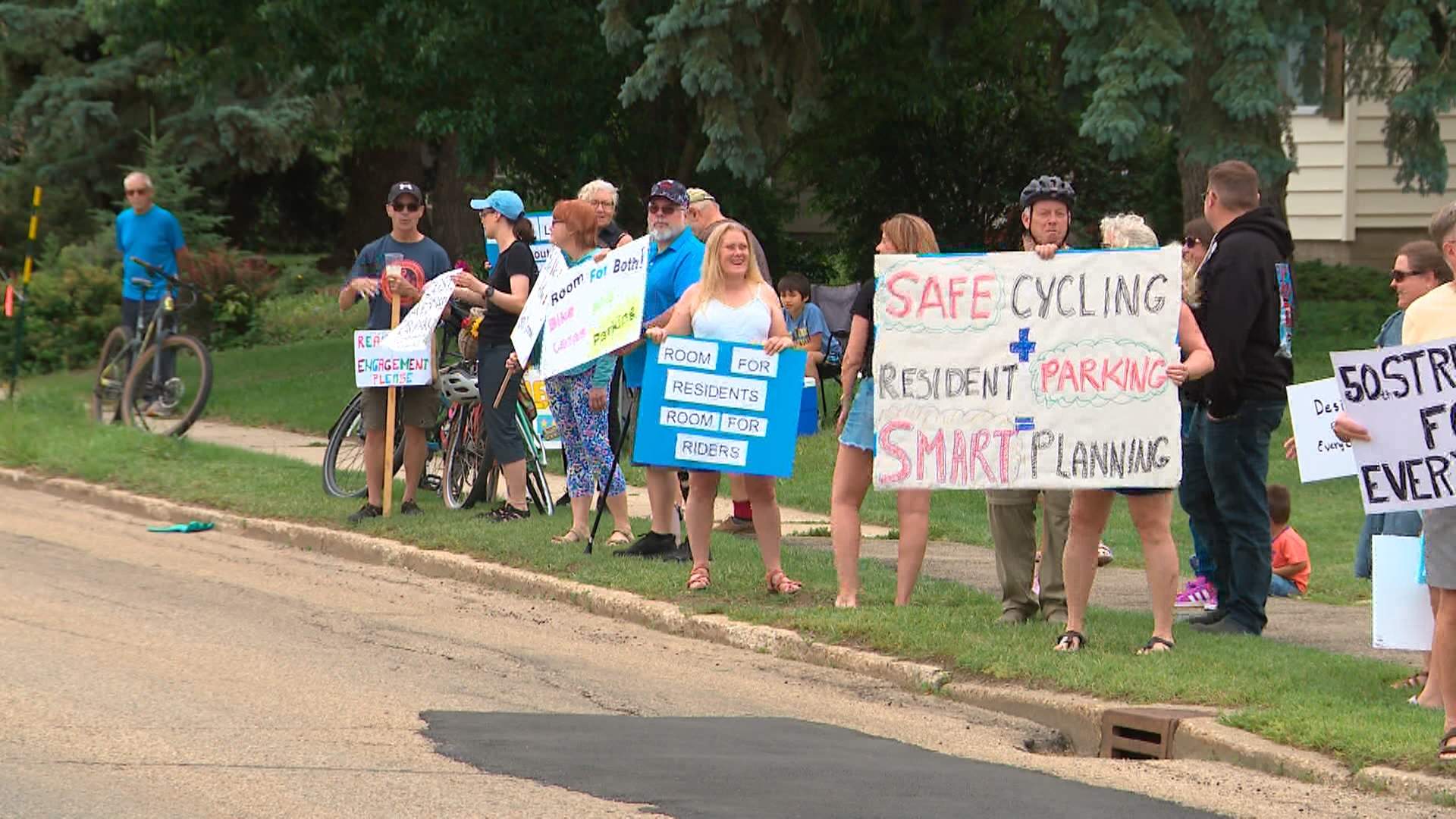
Edmonton city council just hit the brakes on a $2.4-million bike lane project along 50 Street after an immediate, furious wave of community pushback. Residents from Fulton Place, Capilano, and Gold Bar gathered Monday evening to protest the reality of the city's Active Transportation Network Expansion plan. By Tuesday afternoon, council voted to rethink the entire layout.
This isn't just a localized NIMBY spat. It is a classic example of what happens when rapid infrastructure goals collide with the lived reality of established residential neighborhoods.
The Friction Over Free Aspalt
The city's original plan was simple and, on paper, highly efficient. To install protected, one-way bike lanes connecting 102 Avenue to 109A Avenue, Edmonton planned to eliminate all curbside parking along both sides of 50 Street.
City planners backed this move with data. A recent parking utilization review showed that average parking occupancy along this stretch sat between zero and 27 percent. On any given day, that is only about 50 vehicles spread over multiple blocks. To an urban planner looking at a spreadsheet, wiping out 340 potential parking stalls to build safe infrastructure for cyclists looks like an easy win.
To the people living in those 200 homes, that spreadsheet is a fantasy.
Established in the late 1950s and early 1960s, these neighborhoods feature houses built on a slope terraced down toward the North Saskatchewan River. Many properties lack rear lane access entirely. The homes that do have back alleys feature detached garages built more than six decades ago. They were designed for a 1961 Chevy Biscayne, not a modern Ford F-150 or a family SUV.
If you cannot fit your vehicle in your garage, and the city deletes the space in front of your house, where do you go?
Seniors, Deliveries, and the Reality of Suburban Life
The debate quickly shifted from a simple drivers versus cyclists argument into a practical discussion about accessibility.
Original Plan vs. New Compromise
> Original Plan: Cost $2.4 Million | 0 Parking Stalls Retained | Full Median Preserved
> New Compromise: Cost $4.9 Million | ~50% Parking Stalls Retained | 1-2 Meters Cut From Median
For older residents, losing the curb means losing independence. If a senior relies on home care, where does the nurse park? When an Amazon delivery truck, an Uber, or an emergency medical vehicle arrives, they cannot simply park a block away or block a single-lane active transportation corridor.
The immediate safety issue shifted from protecting cyclists to protecting residents trying to step out of a vehicle without dropping straight into a live traffic lane or a separated bike track.
The Million Dollar Compromise
Responding to the community outcry, Ward Métis Councillor Ashley Salvador introduced a motion directing city administration to pivot to an alternate plan.
Unlike tighter, historic urban corridors, 50 Street is unusually wide. It features four lanes of vehicle traffic divided by a massive, 10-meter-wide grassy center median. The new, approved compromise involves shaving roughly one to two meters off that central boulevard to shift the vehicle lanes inward. This adjustment preserves about half of the curbside parking, specifically from 106 Avenue to 109A Avenue, where the highest concentration of vehicles actually park.
Mayor Andrew Knack called it a clear win-win scenario, arguing that preserving traffic lanes, parking, and cycling infrastructure simultaneously is exactly how thoughtful design should work.
But thoughtful design carries a steep price tag.
Modifying the concrete median, moving utilities, and reconstructing the roadway jumps the project cost from the initial $2.4 million to an estimated $4.9 million. The city is spending an extra $2.5 million to save roughly 30 to 50 parking stalls.
That massive cost inflation drew sharp criticism from some council members. Councillors Erin Rutherford, Jo-Anne Wright, and Jon Morgan voted against the alternative plan. Their argument was pragmatic: in a city facing a $10-billion infrastructure maintenance deficit, spending millions of dollars extra to protect a handful of parking spots for homes that already possess back-alley access is a poor use of limited public funds.
Provincial Oversight and the Shifting Political Landscape
This local debate is unfolding under a much larger political shadow. Alberta Transportation Minister Devin Dreeshen has openly targeted major municipal bike lane projects, proposing upcoming provincial legislation that would force cities like Edmonton and Calgary to get provincial approval before ripping out vehicle lanes or parking stalls.
The province wants hard data on traffic flow and parking impacts before municipalities can access funding pools like the Active Transportation Implementation Acceleration program. Edmonton’s swift pivot on 50 Street shows a council highly aware that if they do not find local compromises now, the provincial government might soon strip away their authority to build these networks altogether.
Actionable Next Steps for Neighborhood Infrastructure
If your neighborhood is facing similar infrastructure changes, waiting for the bulldozers to arrive is a losing strategy. You need to act before designs are locked in.
- Audit Your Street Data: Municipalities rely heavily on parking utilization studies. If the city claims your street is empty, log actual vehicle counts over a two-week period during peak hours, weekends, and evenings to counter inaccurate spreadsheet assumptions.
- Identify Geometric Alternatives: Look at the actual right-of-way width of your street. Is there a wide boulevard, an oversized median, or a sidewalk buffer that can be reallocated instead of defaulting to removing parking or driving lanes?
- Organize Around Accessibility: Pushback based on "I want to park my car" often fails. Focus advocacy on emergency service access, paratransit availability, home care workers, and elderly mobility, which carry far more weight in formal council debates.