For decades, textbooks taught a tidy, uniform story about the dawn of dinosaurs. When these ancient creatures first began expanding across the supercontinent of Gondwana some 210 million years ago, scientists assumed southern Africa hosted one giant, homogeneous community. Every corner of the landscape supposedly looked identical, filled with the exact same handful of species.
They were wrong.
The excavation and formal description of Musango matusadonaensis completely shatters that assumption. Unearthed along the rugged shores of Lake Kariba in northern Zimbabwe, this newly named Late Triassic dinosaur proves that ancient southern Africa was far more complex than anyone realized. Instead of a single uniform habitat, the region operated as a mosaic of distinct local ecosystems, each supporting its own unique cast of prehistoric characters.
Who Was Musango Matusadonaensis
Picture an animal built roughly the size of a modern car in length, yet remarkably light. Musango stretched about 4.5 meters (15 feet) from snout to tail, but tipped the scales at a mere 222 kilograms (490 pounds). Think of a creature matching the weight of a fully grown farm pig.
It belonged to the sauropodomorph group. These were the early, two-legged relatives of the colossal, long-necked giants like Diplodocus that would dominate the planet millions of years later. Unlike its massive descendants, Musango walked primarily on two legs and navigated a dense, highly seasonal landscape crisscrossed by ancient rivers and streams.
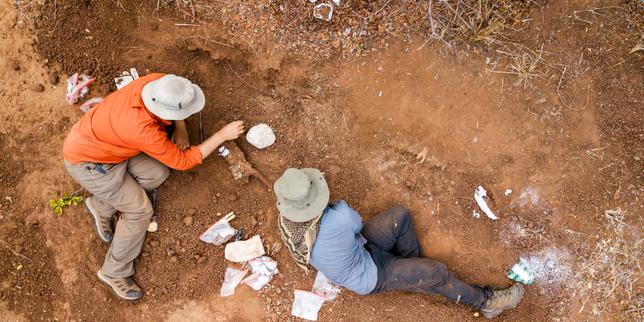
The discovery itself stems from a remarkably complete partial skeleton excavated back in 2018 by an international team of British, South African, and Zimbabwean scientists. Researchers recovered pieces of the spine, ribs, arms, legs, feet, and shoulder and hip bones. While the skull remains missing, scientists deduce it functioned as an herbivore or omnivore, browsing on lush vegetation growing along waterways.
Reading the Bones
Fossils tell stories if you know how to listen. Paleontologists analyzing a thin section of Musango's fibula discovered eight distinct growth rings. That detail reveals the animal was roughly eight years old when it died. More importantly, the spacing of those rings shows its growth had begun to slow down, meaning this specific individual was a late subadult or a nearly fully grown adult.
Even tougher was its physical journey through life.
Microscopic analysis of the same leg bone uncovered reactive bone tissue—evidence of an earlier serious injury or infection. Musango survived whatever trauma struck it years prior, healed completely, and lived to near adulthood in a harsh wilderness populated by lungfish, crocodile-like phytosaurs, and rival early dinosaurs.
The name itself honors that environment. Musango translates from the ChiShona language to mean "living in the bush," acknowledging the remote, rugged terrain of the discovery site. The species name, matusadonaensis, pays direct tribute to the neighboring Matusadona National Park.
Why This Fossil Rewrites the Prehistoric Map
Musango marks only the fifth dinosaur species ever formally described from Zimbabwe, following close behind 2024's discovery of Musankwa sanyatiensis.
For years, fossil hunting suffered from a heavy geographic bias, focusing intensely on Europe and North America while treating Africa as a blank slate. International collaborative efforts are rapidly flipping that script.
Lead researchers point out that finding unique species right next door to each other proves southern Africa was broken up into isolated ecological pockets. Environmental barriers or specific climate zones kept separate dinosaur communities from mixing freely.
We are only scratching the surface. Field teams already know of other undescribed specimens and unexamined bone beds waiting in the region. The rocks surrounding Lake Kariba hold vital keys to understanding the end-Triassic extinction event that eventually wiped out many of these early competitors and paved the way for absolute dinosaur dominance.
Keep your eyes open. The next major chapter of vertebrate evolution is waiting to be dug out of the Zimbabwean brush.