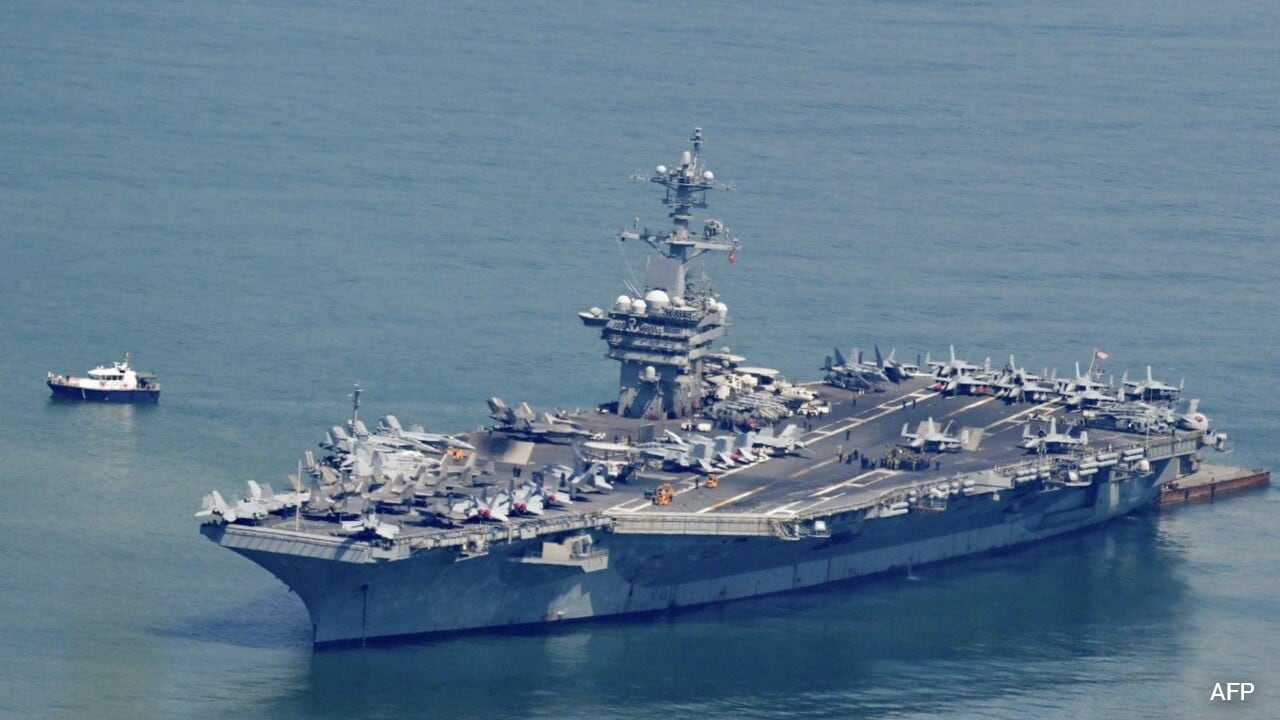
The United States Navy operates on a razor-thin margin of error, and nothing exposes that fragile reality quite like a single carrier rotation. When the USS George Washington packs up its operations in the Pacific to head toward the Middle East, it leaves a glaring temporary void in American maritime power across Asia. People love to talk about grand geopolitical strategies and the pivot to Asia, but ships run on steel, fuel, and human endurance. Right now, those resources are stretched to the breaking point.
If you are wondering why a single vessel movement triggers so much anxiety in Washington and Tokyo, you need to look past the political posturing. The real story isn't just about naval architecture or tactical chess matches against Beijing. It is about an overextended fleet caught between two volatile theaters of conflict, forcing the Pentagon to rob Peter to pay Paul.
The Cost of Endless Deployments
Let's address the immediate trigger behind this carrier shuffle. The USS Abraham Lincoln has spent well over 240 consecutive days at sea, far past its original schedule. Sailors aboard the Lincoln have faced immense strain, resulting in mounting concerns over crew fatigue, severe mental health challenges, and critical supply issues. Congressional scrutiny has intensified because you cannot endlessly flog sailors and machinery without paying a severe human and mechanical price.
The Navy needed an out, and the USS George Washington was designated to take over the burden in the Middle East. But shifting a carrier from the Pacific theater to the Central Command area of responsibility leaves a massive footprint gap. For all the talk about prioritizing the Indo-Pacific to deter China, the hard reality of ongoing operations in West Asia repeatedly forces Washington's hand.
When the Navy's 11 aircraft carriers are continuously cycled to manage simultaneous crises, maintenance backlogs spike at domestic shipyards. You cannot sustain a two-ocean navy with an inventory that forces ships into continuous, back-to-back deployments.
Does China Actually Gain an Opening?
Every time a U.S. carrier departs Asian waters, defense analysts panic about a sudden shift in the balance of power. Beijing has ramped up military exercises, operating near disputed shoals and conducting drills close to regional neighbors.
However, seasoned military observers note that the temporary absence of a floating airfield doesn't mean regional defense falls apart overnight. Greg Poling at the Center for Strategic and International Studies points out that a single carrier movement does not invite immediate invasions. Allies like Japan and the Philippines aren't sitting idly. They are accelerating defense integration, expanding joint patrols, and tightening security architectures.
At the same time, top U.S. officials have rushed to reassure partners. Visits by senior defense leaders to Manila and Tokyo underscore that special operations forces and regional rotational assets remain heavily engaged, even if the grand symbol of American power—the flat-top carrier—is temporarily steaming toward a different horizon.
The Vulnerability Dilemma
Beyond immediate crew fatigue and theater rotations, a deeper strategic question looms over these deployments. Thinkers like Michael Swaine from the Quincy Institute have argued that massive nuclear-powered carriers face growing vulnerabilities against modern anti-ship ballistic missiles and drone swarms.
When adversaries invest heavily in anti-access/area-denial capabilities, parking a multi-billion-dollar floating city near contested littorals becomes an increasingly risky proposition. The U.S. Navy is slowly realizing it must diversify its approach, relying more on distributed maritime operations, smaller surface combatants, and unmanned systems. Yet, the institutional addiction to the prestige and raw power of the aircraft carrier remains hard to break.
What Happens Next
The temporary exit of the USS George Washington from the Pacific highlights a structural crisis in American defense policy. The fleet is simply too small for the global commitments demanded of it. Until the U.S. shipbuilding industrial base catches up—or foreign policy shifts toward more sustainable commitments—the Navy will continue playing a high-stakes game of musical chairs with its most valuable warships.
Watch how regional partners respond in the coming months. If countries like Japan and the Philippines accelerate their own indigenous deterrence capabilities faster than expected, this carrier shuffle might just become the catalyst that forces Asia to truly take security into its own hands.