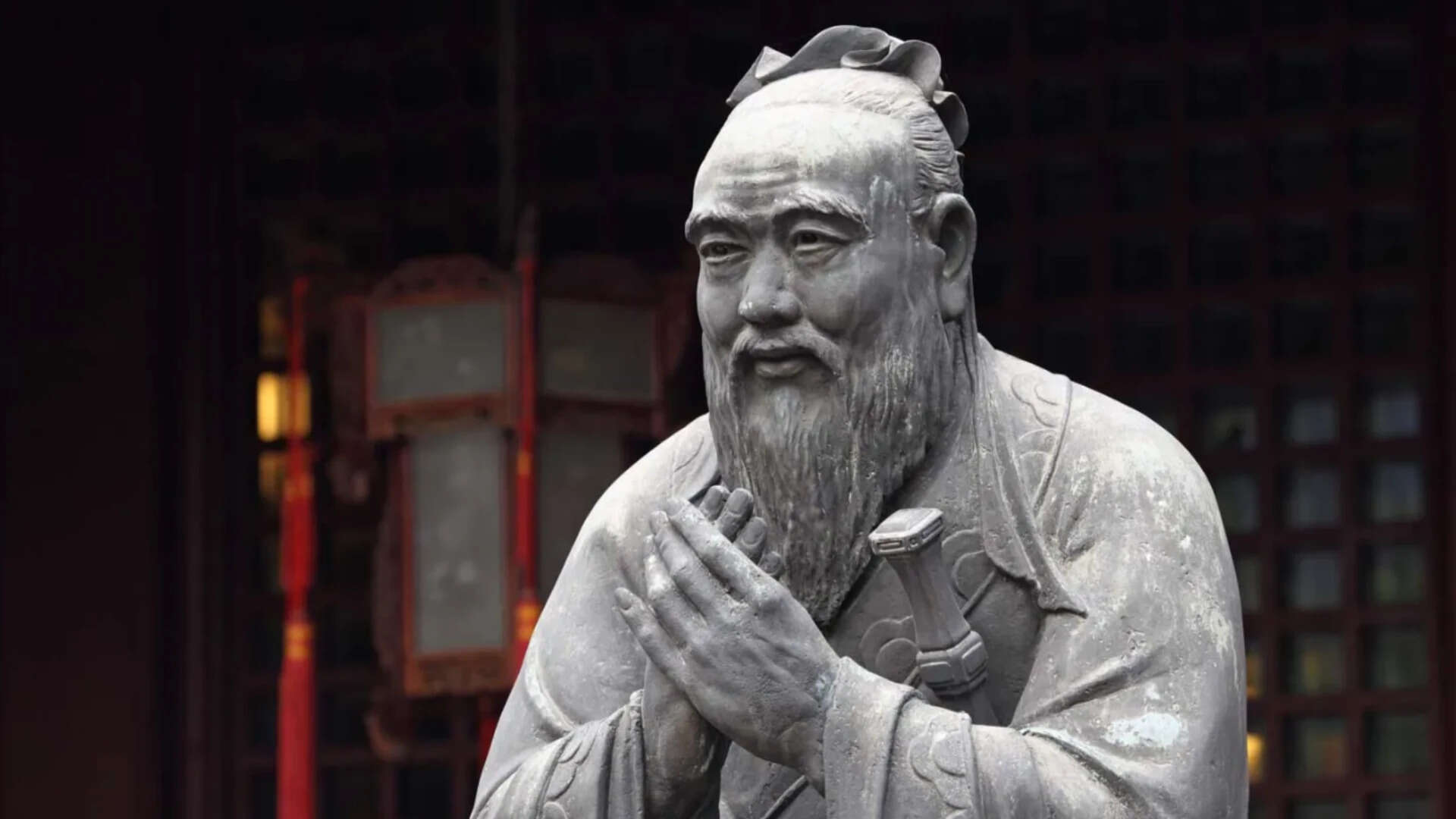
Most people use quotes to sound smart on LinkedIn, missing the actual point entirely.
Take the famous line attributed to Confucius: "If I am walking with two other men, each of them will serve as my teacher." It sounds like a pleasant, harmless bit of ancient wisdom. It gets slapped on motivational posters and dropped into self-help blogs to preach a generic message about being open-minded. Also making news lately: How A Single Island Release Saved Australia's Bilbies From Erasure.
But that interpretation completely misjudges what the philosopher was actually driving at.
When you look closely at the historical context of the text, this line isn't an invitation to passively absorb good vibes from your peers. It's a demanding, active mental exercise that forces you to confront your own worst habits. It turns everyone you meet—especially the people who annoy you the most—into a mirror. More details into this topic are explored by Cosmopolitan.
The Half of the Quote Everyone Ignores
Most articles drop the first sentence and move on. To truly understand what Confucius was doing, you need the complete passage from Book 7 of the Analects.
The full thought goes like this: "If I am walking with two other men, each of them will serve as my teacher. I will pick out the good points of the one and imitate them, and the bad points of the other and correct them in myself."
Suddenly, the sentiment changes. This isn't about finding a wise mentor or hanging out with an inspiring crowd. It's a split-screen mental strategy for navigating daily life.
Consider how this plays out in real time. You're walking with two companions. One acts with remarkable poise and integrity. The other is rude, loud, and incredibly self-centered.
The natural human reaction is to praise the first person and judge or gossip about the second. Confucius rejects both options. He argues that the flawed individual offers exactly as much educational value as the admirable one. The jerk becomes a living warning sign.
Instead of getting frustrated by bad behavior, you're supposed to use it as an immediate cue to audit your own actions. You ask yourself: Where am I acting exactly like that?
What the Original Language Reveals
We also need to clear up a major linguistic detail that translations mess up. The original Classical Chinese phrase is San ren xing, bi you wo shi yan (三人行,必有我师焉).
Literally translated, it means: "When three people walk together, one of them must be my teacher."
In ancient Chinese culture, the number three didn't necessarily mean exactly three individuals. It was frequently used as a stylistic way to say "a small crowd" or "a random group of people."
Basically, Confucius was walking down a dusty road, looking at an ordinary group of citizens, and telling his students that any random collection of humans contains an education.
This was a radical stance for the time. Confucius lived during China's Spring and Autumn period, a brutal era spanning from roughly 770 BC to 476 BC. The ruling Zhou Dynasty was collapsing. Warlords fought for territory, political corruption was rampant, and society was fractured by violence.
In a world governed by raw power and rigid social hierarchies, education was reserved for the elite. Yet here was a philosopher claiming that a peasant, a soldier, or a common merchant held wisdom worth studying. It stripped away social status and replaced it with intellectual humility.
Turning Intellectual Humility into an Active Practice
It's easy to nod along with this philosophy. It's incredibly hard to practice it when you're stuck in traffic or dealing with a difficult coworker.
The biggest mistake people make with this concept is assuming that learning happens automatically. It doesn't. If you don't intentionally process what's happening around you, you just end up copying bad habits or feeling superior to others.
The strategy requires two distinct mental shifts.
1. Reverse Mirroring
When someone does something that irritates you, your brain immediately enters a state of judgment. Reverse mirroring flips this reaction. Instead of focusing on how bad the other person is, you treat their behavior as a diagnostic tool for your own life.
If a manager micromanages you, don't just complain about it. Look at your own responsibilities. Are you micromanaging a junior teammate, a sibling, or a partner in some other area?
2. Active Imitation
Spotting good behavior isn't enough either. True imitation requires breaking a trait down into actionable steps. If a peer handles a high-stress presentation with incredible calm, don't just chalk it up to "natural talent." Observe their specific habits. How do they pause before answering questions? How do they structure their sentences?
Why a Forgotten Thinker Rejects Being a Sage
There's a deep irony in how we view Confucius today. We treat him as an all-knowing master who handed down absolute truths from on high. But the entire point of the "three men walking" passage is that he flatly rejected that identity.
Confucius never claimed to be a prophet or a perfect sage. He viewed himself as an ordinary traveler who simply stayed awake to the lessons around him. By presenting himself as a perpetual student to his followers, he modeled a standard of absolute humility. He was telling his students that if the master still needs to learn from the random people on the road, they certainly do too.
It shifts the focus away from finding the perfect school, the perfect book, or the perfect mentor. The classroom is simply whatever room you happen to be standing in right now.
Your Next Steps on the Road
To move this from a nice philosophical theory into something you actually use, try a simple behavioral experiment over the next twenty-four hours.
- Pick your teacher by frustration: Identify the single most annoying interaction you have today. It could be a rude email, a loud passenger on your commute, or a family member snapping at you.
- Run the internal audit: The moment you feel irritation rising, stop. Ask yourself one direct question: In what area of my life do I exhibit a variation of this exact trait?
- Find the contrast: Look for one quiet, unglamorous example of someone doing something right—like a stranger holding a door or a colleague taking blame for a mistake—and consciously decide to mimic that specific action later in the week.
Stop waiting for a grand mentor to appear and change your life. The people you're walking with right now are already teaching you everything you need to know. You just have to start paying attention to the lesson.