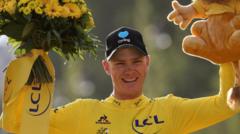
Chris Froome has finally called time on his professional cycling career. For anyone who watched professional cycling over the last decade, this moment feels heavy. It is not just about one rider hanging up his wheels. It represents the absolute final curtain on an era that completely reshaped how Grand Tours are raced, won, and understood.
The four-time Tour de France champion leaves behind a legacy that is as fiercely debated as it is objectively massive. He did not just win races. He dismantled them. Alongside Team Sky, Froome turned Grand Tour racing into a calculated science, suffocating rivals with a mountain train that looked less like sport and more like an unstoppable corporate machine. Love him or hate him, you could not look away.
When news of Chris Froome retirement broke, the immediate reaction across social media focused heavily on his recent years. That is a mistake. It is easy to look at his final seasons with Israel-Premier Tech and see a shadow of the rider who once dropped rivals while running up Mont Ventoux. But evaluating Froome based on his post-2019 output misses the entire point of what made him an all-time great.
The Brutal Reality of the Post Crash Era
We need to talk about the 2019 crash at the Critérium du Dauphiné. It changed everything. Before that horrific day, Froome was hunting a historic fifth Tour de France title to join the elite club of Eddy Merckx, Bernard Hinault, Jacques Anquetil, and Miguel Indurain.
A gust of wind during a recon ride changed the course of cycling history. He hit a wall at 60 kilometers per hour. The injuries read like a trauma ward report. A fractured right femur, a broken elbow, fractured ribs. Most people would look at those injuries and think about walking normally again. Froome thought about winning the Tour.
His return to the peloton was a triumph of human will, but it was never a return to the top step. Critics spent years wondering why he kept pushing, why a multi-millionaire with nothing left to prove kept grinding out anonymous finishes in the middle of the pack.
He did it because he genuine loved the bike. He loved the suffering. The mistake fans make is measuring his greatness by his twilight years. The truth is his willingness to suffer in the back of the peloton for years just to hear the crowd roar on a mountain pass actually humanized a rider who spent his peak looking like a robotic cycling computer.
How Team Sky Changed the Sport Forever
To understand why Froome was so dominant, you have to look at the system around him. Team Sky entered the sport with a mission to win the Tour de France with a British rider within five years. They did it in three with Bradley Wiggins. Then Froome took the reins and built an empire.
Sir Dave Brailsford championed the concept of marginal gains. Every single detail mattered. They brought their own mattresses to hotels. They analyzed power data with terrifying precision. They rode a steady, suffocating tempo on the climbs that neutralized the explosive attacks of pure climbers like Nairo Quintana.
Froome was the perfect executioner for this strategy. He rode with his head staring directly down at his stem, staring at his power numbers, completely unfazed by the chaos around him. Fans complained it was boring. They said Team Sky killed the romance of the sport. They were right, but it was undeniably effective.
Look at the numbers from his golden run.
- Tour de France victories in 2013, 2015, 2016, and 2017.
- A Vuelta a España title in 2017.
- A Giro d'Italia win in 2018.
He held all three Grand Tour jerseys simultaneously. That is an achievement so rare it places him in a tier of cycling royalty that very few humans will ever touch.
The Day the Robot Became a Legend
If you think Froome was just a product of a wealthy team and a power meter, you did not watch the 2018 Giro d'Italia. Stage 19 of that race belongs in a fiction novel.
Froome was well out of the overall lead. Simon Yates was dominant. Team Sky looked defeated. Then came the Colle delle Finestre, an absolute beast of a mountain with gravel roads near the summit.
Froome attacked with 80 kilometers left to go in the stage. Eighty kilometers. In modern cycling, a solo move of that distance is considered tactical suicide. The commentators laughed. The rival teams assumed he would blow up.
He didn't. He rode the entire field off his wheel, took the pink jersey, and won the Giro in the most spectacular, chaotic fashion imaginable. That single day shattered the myth that Froome could only win behind a wall of teammates. It proved he possessed the raw grit of the old-school cycling legends.
The Mixed Legacy and the Shadow of Doubt
You cannot write an honest assessment of Chris Froome retirement without addressing the skepticism. He raced in an era that followed the darkest days of the sport. The ghost of Lance Armstrong still haunted every yellow jersey.
In late 2017, news broke that Froome had returned an adverse analytical finding for Salbutamol, an asthma medication, during his Vuelta victory. The cycling world braced for another fallen idol. The legal battle was fierce, expensive, and messy.
The Union Cycliste Internationale eventually dropped the case, accepting that Froome had not exceeded the allowed dosage intentionally and that his body metabolized the drug uniquely. He was cleared, but the court of public opinion is never quite so forgiving. A segment of cycling fandom will always view his achievements through a lens of suspicion. That is the burden of anyone who dominated sports in the 2010s.
The New Generation of Cycling Has Left the Sky Era Behind
Why does his retirement feel so final right now? Because the sport has moved on to a completely different style of racing. Tadej Pogačar, Jonas Vingegaard, and Remco Evenepoel do not race like Team Sky.
The current peloton throws tactical manuals out the window. They attack from 100 kilometers out just for fun. They race on instinct, raw power, and pure aggression. The calculated, steady-state climbing style that Froome perfected is obsolete.
If a team tried to pull the old Team Sky mountain train today, Pogačar would simply fly past them before the halfway mark of the climb. Froome retirement is the official closing of the textbook on that ultra-calculated era.
What to Do Next as a Cycling Fan
Now that the dust is settling on a monumental career, don't just read the quick news snippets. Take some time to truly appreciate what we witnessed.
First, go watch the replay of Stage 19 of the 2018 Giro d'Italia. It remains one of the greatest tactical gambles in sports history.
Second, rewatch his bizarre descent down the Col de Peyresourde in the 2016 Tour de France. He attacked on the downhill, sitting on his top tube while pedaling furiously, completely catching his rivals off guard. It was weird, dangerous, and brilliant.
Chris Froome was never the most stylish rider on a bike. His elbows stuck out, his head wobbled, and his style was painful to watch at times. But his mental toughness was absolutely unmatched. He took everything the sport could throw at him, from hostile French crowds throwing liquids at him to career-threatening bones breaking into pieces, and he kept turning the pedals. The sport will miss his grit.


