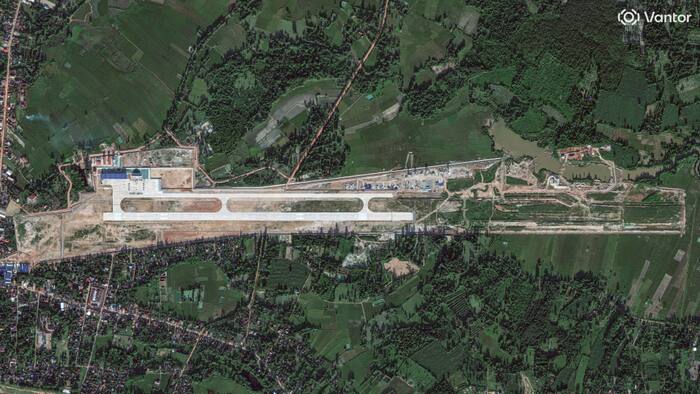
A newly opened airfield just fifty kilometers north of Vientiane looks unassuming on paper, but defense analysts are already treating it as a major geopolitical puzzle piece. Billed officially as a joint training center and aviation academy, the Ban Keun facility in Laos represents Beijing's first overseas military-focused air installation. Construction crews were still actively working on site even as officials cut the ribbon last month, signaling just how fast Beijing wants this asset operational.
If you look at the geography, you'll see why the project has defense planners on edge. Laos is landlocked, heavily indebted to China through massive infrastructure projects like the high-speed rail line connecting Yunnan province to Vientiane, and possesses an air force with only a handful of combat-capable aircraft. Yet the newly laid runway spans roughly two thousand meters, with enough surrounding land to extend it by another kilometer. That extra length changes the equation entirely, opening the door for heavy bombers and large transport planes.
The Vietnam Factor and Regional Pressure
Hanoi is watching every move at Ban Keun with intense suspicion. Vietnam shares a long border with Laos and sits directly across maritime boundaries with China in the South China Sea. While local officials in Hanoi publicly describe the facility as a routine training hub for humanitarian relief and pilot education, behind closed doors the assessment is starker.
A permanent or rotational Chinese military presence in Laos places direct strategic pressure on Vietnam’s western flank. Analysts note that the installation provides the Chinese People's Liberation Army Air Force with alternative flight corridors around Vietnamese airspace and secondary routes into contested maritime zones. It is a classic low-risk, high-reward maneuver. Beijing makes small strategic investments in vulnerable neighbor states, building long-term familiarity with overseas logistics and operations without triggering an immediate armed conflict.
Complicating US Strategy and Regional Response
The implications stretch far beyond Indochina. Defense specialists point out that secondary air strips in mainland Southeast Asia could serve as vital contingency alternates during a major regional crisis, such as a conflict over Taiwan. Damaged fighter jets returning from patrols or long-range missions would have a friendly place to land, refuel, and undergo quick repairs outside China's immediate coastal combat zones.
This creates a messy dilemma for Western planners. How do you respond to a dual-use military facility nestled inside a sovereign Southeast Asian nation that legally consented to the project?
Neighboring Thailand has taken a pragmatic stance, viewing the airfield as Laos's sovereign right while admitting that security forces will monitor developments closely as part of routine intelligence assessments. Meanwhile, local military analysts emphasize that the facility's immediate value isn't just about raw war-fighting power. It is about practice. Beijing is learning how to run an air base outside its borders, manage foreign logistics, and lock in long-term diplomatic leverage across mainland Southeast Asia.
Keep an eye on how runway extensions progress over the coming months. That physical concrete will tell you everything you need to know about where regional power balances are heading.