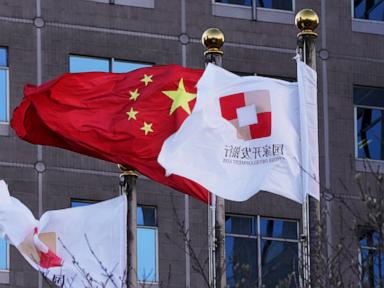
China just sent another massive shockwave through its financial sector. The country's top anti-graft watchdog announced that Ouyang Weimin, the former president of the state-owned China Development Bank (CDB), is officially under investigation. The Central Commission for Discipline Inspection (CCDI) dropped a blunt, one-line statement confirming Ouyang is being scrutinized for "serious violations of party discipline and the law." That is the standard official phrasing for corruption.
If you think this is just another routine bureaucrat getting caught in the gears, you are missing the bigger picture. The CDB isn't a normal bank. It is a financial titan directly overseen by the State Council, responsible for funding China's major infrastructure projects, national industries, and cross-border initiatives. When a former president of an institution this powerful goes down, it signals a deeper, ongoing purge within the upper echelons of Chinese state finance.
The Fall of Ouyang Weimin
Ouyang Weimin isn't a minor player who flew under the radar. He spent decades climbing the ranks of the Chinese financial and political system. He entered the Chinese Communist Party back in 1986 and spent a large chunk of his early career cut teeth inside the central bank, the People's Bank of China.
He didn't just stay in comfortable banking offices, either. He took on major political roles, serving as the vice-governor of Guangdong province. That is China's absolute economic powerhouse, the province bordering Hong Kong that drives a massive chunk of the nation's GDP.
By 2019, he reached the pinnacle of policy banking when he was appointed president and deputy party secretary of the China Development Bank. He held the reins during a period of intense economic transition until he stepped down in 2023. Now, those years in power are under the microscope.
Why the China Development Bank Rules the Economy
To understand why this probe is sending jitters through Beijing and international markets, you have to look at what the CDB actually does. Founded in 1994, it stands as a state-funded mega-lender. It doesn't hand out credit cards or manage checking accounts for ordinary citizens.
Instead, the bank serves as the financial engine for the state's biggest ambitions. It pours billions into domestic highways, high-speed rail networks, and tech sectors. On the global stage, it has been a primary funding mechanism for massive international investments. Because the bank controls trillions of yuan in assets, its executives hold immense power over which industries thrive and which projects get greenlit. That level of unchecked financial control creates a hotbed for potential kickbacks, favoritism, and massive misallocations of state capital.
A Pattern of Financial Cleanups
Ouyang is far from the first big name at the CDB to face the anti-corruption hammer. The bank has practically had a target on its back for years.
- Hu Huaibang: The former chairman of the CDB was put under investigation a few years back, eventually exposing a messy web of bribes involving private energy conglomerates.
- Li Jiping: A former vice president of the bank was targeted by the CCDI for severe disciplinary violations.
- Provincial Chiefs: Multiple heads of provincial branches, from Hainan to Shanxi, have been systematically rooted out and punished for issuing illegal loans that caused devastating losses to the state.
The continuous targeting of CDB executives shows that authorities view the policy lender as a critical point of systemic risk. When state banks issue bad loans due to corruption, the entire economic foundation takes a hit.
The Broader Campaign and Political Realities
This latest move fits directly into the sweeping anti-corruption campaign championed by President Xi Jinping. The scale of the cleanup is staggering. The CCDI recently noted that over 110,000 Chinese Communist Party officials faced disciplinary action in a single year, including dozens of high-ranking cadres.
The campaign has hit every sector imaginable. Ministers have disappeared from public view, military generals have been removed, and banking executives have received harsh sentences, including reprieved death penalties for insider trading and bribery.
Predictably, this relentless drive divides observers. On one side, analysts argue that cleaning out financial rot is necessary to keep the economy stable and stop state funds from leaking into private pockets. On the other side, critics point out that the anti-graft apparatus serves as a highly effective tool to wipe out political rivals and consolidate control over key state assets. The truth usually sits right in the middle. It is both an economic necessity to stop financial bleeding and a political weapon to ensure absolute loyalty.
What Happens Next
The announcement of a probe by the CCDI and the National Commission of Supervision is rarely just an inquiry. In the Chinese legal and disciplinary system, by the time an official announcement drops, investigators have usually built a substantial case.
Ouyang will face intense interrogation and a thorough review of every loan, deal, and appointment made during his tenure at the CDB and his time in Guangdong. For businesses and international investors dealing with Chinese state enterprises, it means navigating an environment where the rules can shift overnight as leadership changes.
If you want to track how this impacts the broader market, keep a close eye on the upcoming policy announcements from the State Council regarding bank regulations. The immediate step for anyone exposed to these markets is to audit existing partnerships with state-tied entities. Watch the public court filings that will eventually emerge from this probe. They always reveal the exact mechanisms of how capital was diverted, giving a rare look into how power and money really interact behind closed doors.