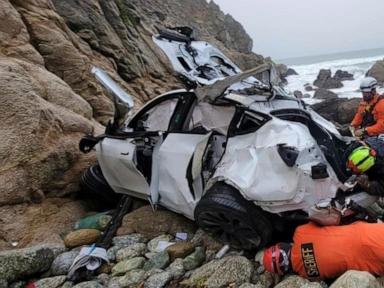
The public outrage was entirely predictable. When news broke that all charges against the dad who drove his family off a cliff were dropped after mental health treatment, social media melted down. People wanted vengeance. They saw a wealthy doctor who intentionally steered his Tesla over a 250-foot precipice with his wife and young children inside, and they wanted him behind bars for life. Instead, he walked out of a San Mateo County courtroom a free man, his criminal record wiped completely clean.
It looks bad. On the surface, it feels like a textbook failure of the justice system. But if you look past the shocking headlines, the reality of what happened to Dharmesh Patel reveals a deeply complicated intersection of severe psychosis, legal mandates, and a family's extraordinary choice to forgive. For a deeper dive into similar topics, we suggest: this related article.
This isn't a story about a man beating the system. It's a look at how California law treats a mental health crisis when it turns violent.
The Miracle at Devil's Slide and the Madness Behind It
To understand why a judge dismissed three counts of attempted murder, you have to go back to January 2, 2023. Patel, a 45-year-old radiologist from Pasadena, was on a family road trip along the scenic Pacific Coast Highway. As his white Tesla approached a notorious stretch of road known as Devil's Slide, he sharply veered off the asphalt. For further context on this development, in-depth analysis is available on Reuters.
The car plummeted down a jagged 250-foot cliff, smashing into the surf and rocks below.
By all logic, everyone inside should have died. First responders who arrived at the scene expected to recover bodies. Instead, they found a miracle. Firefighters climbed down the cliff face and cut Patel, his 41-year-old wife, and their two children, ages 4 and 7, from the mangled wreckage. All four survived with injuries that, while severe, were not fatal.
As the rescue pulled the family to safety, Patel's wife made a chilling statement to emergency workers. She told them her husband drove off the cliff on purpose and desperately needed a psychiatric evaluation. "He said he was going to drive off the cliff," she told authorities.
The initial public reaction was pure horror. Patel was arrested and thrown into jail without bail. Prosecutors immediately painted him as a calculated attempted murderer.
But behind closed doors, a team of medical professionals began evaluating what actually happened inside Patel’s mind before he turned the wheel.
He wasn't acting out of malice or anger. He was completely out of touch with reality.
Psychiatrists later testified that Patel was suffering from episodic major depression paired with severe, terrifying hallucinations. He told doctors he was drowning in a delusion that his children were about to be snatched by international human traffickers. In his twisted, broken state of mind, driving the car off the cliff was a desperate, horrific attempt to save his family from a fate he believed was far worse. He carried a knife around for days before the crash because he thought he needed to protect them.
He wasn't a monster. He was a man experiencing a catastrophic psychotic break.
How the Law Allowed These Attempted Murder Charges to Disappear
So how do we get from a 250-foot plunge to dismissed charges? The answer lies in California's controversial mental health diversion law, which went into effect a few years back.
The statute allows judges to pause criminal prosecution for defendants who commit crimes due to a qualifying mental illness. Instead of going to prison, the defendant enters a strict, court-monitored treatment program. If they complete it successfully, the law requires the judge to dismiss the case.
In 2024, a San Mateo County Superior Court judge ruled that Patel qualified for this exact program. The prosecution fought the decision tooth and nail, but the defense proved Patel's major depressive disorder was the direct cause of the crash.
Patel didn't just go home and sit on the couch. His life for the past two years was an intense, highly restricted legal gauntlet.
- He was confined to his parents' home in Belmont under strict GPS monitoring.
- He had to surrender his driver's license, passport, and any access to weapons.
- He was forced to undergo drug and alcohol testing twice a week to prove compliance.
- He participated in rigorous, ongoing psychiatric treatment with Stanford professionals and family therapists.
- He was barred from practicing medicine, and he ultimately surrendered his California medical license permanently.
On Monday, July 6, 2026, Patel’s treating doctors presented their final reports to the court. They showed he made massive, undeniable progress and remained fully compliant with his medication and therapy.
Under California law, the judge had no choice. The text of the law is absolute. If a defendant checks every box of their diversion program, the court must drop the charges.
"The judge was required by the law to dismiss the charges," San Mateo County District Attorney Steve Wagstaffe admitted afterward.
The Backlash From the Prosecution
While the defense celebrated a victory for mental health rehabilitation, the local district attorney's office was furious. Wagstaffe didn't hold back his thoughts on the outcome, stating plainly that Patel received "the break of a lifetime".
The frustration from law enforcement stems from a glaring loophole in the current legal framework. When California lawmakers wrote the mental health diversion statute, they explicitly barred certain severe crimes from being eligible. Murder, sexual assault, and child molestation are completely excluded.
But attempted murder was left off the exclusion list.
Because Patel's family miraculously survived the fall, his charges were for attempted murder, making him technically eligible for the program. If any member of his family had died in that wreckage, Patel would be looking at a life sentence in a state penitentiary right now.
Wagstaffe and several other district attorneys across California are actively lobbying state legislators to change this loophole. They argue that anyone who tries to kill multiple people, regardless of their mental state, poses too great a risk to the public to ever have their record wiped clean.
"We'll try again in the future," Wagstaffe said regarding their legislative push. "We're not giving up".
What Happens Now for the Patel Family
The legal battle is over, but the human story is far from finished. The most surprising element of this case isn't the legal loophole, it's the reaction of Patel’s wife.
Many expected her to take the children and run. Instead, she became her husband’s fiercest advocate. She explicitly testified in court that she forgave him, deeply understood that his actions were driven entirely by a sudden mental illness, and did not want him prosecuted. She told the judge that her children missed their father terribly and that the family simply wanted him back home.
Over the last few months of his diversion, the court loosened restrictions, allowing Patel to see his family and even take them out on drives.
When the judge officially dismissed the case on Monday, Patel didn't celebrate or make a scene. He simply walked over to the courtroom gallery where his wife was waiting, took her hand, and the two walked out of the courthouse together to rebuild their lives.
If you or someone you care about is experiencing a severe mental health dip, don't wait for a breaking point. Reach out to the National Suicide and Crisis Lifeline by calling or texting 988 to get immediate, confidential support. Texting HOME to 741741 connects you directly with the Crisis Text Line for free, round-the-clock crisis counseling. Do it before a crisis takes the wheel.