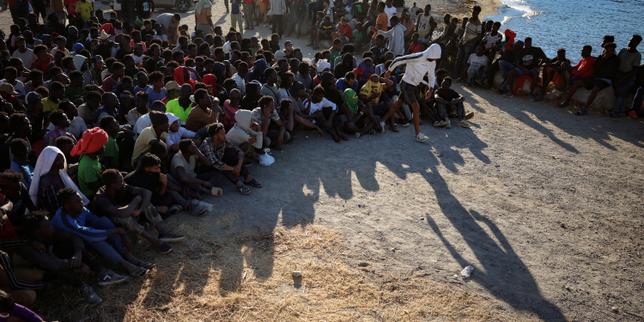
When tens of thousands of people overwhelm a border in a matter of hours, nobody is looking at an accident. They are looking at a system designed to apply pressure.
The recent massive influx into the Spanish enclave of Ceuta laid bare a stark reality that experts like Carlos Echeverría Jesús have pointed out for years. This isn't just about migration management or temporary diplomatic friction. It’s about long-standing geopolitical goals. Rabat wants control over territories it has claimed since gaining independence in 1956, and using human flows has become a primary instrument to achieve it.
Beyond Migration Control
Let's be honest about what happened at the border. When security forces stand back and allow tens of thousands of individuals to cross a heavily fortified perimeter, you're witnessing a calculated choice.
According to estimates from local authorities and specialized journalists, up to sixty thousand people arrived in a staggering two-to-three-day window. That rate translates to roughly two hundred arrivals every minute. You don't get numbers like that by chance. You get them when state-controlled auxiliary forces look the other way.
Carlos Echeverría Jesús, director of the Observatory of Ceuta and Melilla and a professor of international relations at UNED, argues that describing these events as an invasion is entirely justified. Thousands of people breached an international border to put direct pressure on a neighboring state. Yet, institutional hesitation in Madrid often prevents leaders from calling things by their proper names.
The Historical Claim on Enclaves
Why does Rabat keep turning the pressure valve on and off? The answer sits right on the map.
Morocco claims ownership over several Spanish possessions in North Africa, notably the cities of Ceuta and Melilla, alongside minor sovereign rocks and islands like the Chafarinas. From the perspective of Moroccan official strategy, the kingdom suffers from what it perceives as a persistent territorial deficit.
Madrid rejects negotiations outright. Because Spain refuses to discuss sovereignty over these enclaves, Rabat relies on alternative pressure tactics. Whenever bilateral relations sour or Moroccan leadership wants to extract concessions from Europe or Spain, the border experiences a sudden surge. We saw a smaller version of this playbook in May 2021 when roughly twelve thousand people crossed over. The 2026 crisis blew those numbers completely out of the water.
The Weakness of European Deterrence
Europe has a blind spot when it comes to defending its external borders in North Africa. Spain historically prefers to handle these disputes through direct bilateral channels rather than internationalizing them.
When crises erupt, Madrid routinely avoids calling for heavy European border agency intervention. This leaves the security architecture heavily reliant on political deals with Rabat. If Morocco decides to relax its controls, Spanish enclaves face immediate chaos.
Echeverría points out that Spain urgently needs to rebuild real credibility in terms of deterrence. Without a firm stance that imposes actual costs for weaponizing migratory flows, Rabat will continue using human movements as strategic leverage.
Look closely at the diplomatic reactions. While conservative European politicians sound alarms over border security, actual policy shifts remain slow and reactive. The diplomatic silence from major capitals shows just how reluctant Western governments are to confront Rabat directly.
What Comes Next
You can expect more of the same tension. As long as Morocco maintains its official territorial claims over Ceuta and Melilla, these sudden border crises remain a predictable feature of Mediterranean politics.
Stop viewing these events as spontaneous humanitarian emergencies. They are calculated geopolitical moves designed to keep Spain off balance and force concessions on territorial sovereignty. Until Madrid and Brussels change their approach, the border will remain a pressure point waiting to explode.